
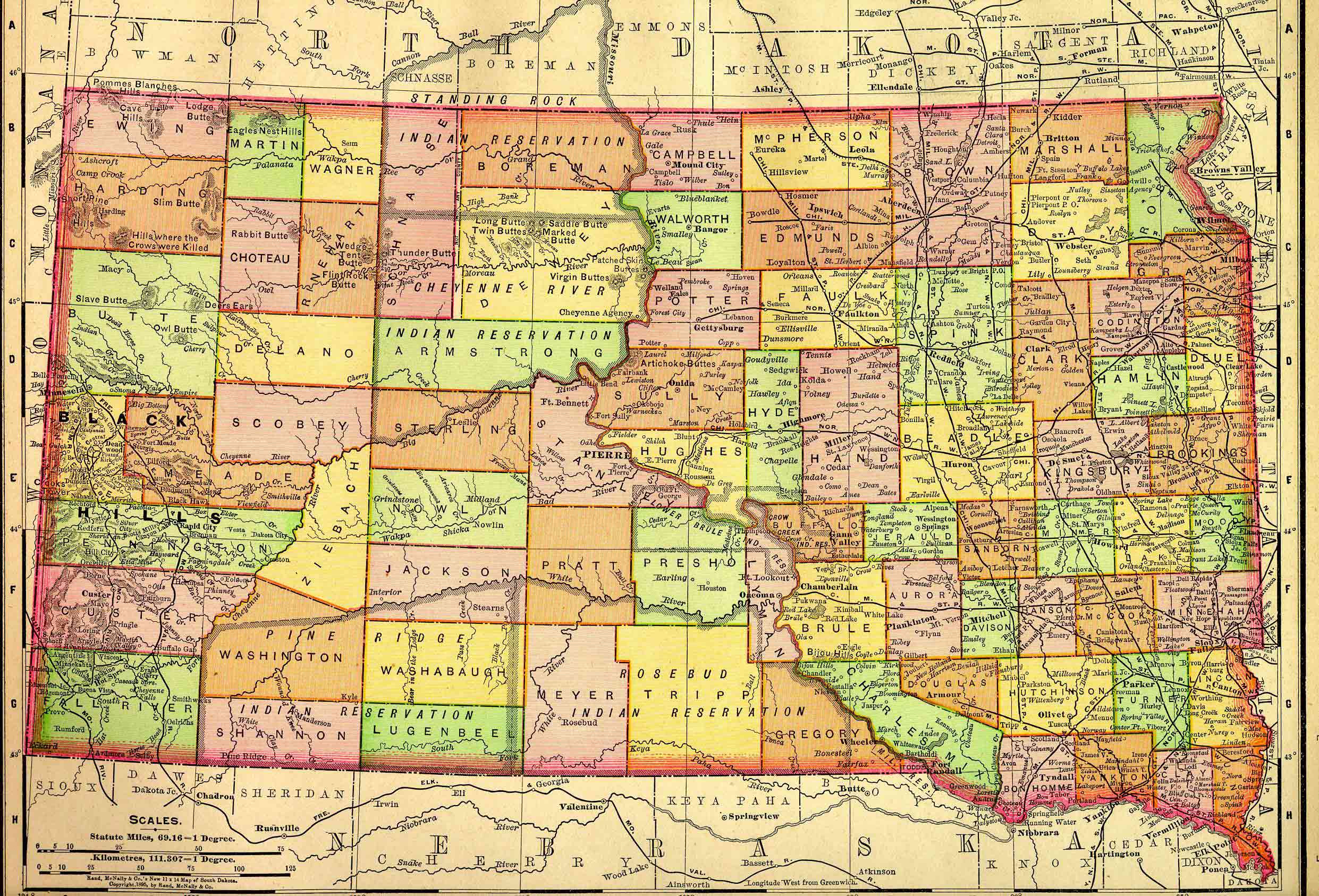
South Dakota, one of the north central United States, is bounded on the north by North Dakota; on the east by Minnesota and Iowa, from which it is separated in part by the Big Sioux River; on the south by Nebraska; and on the west by Wyoming and Montana. It lies between about 42º 29′ and 45º 56′ north latitude, and between 96º 26′ and 104º 3′ west longitude. The state measures about 210 miles from north to south and about 380 miles from east to west. It contains approximately 77,116 square miles, or 49,354,240 acres.
This state project is part of the much larger American History & Genealogy Project or better known by the abbreviation of AHGP. It has been in existence online since 2000 and over the years has been spread out across the web. These pages are an attempt to consolidate it under one website of the larger project.
South Dakota Information
- South Dakota County Courthouse Addresses
A list of current mailing addresses for county courthouses in South Dakota.
South Dakota History
In 1803, the United States purchased the Louisiana Territory, an area that included most of South Dakota, from Napoleon Bonaparte, and President Thomas Jefferson organized a group commonly referred to as the “Lewis and Clark Expedition” to explore the newly acquired region. In 1817, an American fur trading post was set up at present-day Fort Pierre, beginning continuous American settlement of the area. In 1855, the U.S. Army bought Fort Pierre but abandoned it the following year in favor of Fort Randall to the south. Settlement by Americans and Europeans was by this time increasing rapidly, and in 1858 the Yankton Sioux signed the 1858 Treaty, ceding most of present-day eastern South Dakota to the United States.
In 1861, the Dakota Territory was established by the United States government (this initially included North Dakota, South Dakota, and parts of Montana and Wyoming). Settlement of the area, mostly by people from the eastern United States as well as western and northern Europe, increased rapidly, especially after the completion of an eastern railway link to Yankton in 1873 and the discovery of gold in the Black Hills in 1874 during a military expedition led by George A. Custer. This expedition took place despite the fact that the western half of present day South Dakota had been granted to the Sioux in 1868 by the Treaty of Laramie as part of the Great Sioux Reservation. The Sioux declined to grant mining rights or land in the Black Hills, and war broke out after the U.S. failed to stop white miners and settlers from entering the region. The Sioux were eventually defeated and settled on reservations within South Dakota and North Dakota.
An increasing population caused the Dakota Territory to be divided in half and a bill for statehood for both Dakotas titled the Enabling Act of 1889 was passed on February 22, 1889 during the Administration of Grover Cleveland. His successor, Benjamin Harrison, signed proclamations formally admitting both states on November 2, 1889. Harrison had the papers shuffled to obscure from him which he was signing first and the actual order went unrecorded.
- South Dakota Indian Tribes
- South Dakota Military Forts
- Encyclopedia of South Dakota
Select articles which come from Doane Robinson’s Encyclopedia of South Dakota. We believe these specific articles serve a beneficial purpose for genealogical research in South Dakota. - South Dakota Historical Collections
These select articles were published in the South Dakota Historical Collections. Over more than eighty years, these volumes have become a foundational resource, containing research, documents, essays, and source material on a wide spectrum of topics related to South Dakota and the northern Great Plains region.
South Dakota Genealogy
- Biographies from the History of South Dakota
Biographies from the manuscript by Doane Robinson, History of South Dakota: together with mention of Citizens of South Dakota as published in 1904. - Memorial and Biographical Records of Turner, Lincoln, Union and Clay Counties
Containing biographical sketches of hundreds of prominent old settlers and representative citizens, with a review of their life work; their identity with the growth and development of these counties; reminiscences of personal history and pioneer life; and other interesting and valuable matter which should be preserved in history. - South Dakota Cemetery Records
- South Dakota Census Records
- South Dakota Historical Newspapers
- Who’s Who in South Dakota
- Vital Records
- Oregon and South Dakota Indians Wounded in Action
The list details Native Americans from Oregon and South Dakota who were wounded in action, identified by name, tribal affiliation, and location of injury, primarily during World War II. Notable individuals include John Sampson from Oregon and a number of Sioux individuals from South Dakota who fought in diverse locations, including France, Germany, and the Pacific. - Persons who Died in Dakota Territory, 1870 (by County)
- Persons who Died in Dakota Territory, 1880 (by County)
- Pioneer Deaths, 1916
- Pioneer Deaths, 1917
- South Dakota Indian Honored War Dead
The Honored War Dead list identifies individuals from various Sioux tribes, noting their names, tribal affiliations, and locations of death. Among them are Guy L. Archambeau from Yankton, and others like Floyd Bear Saves Life, who fell in France. Each entry signifies their sacrifice across multiple theaters of war, including Germany, Pacific, and Africa.
- Oregon and South Dakota Indians Wounded in Action
South Dakota Counties
- History of Day County, 1873-1926
- History of Jefferson South Dakota
This history of Jefferson South Dakota provides a glimpse into the establishment and growth of Jefferson, South Dakota, from its early days in 1859 up to the mid-20th century. Jefferson, strategically nestled between the Big Sioux River and the Missouri River, and bordered by the hills of Iowa and Nebraska, became a beacon for early settlers drawn by its promising land. The narrative begins with the arrival of the first white settlers among indigenous populations, highlighting the foundational role of families like Michael Ryan Sr., A. Christie, and Mr. Matthews. - History of Lawrence County South Dakota
In celebration of the Dakota Territory Centennial, the 186-page book “Lawrence County for the Dakota Territory Centennial, 1861-1961” serves as a comprehensive guide and a treasure trove of information for genealogists and historians alike, offering a detailed exploration of Lawrence County’s rich history, culture, and development over a century. Compiled with meticulous care by editor Mildred Fielder and published by Seaton Publishing Company in 1960, this book is free to read and download. - Marshall County North Dakota Genealogy
- A Comprehensive History of Minnehaha County, South Dakota
A Comprehensive History of Minnehaha County, South Dakota: Its Background, Her Pioneers, Their Record of Achievement and Development” by Charles A. Smith is an extensive and detailed chronicle of the county’s past, encapsulating its evolution from its earliest days. This work, published in 1958, spans 504 pages, elaborately documenting the county’s journey through various phases of development. Particularly noteworthy are the chapters on the City of Sioux Falls, which provide a comprehensive overview of its growth, municipal enterprises, public buildings, and transportation systems. As well, for genealogists, the few biographies in chapter 13 of part 1. - Seeing Potter County, South Dakota
- History of Union County South Dakota
This History of Union County, South Dakota was authored by Donald Dean Parker and published in 1959 by South Dakota State College, and it stands as a comprehensive chronicle of the region’s development from its earliest settlements to its role in the broader tapestry of state and national history. This work delves into the intricate narrative of Union County, capturing its transformation from a sparsely populated territory to a flourishing agricultural hub, enriched by a vibrant community and diverse cultural heritage.
Back to: American History & Genealogy Project