
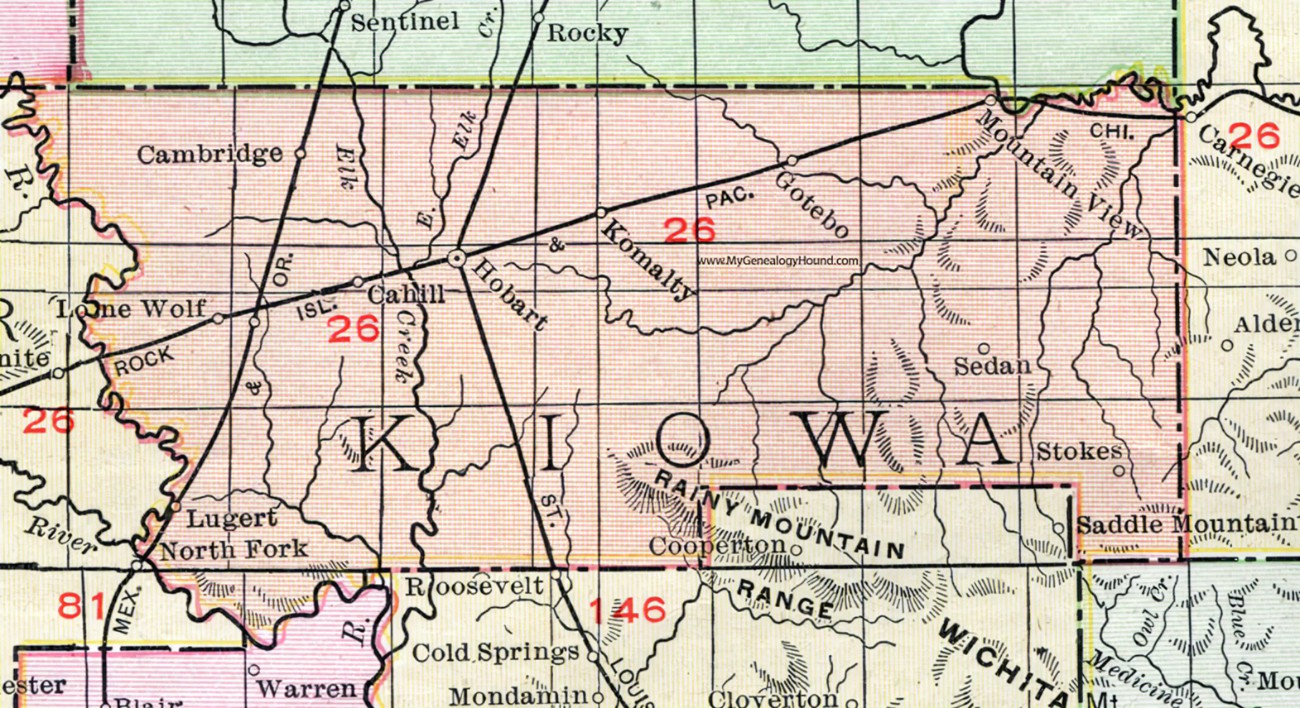
Kiowa County Oklahoma History & Genealogy Project was always hosted by Ethel Taylor for the American History & Genealogy Project and much of the information on this website reflects her words and her sentiments. Ethel grew up in Kiowa County, Oklahoma, and was familiar with its surroundings and people. With her words she can take you back to the days of old, when the stories were as long as the time you had to hear them, and you had a lot of it some days, not so much on other days. The rush to settle Kiowa County at the turn of the 20th century was wild and the decades after stayed wild. But the communities eventually settled down, and as life often does, some communities faded away earlier than they should have, just like people do.
Genealogy of Kiowa County Oklahoma
- Cemeteries of Kiowa County
- Directories of Kiowa County
- Early Marriage Records
- Families of Kiowa County, Oklahoma
- Kiowa County Resources
- Obituaries
History of Kiowa County Oklahoma
- Cattle Trailing
- Chisholm Trail
- Deputy Fatally Wounded by Filling Station Operator at Roosevelt, Oklahoma
- Early County Schools
- Doan’s Crossing
- Hoberta Shelby
- Hobart’s Junior College
- Kiowa County Hall of Fame
- Kiowa County Lawmen
- Kiowa County Legends
- Kiowa County Tornadoes
- Lost Treasures of Kiowa County
- Prairie Tales
- Thar’s Gold In Them Thar Hills!
- “Tornado Belt”
Communities of the County
- Cooperton History
- Gotebo History
- Hobart History
- Lone Wolf History
- Mountain Park History
- Mountain View History
- Roosevelt History
- Snyder History
- Towns of the Past
The Kiowa People
- Kiowa – Comanche – Apache Army Scouts
In the Tribal Buriel Grounds, there are veterans of another time. This is a list of Kiowa – Comanche – Apache Army Scouts. - Rainy Mountain Kiowa Indian Mission School
Kiowa Military Records
We honor all our Kiowa County Veterans, past and present, and Veterans everywhere. We salute them with love and thanks. We realize our freedom isn’t free, but is bought and paid for, for us by our SOLDIERS, SAILORS, MARINES and AIRMEN, who have fought and died so we may enjoy this gift of freedom. Our service men and women are now serving in Iraq and Afghanistan. These young people are standing on that line in the sand between us and those that would destroy our way of life. They are there just as their fathers, grandfathers, great-grandfathers were for the past 231 years. Be proud of them and let them know. When you meet a service person, thank them for their service and let them know it is appreciated.
- Civil War Veterans
- Decorated Kiowa County Veterans
- Kiowa County’s Medal of Honor Recipient, Col. Jack Lemaster Treadway
- Kiowa County Veterans List
- Major John Mullins, USA (Ret.) Silver Star, Vietnam
- Okie Party In Korea, 1946
- Oklahoma’s General Tommy Franks has Kiowa County ties
- USN Lt William N. Arbuckle
- Veterans Honor Roll
Thank you to the many families and residents of Kiowa County that sent me names for our Veterans List. Your loved ones are remembered. - WWII POW Camps
The history of Kiowa County is as colorful as a summer sunset. I grew up in Kiowa County. I remember those hot summer days, and the big prairie moon. Looking at the stars, millions of diamonds in a black velvet sky, what had they seen, silently watching, over the millions of years? They were a silent witness to the changing landscape and evolution of this tiny speck called earth, in such an enormous universe.
I could sit in the evenings, listening to the crickets, watching the fireflies flitting here and there—-and with my imagination, travel back to the time when this prairie was untamed, when it was the home of the Kiowa, Comanche, and Apache that lived here on a Reservation. Listen close—— you can hear distant drums and voices raising to the sky in prayer, joy or mourning the death of a warrior
In the early days of the free roaming plains tribes, great herds of buffalo wandered this area. The tribes followed them as this was their main source of of food, clothing and tools.
I could almost see the buffalo, and villages with the tipi’s reaching for the clouds. I can hear softly on the wind, an owl hoot, and the call of a mockingbird. In modern times, these are natural sounds of the night in Kiowa County. But, in the time before, in my imagination, it is the communication between these warriors of the plains. The Wichita Mountains have seen the battles fought here, the smoke signals that sent word to others of approaching enemies, or a gathering of celebration of a successful hunt.
The county was named for the Kiowa that lived here. These fierce warriors are credited with stopping the progress of the Pacific railroads westward for forty years. The Kiowa were first located along the Columbia river in Canada, in 1700, when the British Columbia traders wrote of them. They migrated south to the Upper Yellowstone, into the Black Hills where Lewis and Clark came upon large encampments of Kiowa, then continued downward, through Nebraska, Kansas and Colorado to Oklahoma and Texas. They settled along Elk Creek, near the present site of Hobart.
This land of the Kiowa was shared by the Kiowa-Apache, sometimes called the Plains Apache, and the Comanche. Later in the 19th century, a small band of Chirachahua Apaches, Geronimo’s people, were moved from Florida to near Fort Sill. They remained P.O.W.’s for 27 years, until after Geronimo died, before they were allowed to go home. There are still descendents of Geronimo’s band living in Oklahoma.
There are Indian names in Kiowa County that are familiar to all school children. The names of the great warriors of these tribes still echo across the plains from a by-gone time. From the Kiowa, we hear the names of Gul-Pah-Go, the first Chief Lone Wolf, Santanta (White Bear) Satank (Sitting Bear), Adveta (Big Tree), Zip-ko-ete (Big Bow), the Kiowa chiefs who led their people during the time the whites were closing in the People. Some of the Kiowa have towns and communities named after them, such as Gotebo, Komalty, Lone Wolf, and the Kiowa-Apache Chief, Koon-Ka-Zachey.
Every school child is aware of Quanah Parker, Chief of the Comanche. This Warrior was as fierce in War as he became in peace. It is astounding, the fans that Quanah Parker has, around the world.
Prior to the lands being opened for settlement to Whites, in the 1880’s, Texas ranchers began to rent pastures for their herds. This short grass prairie was ideal ranch land.
On the 125th anniversary of the Declaration Of Independence, July 4, 1901, President William McKinley, proclaimed the lands of southwestern Oklahoma be opened to white settlement. It was decided to have a land lottery, as when other portions of Oklahoma Territory had been “opened” by “runs”. These proved to be violent, uncontrollable, and lawless.
Several days before the ticket booths were to be set up, Chief Lone Wolf of the Kiowa attempted to obtain an injunction restraining the Department of Interior from opening the lands to settlement. Although the speech of Lone Wolf was eloquent, it was to no avail. After 3,500 Indians received their allotments and two million acres, about 3,000 square miles were ready to be opened. The land was divided into 3 counties, Kiowa, Caddo and Comanche. 165,000 envelopes equaling 160 acres each were given out.
The moon has seen many things as it traveled across the sky. It saw the coming of the whites and the passing of the buffalo; the wild free ways of the Indian gave way to civilization. It has seen the church doors open to black, white, brown and red, worshiping the same God. In no other state or country has there been so much change.
We are proud of the Indian Peoples, who have shown us another way of life and will not loose sight of the Indian way of living and the wonderful legends of the Kiowa, Comanche and Apache that lived on these prairies.
– Ethel Taylor
Back to: Oklahoma History & Genealogy Project
Back to: American History & Genealogy Project
Any information compiled, prepared and submitted to this site by Ethel Taylor remains the property of the submitter. Ethel Taylor grants that this information and data may be used by non-commercial entities, as long as this message remains on all copied material, for personal and genealogical research. These electronic pages cannot be reproduced in any format for profit, can not be copied over to other sites, or other presentation without written permission of Ethel Taylor.