
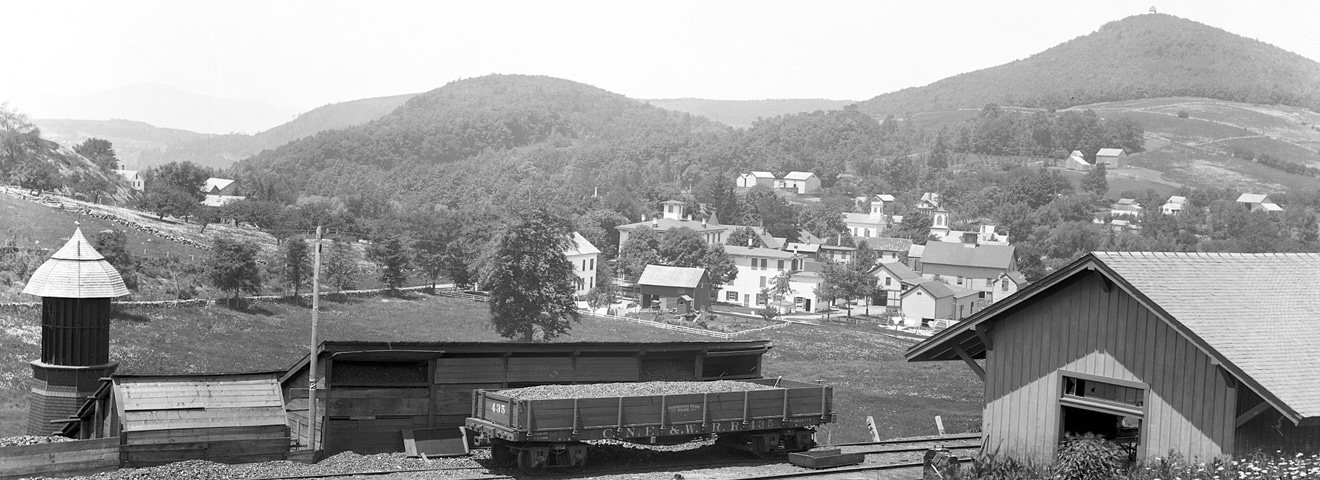
Norfolk, lying amid the northwestern uplands of Connecticut, occupies one of the most elevated and picturesque portions of Litchfield County. The town stands about thirty-five miles northwest of Hartford, bordered by Canaan on the west, Colebrook and Winchester on the east, Goshen to the south, and the Massachusetts line to the north. Its length extends nine miles from north to south, with an average breadth of four and a half miles. The terrain is bold and mountainous, the air cool and bracing, and the landscape distinguished by wooded hills, clear streams, and fertile pastures. Known even in later years as “the Icebox of Connecticut,” Norfolk’s climate has ever been its most defining feature, shaping both the habits and industries of its people.
These Norfolk Connecticut genealogy & history pages are part of the larger American history & genealogy project, better known by the abbreviation of AHGP, which has been online since the year 2000. Since then it had spread out across the web, being built on various family and free website hosts, until those pages began to grow stale or disappear. We are now recovering the pages built by our volunteers and presenting the history and genealogy information on this one website. This town project is part of the Litchfield County – Connecticut history & genealogy project,
Online Genealogical Records
- Legal Voters of Norfolk Connecticut in 1758
The inhabitants who were legal voters assembled December the 12th, 1758, and organized their first town meeting; it consisted of 44 members—These are their names. - Marriages of Norfolk Connecticut 1762-1800
These Norfolk, Connecticut marriage records were extracted from Frederic W. Bailey’s Early Connecticut Marriages series. They are not taken from official town records; instead they represent the records of the Congregational Church in Norfolk, which served as one of the sources for Bailey’s seven-volume compilation. - Honor Roll of Norfolk Connecticut—Revolutionary Soldiers
This is a list of those Revolutionary Soldiers from Norfolk Connecticut who died during the war. This list has been extracted from the published sources shown below the table. We provide the list of soldiers names so you can refer to the published source to find more information on the individual.
History of Norfolk Connecticut
The early history of the township reaches back to the colonial period, when the land, owned by the government of Connecticut, was among several western tracts offered for sale by public vendue at Middletown in 1742. The township was surveyed into fifty-three rights, three of which were reserved for public uses: one for schools, one for the first minister, and one for a parsonage. Of the original proprietors, only Timothy Horsford of Windsor retained his purchase, consisting of four hundred acres. The remaining purchasers failed to make the first payment of forty shillings per right and thereby forfeited their claims. Horsford sold his holding to Titus Brown, also of Windsor, who later removed to the township and died there. In 1744, the Browns, together with John Turner and Jedediah Richards of Hartford, became the first permanent settlers. They established their dwellings upon Brown’s right, and being families of devout character, they attended religious services in Canaan until their own church could be organized.
For a decade the little settlement grew but slowly. The first purchasers had faced formidable conditions: the hills were thick with forest, the soil rocky and cold, and the winters severe. Yet the natural pastures of the uplands promised rich grazing, and those who persevered found the country well suited to stock and dairy farming. In 1754, the township, with the exception of Brown’s right, was again offered for sale, and a second wave of settlers soon followed. By the time of its incorporation in 1758, twenty-seven families, 44 voting members, were established within its borders, and the town took the name of Norfolk, after the English county. The population increased steadily thereafter; in 1761, when the Rev. Ammi Ruhamah Robbins was ordained as the first minister, the number of families had reached sixty.
Rev. Robbins, only twenty-one years of age at his ordination, proved to be one of the most influential figures in Norfolk’s early history. His ministry extended for fifty-two years, during which time the population rose to more than sixteen hundred persons, living in about two hundred and ninety families by the year 1800. He guided the town through the formative period of its civil and religious life, and his influence persisted decades after his death. The first meetinghouse, built soon after his settlement, stood near the present Green; and its successor of 1813, the beautiful Congregational Church still adorns the village.
Throughout the eighteenth and early nineteenth centuries, Norfolk’s chief reliance was upon agriculture. The soil, while gravelly and filled with stones, had a depth and vigor that supported rich meadows and abundant pastures. Dairy farming became the town’s leading occupation, its butter and cheese commanding a ready market in the surrounding towns. The dense forests furnished not only timber but also an early source of income through the manufacture of maple sugar. In favorable seasons, as much as twenty thousand pounds were produced, though the industry declined when clearing the land reduced the number of trees and storms destroyed many of the older groves. The Blackberry River, flowing near the center of the township and descending in a thirty-foot fall just west of the Congregational Church, furnished ample power for sawmills and gristmills, and later for small manufactories of textiles and ironware. Along its banks arose the modest industries that sustained the town through much of the nineteenth century.
Trade developed along the principal roads leading through the hills to Canaan, Winsted, and Torrington. Greenwoods Road, the old turnpike to the Hudson River, carried the slow procession of ox-carts that brought goods and merchandise from the west. Among the foremost merchants of this era was Joseph Battell, whose store near the family homestead became a center of trade and whose enterprise laid the foundation for one of the most prominent families in the later history of the town. From such beginnings grew the Battell, Eldridge, and Stoeckel families, whose gifts and civic leadership in the nineteenth and early twentieth centuries shaped the cultural identity of Norfolk.
By the latter part of the nineteenth century, Norfolk had gained a new distinction. Its lofty elevation, pure air, and beautiful scenery attracted summer visitors, many of whom erected country homes and became permanent benefactors of the community. The Battell Memorial Chapel, adjoining the Congregational Church, was built of native stone and enriched with stained glass windows by Tiffany, each representing one of the four seasons. The Norfolk Public Library, erected in 1888–89 through the generosity of Isabella Eldridge, became both a literary and architectural landmark, housing collections of rare books and autographed letters. Under the patronage of Carl and Ellen Battell Stoeckel, the Litchfield County Choral Union was organized, assembling as many as seven hundred voices for its annual concerts. Norfolk thus gained a national reputation as a center of music and culture, a tradition that continues through the Yale Summer School of Music, which occupies part of the Stoeckel estate.
The physical beauty of the town was further enhanced by its surrounding highlands. Haystack Mountain, with its summit tower built in 1929 by Mrs. Stoeckel in memory of her father, Robbins Battell, commands one of the finest prospects in Connecticut. Dennis Hill, rising to 1,610 feet, became a State Park in 1934 through the bequest of Dr. Frederick S. Dennis, a distinguished surgeon. Buttermilk Falls, Tobey Pond, and Beckley Pond all add to the charm of the landscape, while the laurel thickets that line the byways fill the countryside with bloom each June. Norfolk’s mountain roads remain favored routes for bicycling and leaf watching, preserving much of the quiet character of an earlier age.
The town has also been the birthplace of several persons of national distinction. Dr. William Henry Welch, born here in 1850, became the founding dean of the Johns Hopkins University School of Medicine and a leader in scientific research. A memorial tablet marks his birthplace on Greenwoods Road. Other notable residents include Michael I. Pupin, the inventor and scientist; Laura M. Hawley Thurston, poet and teacher; Hayden Carruth, whose “Norfolk Poems” catch the feeling of a New England town; and Brendan Gill, writer for The New Yorker. The intellectual and artistic life of the town has maintained a continuity rare among rural communities.
Though its industries declined with the passing of water power and the rise of large-scale manufacturing elsewhere, Norfolk remains faithful to its traditions. Its agricultural pursuits, its cultural institutions, and its devotion to the preservation of natural beauty have given it a character both dignified and enduring. Many of its historic structures—the Blackberry River Inn of 1763, the Norfolk Library, Infinity Hall of 1883, the Church of the Immaculate Conception, and numerous early homesteads—remain as witnesses to more than two centuries of civic and domestic life. The town center, now protected within the Norfolk Historic District, preserves the integrity of a New England village little altered in spirit since the days of its founders.
Through all its history, Norfolk has borne evidence of a resolute but thoughtful community of people, patient in labor and generous in public spirit. From the first pioneers who cut their way through the forests of 1744 to the benefactors and artists of later years, the citizens of Norfolk have honored the precept inscribed upon Haystack Tower: “To thy country, state, and town be thou ever faithful.” In that fidelity rests the enduring life of the community, whose soldiers, leaders, and villagers represent a heritage deeply rooted in both faith and the land.
Back to: Litchfield County – Connecticut History & Genealogy