Greene County Arkansas Chancery Court

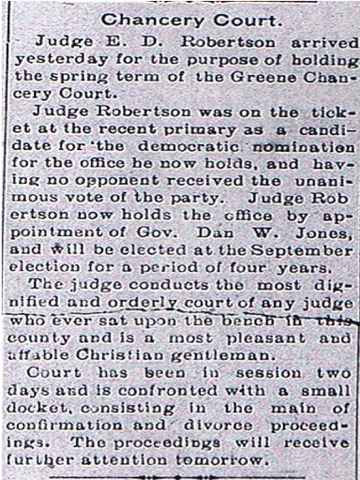
1902 Chancery Court News article

Judge E. D. Robertson commenced the spring term of the Greene Chancery Court, having recently received the Democratic nomination unopposed. Appointed by Governor Dan W. Jones, he will face election in September for a four-year term. Known for his dignity and affability, Judge Robertson oversees a court with a small docket primarily focused on confirmation and divorce cases, continuing proceedings into the next day.
Arkansas Naturalization Index – E Surnames

Back during the Great Depression the WPA was utilized to index records at courthouses and statehouses across the country. The intent was to employ individuals while providing the local, county, and state workers with indexes that were not otherwise readily available. The Naturalization records for Arkansas in the 19th Century is one of those sets of data that were indexed. Users of this index should consult the county circuit or chancery court to see if there is any additional information, but generally, pre-1906 contain less information than post-1906. This is an index for those surnames which start with the letter E.

Arkansas Naturalization Index – M Surnames

Back during the Great Depression the WPA was utilized to index records at courthouses and statehouses across the country. The intent was to employ individuals while providing the local, county, and state workers with indexes that were not otherwise readily available. The Naturalization records for Arkansas in the 19th Century is one of those sets of data that were indexed. Users of this index should consult the county circuit or chancery court to see if there is any additional information, but generally, pre-1906 contain less information than post-1906. This is an index for those surnames which start with the letter M.

Arkansas Naturalization Index – L Surnames

Back during the Great Depression the WPA was utilized to index records at courthouses and statehouses across the country. The intent was to employ individuals while providing the local, county, and state workers with indexes that were not otherwise readily available. The Naturalization records for Arkansas in the 19th Century is one of those sets of data that were indexed. Users of this index should consult the county circuit or chancery court to see if there is any additional information, but generally, pre-1906 contain less information than post-1906. This is an index for those surnames which start with the letter L.

Arkansas Naturalization Index – K Surnames

Back during the Great Depression the WPA was utilized to index records at courthouses and statehouses across the country. The intent was to employ individuals while providing the local, county, and state workers with indexes that were not otherwise readily available. The Naturalization records for Arkansas in the 19th Century is one of those sets of data that were indexed. Users of this index should consult the county circuit or chancery court to see if there is any additional information, but generally, pre-1906 contain less information than post-1906. This is an index for those surnames which start with the letter K.

Arkansas Naturalization Index – J Surnames

Back during the Great Depression the WPA was utilized to index records at courthouses and statehouses across the country. The intent was to employ individuals while providing the local, county, and state workers with indexes that were not otherwise readily available. The Naturalization records for Arkansas in the 19th Century is one of those sets of data that were indexed. Users of this index should consult the county circuit or chancery court to see if there is any additional information, but generally, pre-1906 contain less information than post-1906. This is an index for those surnames which start with the letter J.

Arkansas Naturalization Index – I Surnames

Back during the Great Depression the WPA was utilized to index records at courthouses and statehouses across the country. The intent was to employ individuals while providing the local, county, and state workers with indexes that were not otherwise readily available. The Naturalization records for Arkansas in the 19th Century is one of those sets of data that were indexed. Users of this index should consult the county circuit or chancery court to see if there is any additional information, but generally, pre-1906 contain less information than post-1906. This is an index for those surnames which start with the letter I.

Arkansas Naturalization Index – H Surnames

Back during the Great Depression the WPA was utilized to index records at courthouses and statehouses across the country. The intent was to employ individuals while providing the local, county, and state workers with indexes that were not otherwise readily available. The Naturalization records for Arkansas in the 19th Century is one of those sets of data that were indexed. Users of this index should consult the county circuit or chancery court to see if there is any additional information, but generally, pre-1906 contain less information than post-1906. This is an index for those surnames which start with the letter H.

Arkansas Naturalization Index – G Surnames

Back during the Great Depression the WPA was utilized to index records at courthouses and statehouses across the country. The intent was to employ individuals while providing the local, county, and state workers with indexes that were not otherwise readily available. The Naturalization records for Arkansas in the 19th Century is one of those sets of data that were indexed. Users of this index should consult the county circuit or chancery court to see if there is any additional information, but generally, pre-1906 contain less information than post-1906. This is an index for those surnames which start with the letter G.

Arkansas Naturalization Index – F Surnames

Back during the Great Depression the WPA was utilized to index records at courthouses and statehouses across the country. The intent was to employ individuals while providing the local, county, and state workers with indexes that were not otherwise readily available. The Naturalization records for Arkansas in the 19th Century is one of those sets of data that were indexed. Users of this index should consult the county circuit or chancery court to see if there is any additional information, but generally, pre-1906 contain less information than post-1906. This is an index for those surnames which start with the letter F.

Arkansas Naturalization Index – D Surnames

Back during the Great Depression the WPA was utilized to index records at courthouses and statehouses across the country. The intent was to employ individuals while providing the local, county, and state workers with indexes that were not otherwise readily available. The Naturalization records for Arkansas in the 19th Century is one of those sets of data that were indexed. Users of this index should consult the county circuit or chancery court to see if there is any additional information, but generally, pre-1906 contain less information than post-1906. This is an index for those surnames which start with the letter D.

Arkansas Naturalization Index – C Surnames

Back during the Great Depression the WPA was utilized to index records at courthouses and statehouses across the country. The intent was to employ individuals while providing the local, county, and state workers with indexes that were not otherwise readily available. The Naturalization records for Arkansas in the 19th Century is one of those sets of data that were indexed. Users of this index should consult the county circuit or chancery court to see if there is any additional information, but generally, pre-1906 contain less information than post-1906. This is an index for those surnames which start with the letter C.

Arkansas Naturalization Index – B Surnames

Back during the Great Depression the WPA was utilized to index records at courthouses and statehouses across the country. The intent was to employ individuals while providing the local, county, and state workers with indexes that were not otherwise readily available. The Naturalization records for Arkansas in the 19th Century is one of those sets of data that were indexed. Users of this index should consult the county circuit or chancery court to see if there is any additional information, but generally, pre-1906 contain less information than post-1906. This is aN index for those surnames which start with the letter B.

Arkansas Naturalization Index – A Surnames

Back during the Great Depression the WPA was utilized to index records at courthouses and statehouses across the country. The intent was to employ individuals while providing the local, county, and state workers with indexes that were not otherwise readily available. The Naturalization records for Arkansas in the 19th Century is one of those sets of data that were indexed. Users of this index should consult the county circuit or chancery court to see if there is any additional information, but generally, pre-1906 contain less information than post-1906. This is an index for those surnames which start with the letter A.

Arkansas History & Genealogy

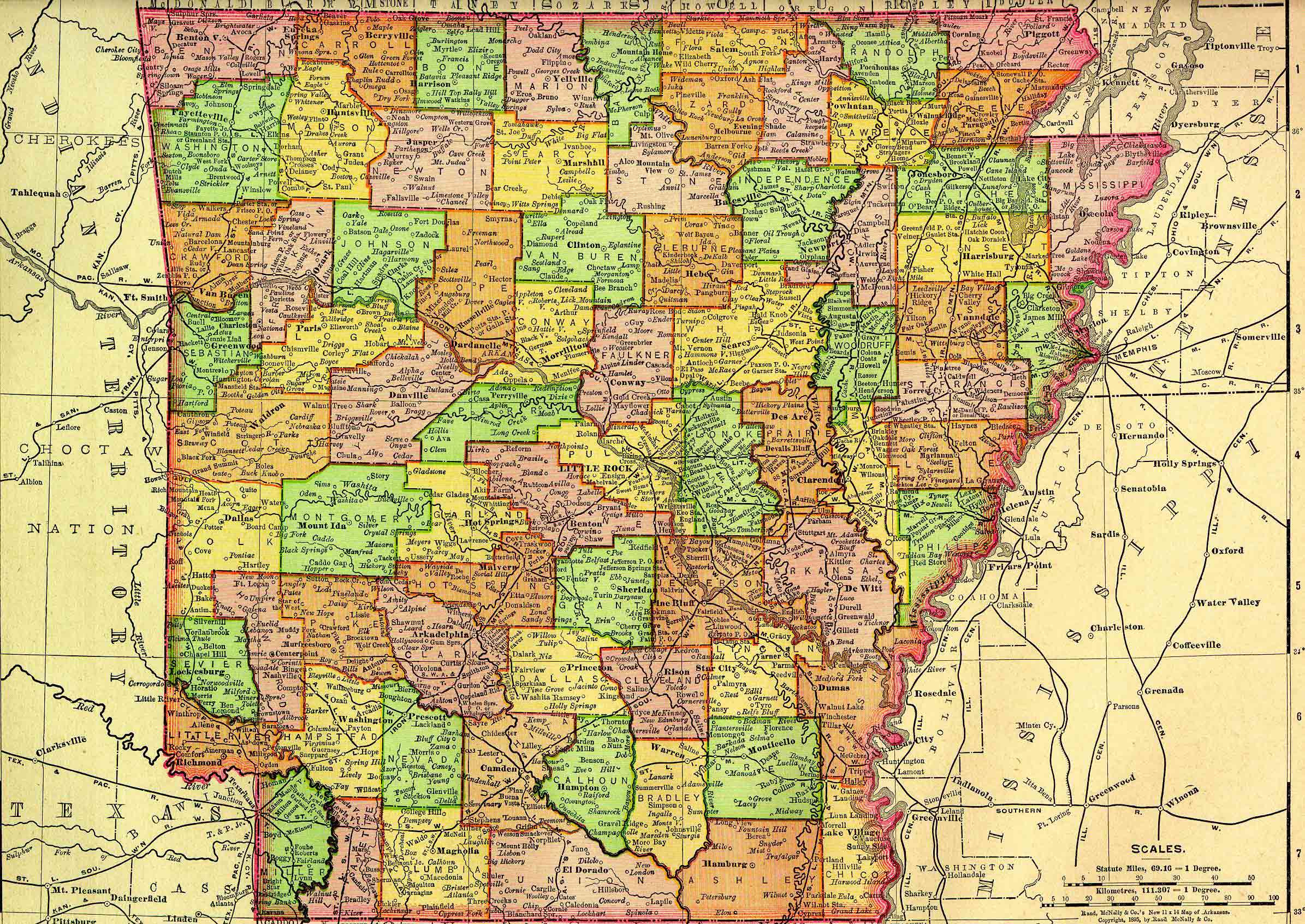
1895 Map of Arkansas

Arkansas is a southern U.S. state bordered by Missouri, Tennessee, Mississippi, Louisiana, Texas, and Oklahoma, covering approximately 53,179 square miles. This state project is part of the larger American History Genealogy Project (AHGP), established online since 2000 to centralize historical and genealogical information. Various county projects, including Benton, Greene, Jefferson, and Washington, provide diverse resources for researching Arkansas’s history and genealogy.

Arkansas Naturalization Records Index 1809-1906

Back during the Great Depression the WPA was utilized to index records at courthouses and statehouses across the country. The intent was to employ individuals while providing the local, county, and state workers with indexes that were not otherwise readily available. The Naturalization records for Arkansas in the 19th Century is one of those sets of data that were indexed. Users of this index should consult the county circuit or chancery court to see if there is any additional information, but generally, pre-1906 contain less information than post-1906.

The Kiowa Five

Kiowa Five

The Kiowa Five, consisting of James Auchiah, Spencer Asah, Jack Hokeah, Stephen Mopope, Monroe Tsatoke, and Lois Smokey, emerged from a mission school in Anadarko, Oklahoma. They were encouraged by Susie Peters to depict Kiowa culture through their art, preserving traditions threatened by encroaching settlers. Under Oscar Brousse Jacobson’s mentorship at the University of Oklahoma, their work gained recognition, leading to exhibitions in Prague and New York. Their distinctive style featured flat colors and traditional themes. Their legacy continues to influence Native American art, with their artworks celebrated in various exhibitions and collections.

Tribal Marines

The Warriors of the Plains have evolved from traditional combat to modern warfare, utilizing advanced military equipment. This message details the names of veterans from the United States Marine Corps, specifically highlighting the Kiowa Tribal Marines, as well as acknowledging deceased members. These individuals, both living and departed, exemplify the valor and service of the Kiowa community. The list, donated by tribal member William Hall Zotigh, serves as a tribute to their contributions. For more names across different services, reference the Kiowa County Veterans lists.

The Last Kiowa Sun Dance

This article honors Kiowa Elders Linn Pauahty and Scott Tonemah for their efforts in preserving Kiowa history and culture, particularly the significance of the Sun Dance ceremony—a vital aspect of Kiowa life for centuries. Despite the U.S. government’s attempts to suppress traditional practices, the Kiowa have managed to retain elements of the Sun Dance, such as the Tah-lee Medicine bundles and modern adaptations like the Brush Dance. This overview highlights the resilience of the Kiowa people and their cultural heritage amidst historical challenges.

Kiowa Calendar

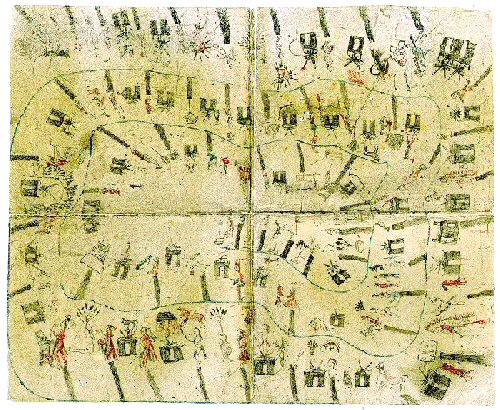
Set-t'an Annual Calendar

The Sett’an calendar documented key events in Kiowa history through winter and summer pictographs from 1832 to 1892. Each entry illustrated significant occurrences, including battles, leadership changes, and natural phenomena, as well as cultural practices like the Sun Dance. The Anko calendar ran concurrently until 1892, detailing further historical events and transitions faced by the Kiowa. Notably, the calendars highlight the impact of trade, disease, and conflicts with other tribes and settlers, culminating in the social changes as the tribe adapted to life post-reservation through farming and building homes.

Kiowa Indian Agency on 26 Nov 1907

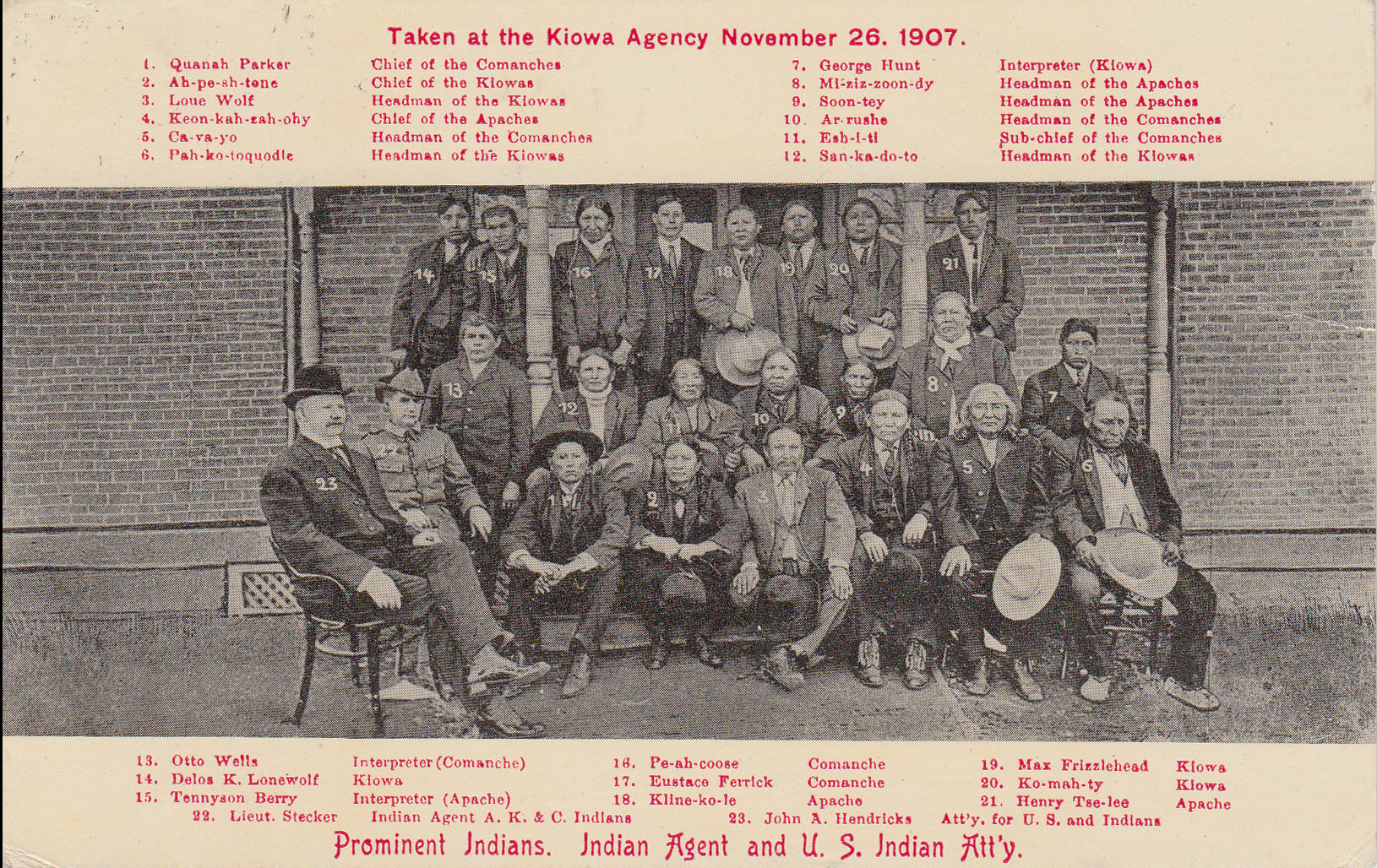
Prominent Indians at the Kiowa Agency, 1907

On November 26, 1907, prominent leaders and representatives from the Kiowa, Comanche, and Apache tribes gathered at the Kiowa Agency. Key figures included Quanah Parker, Chief of the Comanche; Ab-pe-sh-tone and Pah-Ko-toquodle, Chiefs of the Kiowa; and notable Apache leaders like Keon-Kah-zah-ohy and Mi-ziz-zoon-dy. The gathering also featured interpreters and U.S. officials such as Indian Agent Lieut. Stecker and Attorney John A. Hendrecks, highlighting important interactions between Indigenous leaders and U.S. government representatives.

Millie Durgin

Millie Durgan, later known as Sain-toh-oodie, was abducted by the Kiowa at 18 months during a raid in Texas. Initially taken captive with her family, she was adopted and raised by a Kiowa warrior and his wife, receiving love and care. Millie’s life intertwined with significant historical events and cultural shifts within the Kiowa tribe. She lived a fulfilling life among them, eventually marrying Goombi, a renowned scout. Despite various accounts of her fate, she passed away in 1934, leaving behind a large family. The narrative of her life highlights the complexities of identity and cultural heritage amidst turbulent historical contexts.

Cutthroat Massacre

In the spring of 1833, around 2,000 Kiowa gathered near Mountain View for a tribal council and the Sun Dance. Afterward, many warriors left for a raid on the Utes, while others went buffalo hunting. Unbeknownst to them, the Osage tracked their movements and launched a surprise attack on their camp, leading to a massacre of women, children, and the elderly. Many brave acts of defense were noted, but ultimately, the Osage decimated the camp, leading to a significant loss for the Kiowa, who subsequently avoided the site known as Cutthroat Gap.

Kiowa Elder Tells Tribal History Through Song

Evans Ray Satepauhoodle

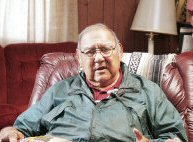
Evans Ray Satepauhoodle, a 74-year-old Kiowa elder, perseveres through physical challenges to preserve Kiowa history through song. He records traditional American Indian songs, detailing the story of warrior Sitting Bear, to help all Oklahomans understand his culture. Partnering with university professor Hugh Foley, they aim to document and share Kiowa history, making it accessible to future generations. Through modern technology like YouTube, Satepauhoodle hopes to inspire other tribes to share their stories. Their collaborative efforts highlight the importance of preserving Native American history through traditional songs, ensuring their legacy continues.

The Ten Grandmothers Religion

The Grandmothers religion of the Kiowa is a central spiritual belief for the plains tribes, revolving around revered figures known as the Grandmothers, who serve as intermediaries to the Creator. Each Grandmother resides in her own tipi and holds significance in tribal life, with prayers directed to them for communication with the all-powerful Creator. Their history is primarily oral, including the myth of Earth Woman and Sun Boy, which narrates the origins of the Kiowa people. This rich tradition is maintained and shared through generations, emphasizing the importance of memory and storytelling.