
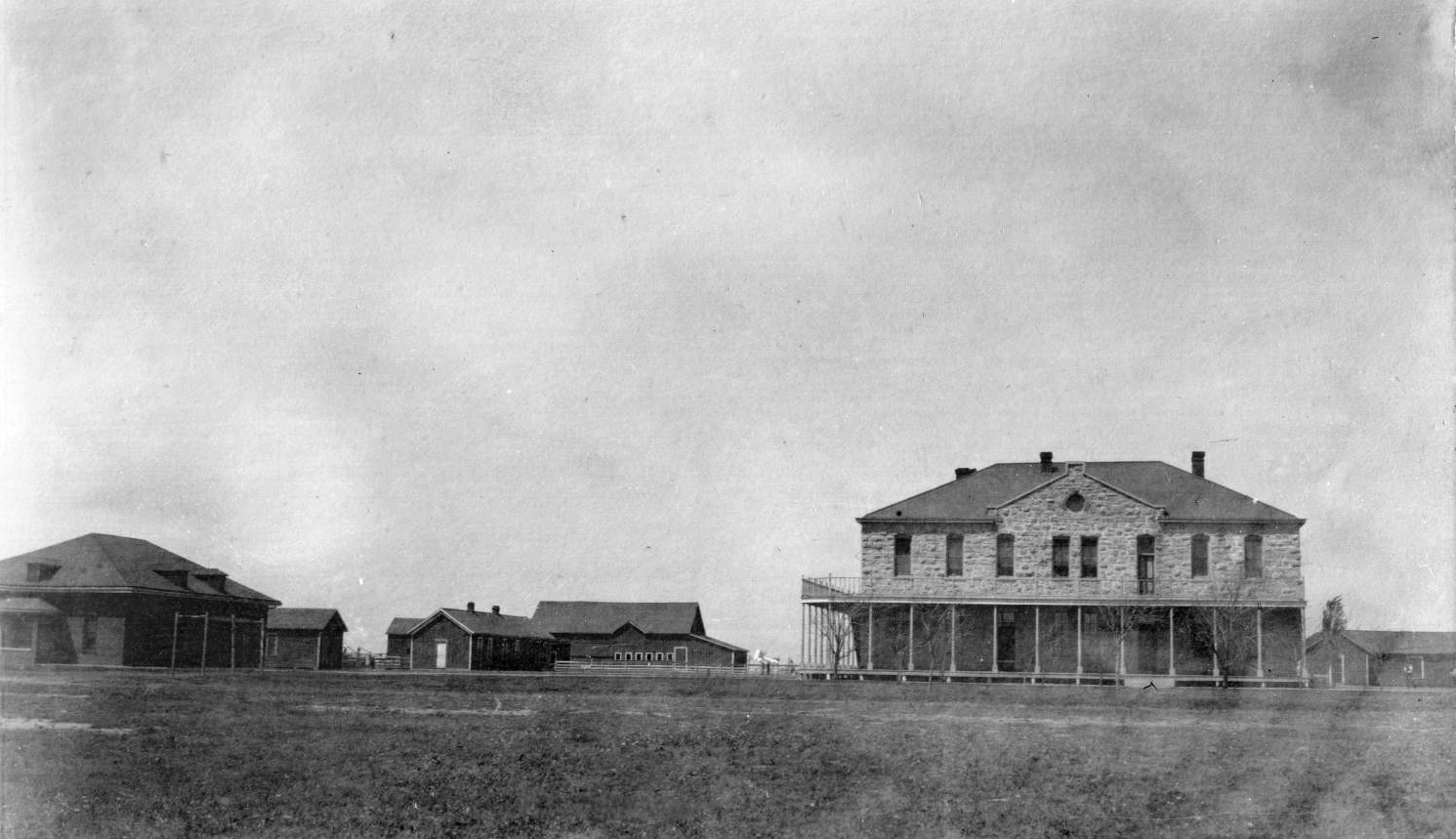
Kiowa County had 112 district schools at some point in its history. over time many of these have consolidated into district and regional schools as transportation shifted to motorized vehicles. The following is what we know about the history of many of those schools.
Kiowa County School Districts
Hobart Schools, District 1
See: Hobart Schools, District 1, also see: Hobart’s Junior College
Lone Wolf School District 2
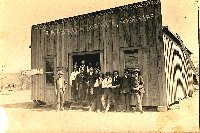
Owned by Gen. Bunyard’s grandfather, Donald Burgess Yarbro. Photo courtesy Lt. Gen.Jerry Max Bunyard, USA (ret.)
The first school for Lone Wolf was opened in 1901. It was a two room school located where the S. Higgins residence is currently. Probably a Mr. Devans was the first teacher. The first graduate of Lone Wolf high school was Mae Bowlware, May 19, 1911. She taught 3 years at Lone Wolf.
Cold Springs (Wildman) District 5
(was District 108)
The town of Cold Springs had a consolidated school with 11 grades being taught until 1925 when the high school was abandoned and the students transferred to Roosevelt. In 1951, the attendance fell below the minimum allowed by state law and the district with Roosevelt. The school building was used until 1972 as a neighborhood center and maintained by the Harmony Extension Homemakers Club. Several almost famous kids went to school at Cold Springs and there were a lot of kids that might have been famous had they left earlier. The creek and mountains made it a marvelous place to grow up as a kid and a real nice place for adults to settle and raise a family in a frontier area.
The School at Wildman, which was a short distance from Cold Springs, was organized and Miss Nell Muldowney of Roosevelt taught the miners’ children.
Mountain Park District 6
(changed to District 4 in 1929)
The first school was built in 1901, by townspeople’s subscription, of the usual frame style, one room, 3 windows on each side, 2 windows and door in the front, located at the east end of Main street across from present Hwy. 183. The first teacher was Levi Frazier. This building was sold to the Baptist church . They used it for about 3 years, then it was bought by George W. King, moved to his farm east of town, where the family used it as residence for several years.
The second school, a 2 story with a cupola and bell was built in 1903. The second building was on the south side of the block where the present building now stands. The next building was completed in 1912. For several years Mountain Park did not carry all 4 high school grades. In 1913-14, eleven grades were taught, with 3 members in the 11th.
The District was changed from #4 in 1929. The building was destroyed by fire in 1953, and the present one was built. It was financed jointly by the district and community. It became part of Snyder #51.
Lone Star District 8
(later Consolidated 8)
Lone Star school began about 1912, was consolidated in 1929 to Con 8. See Consolidated 8 School District.
Sedan District 9

(originally Fairview; later Consolidated #9)
Sedan was organized June 28, 1911 as Consolidated 9 District. Three little schools, Fairview, Mountain Hope and Star Center combined to become Sedan School. District 110, Rocky Hill annexed in 1929. In 1949 Sedan annexed all of Pecan Districts 99 and Dixie District100, parts of Saddle Mountain District 101 and Rainy Valley (Rainy Mountain District 103, parts of Green Valley District 11 and West Saddle Mountain District 12 making Sedan the largest district in the area.
Only after the 1929 annexation did the number of teachers rise above 4, with 6 reported for the first term in 1931. For several years the faculty was 7 or 8 but went to 6 in 1953.
The State Department of Education High School Bulletin reported 8 units of accredited high school work in 1930, 12 in 1935, and 15 in 1940. Apparently by 1940, Sedan was offering 4 years of High school. In later years 18 or 19 units were reported including more business subjects and what was listed as “vocational education” which probably included both agriculture and home economics.
After 1957, when Consolidated 8 was discontinued, Sedan was the last rural school in Kiowa County. Sedan School was discontinued in the 1960’s.
Cooperton Valley District 10
(Cooperton; later Consolidated #10)
Cooperton School was the center of early community life. The first School was held in the fall of 1901 in a one room building. It is thought that t. H. Maness was the first teacher . Later a 2 room school was built. Cleo Davis taught in 1912, with 12 students and was paid a salary of $45.00 month.
There was the pot bellied stove where you burned on one side and froze on the other. It was a long walk to the out house in the wintertime. In 1920 Union Graded I was organized with Cooperton #6 as the center, numbers 13, 55, 56, 66, 67 and 98 becoming part of the new district. In May this Union Graded status was dissolved and the districts returned to their original boundaries and functioned as separate districts.
In 1925, Nos. 6, 55, 56, 66, and 98 consolidated to become District 10. The first Cooperton high school graduates were Willard Smith and George Lester in 1927.
Sports played a very big part in the Cooperton School. In the early days, they had winning teams, as many trophies left behind can testify. The school sported on of the finest girl’s basketball teams in the county. One of the team members, Hazel Vickers, played with a professional girls basketball team, the “Red Heads”. She was All American for 5 years. The school also had a winning debate team.
School attendance dropped and in 1965, the high school was dissolved. 1972 saw the end of the grade school. Cooperton was the last consolidated school in the county.
Green Valley District 11
The one room Green Valley School was designed and built by the men of the community in 1904. It was taught by a much loved teacher, Miss Belle Stewart. She rode on a side saddle when she didn’t drive her buggy with her pony, a distance of 4 miles. Previous to this, classes was taught by Wilbur Rushton in 1903 in a private home.
W. R. Rushton was Sunday School Superintendent for 17 years, Kelly Askew played his violin for social events. Mrs. Otis Lee and Nora Rushton Cook played the organ for most of the church services and community singings.It served not only as a school, but Sunday School, Church services, box and pie suppers, school programs, spelling and ciphering matches, school board and meetings for community improvement.
When population increased, a second room was added in 1915, making it a 2 room, 2 teacher accredited school. Better qualified teachers were available and many students finished the 8th grade to on to higher education. After consolidation, the school was moved away.
Saddle Mountain, District 12
The first school had it’s beginning in the home of A. A. Moss and it continued there for two weeks, at the end of which time there was a large tent set up, twenty by twenty feet. This was used as the school for three months.There was no floor in the tent and each student brought his own chair or box to sit on. Everyone used slates since there was no blackboards.
The first school building near Saddle Mountain was built in the winter and started April, 1903. It was given the name of “Number 12”, and was small, about twelve by sixteen feet. Later some of the people called it Saddle Mountain School which caused some confusion with District 101 which was closer to Saddle Mountain. It was then referred to as “West Saddle Mountain” to distinguish between the two. Later for some reason, it acquired the nick name of “Lick Skillet” or “Slick Skillet”.
In 1907 a larger building was built across the road from the first. The last building was built in 1916, located one half mile north and east of the other. In 1940 the district was annexed to Sedan and Cooperton.
Mount Moriah District 13
Mount Moriah School was located on the Walter Truelove farm one mile north and 3 miles east of Cooperton. It is thought a prior school building had been built one half mile east and that it had burned. The last year of school was 1936, when it consolidated with Cooperton.
Pleasant Ridge School, District 16
Pleasant Ridge was located NW of Hobart, 2 miles west and 4 ½ miles north. It was a one room school and had one teacher from 1902 through 1935-1936. In 1949 it was annexed to Hobart and Sentinel. Like other schools of the time, it served as a meeting place for box suppers programs and Christmas Programs.
Big Elk School, District 17
The school was located 5 miles west and 4 ½ miles north of Hobart, on the southeast corner of O. T. Whitaker’s land in 1901. It was a one room structure and was named for Big Elk Creek which ran about one half mile east. In 1914, another room was added. Big Elk was an important center of the community.
The church life was very active. People would invite friends to dinner, then go to the school for singing or ball games with both children and adults taking part. The ladies exchanged canning ideas or discussed quilting, box socials and Christmas programs were held. Money raised this way went for playground equipment
Christmas treats, etc.
For the box supper, a picnic meal was prepared by the ladies and packed in a pair of socks. The man buying the socks got to keep them after the meal was over, and got to eat with the young lady that made it. Of course, he was not supposed to know who made it, but clues always seemed to find their way to the right young man.
The Christmas program was the big event, with a real cedar tree decorated with popcorn, cranberries and paper chains. One of the best remembered Christmas programs was a “Tom Thumb Wedding”. The groom was Marion Strong and Vera Howl was the bride, with Gulf Palmer as the preacher.
Some of the tragedies of the Big Elk District were a prairie fire, a storm, death of Arthur Duncan who was killed by a mule and a tornado in 1912.
Valley View School, District 18
Built in 1902, Valley View School was located 7 miles north of Lone Wolf. The one room school was built in the fall of 1902 on land given by Charlie Edwards and Buck Ballew. It was built in a valley between 2 ridges which gave a beautiful view of the country. It was a one teacher school, all 8 grades being taught until 1911. Due to a large enrollment another room was built on the north side and two more teachers hired. There were 60-65 students in the early years.
For several years, drinking water was hauled from a spring about one-half mile away on the Woods farm. coal and kindling were carried in for heating in the big pot belly stove in the middle of the building. It was a thrill for the boys to be chosen for these tasks. Later a big cistern was built to provide water, and a concrete cellar for protection from the storms.
There was no playground equipment those days so the children played games such as baseball, jump the rope, hide and seek, and the smaller boys played marbles. Ciphering and spelling matches were held on Friday afternoons after last recess.
The building served as a community center as well as a school. In the early days there was an Anti-Horsethief Society organized. This organization was very popular in America in those days and is still in existence in some states today. Social events were held at the school as were church services. Due to dwindling attendance, the school was disbanded in 1947 and students transferred to Lone Wolf or Port.
Union School, District 19
In the Northeast part of Kiowa County, 3 miles east of Simpler School, was another Union School, but the patrons who named District 19 did not know of District 59. They were some distance apart, so there was no conflict. This school was consolidated with Lone Wolf.
George E. Mitchell had drawn a farm ½ mile from the school. He hauled the first load of lumber for the school building, which later became a voting precinct called Mitchell Precinct.
After consolidation with Lone Wolf , the school building was taken over by the B-U-Busy club (members from Bethel and Union Districts) who painted it and maintained it. The building was used for club meetings, showers, family dinners, and was the center for social activities for the 2 districts.
Northwest (Simpler) School, District 20
Northwest District also known as Simpler, was located in the extreme northwest corner of Kiowa County. It was isolated from other towns, the nearest being about 15 miles away. It incorporated an area of about 14 sq. miles with it’s western boundary the North Fork of the Red River and it’s northern boundary the Washita County line.
The school house was a barn like structure about 30 x30 feet. It was named Simpler for John Simpler, a farmer that lived across the road.
The first term was in 1902. It opened with T. J. Allen as the teacher. It was a one room school until after the 1910-1911 term. At this time there were 72 students and a partition was built down the middle to turn it into a two room school.
In 1905 the old building was torn down and a new Spanish mission design building was erected by E. L. Martin, who designed it. Then the name was changed to Northwest..
The school fulfilled an important mission in the lives of the families in the district. Northwest sent hundreds of children from it’s doors better prepared to understand life and it’s responsibilities as they faced the future of adult life and to become more substantial citizens of whatever community they lived in. One of the students attending this school went to become a teacher, banker, judge and finally U. S. Senator, Ernest McFarland, from Arizona.
Bethel School, District 21
Located 3 miles north, 3 west of Lone Wolf, Bethel was a little one room school house, which served as community center and church for the community. There was 1 teacher and two 3 month terms, one in the summer and 1 in the winter when there was the least work to do on the farms. The usual meetings were Sunday School, church on Sunday morning, singing in the evenings, occasional services on Sunday night. Literary on Friday nights during the least busy seasons and a week’s revival in the summer.
Other social life held in various homes consisted of play parties, ice cream socials, candy pullings, watermelon eatings, picnics, hayrides and sleigh rides depending on the season.
Russell School, District 22
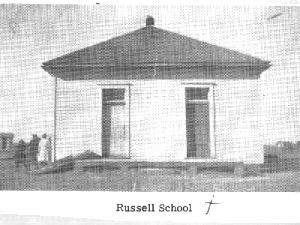
Russell School was the center of activities for the neighborhood with Sunday School held each week by ministers from Hobart and Lone Wolf alternating, revivals, literary societies, and Christmas programs.
When money was needed, box and pie suppers were held. Drinking water was carried from the house south of the school, the teacher appointed someone to do it. It was a great privilege to be “water monitor” and they walked as slowly as possible with the water. A coal stove in the middle of the room provided heat, and it had to be kept “red hot” on winter days, those setting next to it “burned” to keep the others from freezing. Coal oil lanterns hung on the walls provided light. Everyone brought their lunches in buckets, baskets, or sacks.
The school was blown away in a tornado Easter Sunday, 1944 and the school term was finished in a chicken house on the Watkin’s farm.
Sunnyside School, District 23
Sunnyside was located 3 miles north of Lone Wolf and 3 miles west of Russell School, on the east side of Lone Wolf. The one room building was located on the SW corner of Nick Snyder’s farm. It was consolidated into Lone Wolf in 1929.
Elk View School, District 26
Located 3 miles west and one mile south of Hobart, Elk View school was a one room school for grades one through eight. In the center of the room was a large coal stove furnishing heat in the winter and on occasion heating a large kettle of cocoa as a special treat for the students. The school was built on land owned by Jess Reed, for as long as the school existed. When the school disbanded, the land returned to the Reed estate.
The school was the scene of many community activities; Sunday school and church, box suppers, Christmas programs and other entertainment. At one time the community had a very active literary society which put on plays, skits and other entertainment.
Elk View was noted for some very good baseball teams.A good water well was located at the school and during the “dirty thirties” nearby farmers hauled their drinking water from there.
Students of Elk View were transferred to Hobart and Lone Wolf Schools through 1947-1949. In 1949, Elk View was annexed to Hobart and Lone Wolf and students were transferred.
The Neighborly Home Demonstration Club used the school building for the club and activity house for a number of years after the school district was annexed. Finally the building was sold to Bryan Gentry who tore it down to salvage the lumber. Mr. Gentry gave the corner stone to Paul Edge, a former student at Elk View.
McIlvain School, District 27
Charles McIlvain gave the land for a school 3 miles southwest of Lone Wolf. First classes started in 1908. At first water was carried from Mr. Ray’s, who lived just up the hill from the school. Heat was from a big pot bellied stove in the middle of the room. Of course, that meant the nearest got too hot—-at least on one side, while pupils in the outer part of the room were always cold.
The building was used as community center, church, Sunday School, as well as various other group meetings—spelling bees, debates, and singing conventions when other communities came with their quartets and other specialties.. Of course, there were the Christmas parties, with a big tree, candy and apples for the children and Santa Claus.
Spring Valley School, District 29
Zoddletone Springs, a health resort, was once in this locality and gave the school its name. It was a one teacher school through 1946-1947 except for 9 years when there were 2 teachers. It was annexed in 1949 to Sedan and Carnegie. It was closed because of an explosion caused by raw natural gas used for heating.
Mount Zion School, District 30
Mount Zion School was two miles west and one mile north of Hobart. It was a one room school through 1906-1907.
Plainview School, District 31
Plainview School was located 3 miles SE of Hobart. It was originally called “Hobart View” in the early days, then changed to Plainview. It was a one teacher school, nicknamed “Crackerbox”from the time it was built. It was annexed to Hobart in 1938.
Soldier Springs School, District 33
Soldier Springs School was built in 1902 on the Jake Riley farm and was located in the extreme southwest part of the county. It was a large one room frame structure and was built by Mr. A. J. Reed, a farmer and carpenter, who lived in the district. Residents of the area furnished the lumber, and Mr. Reed agreed to do all the building for the scrap lumber.
The school was blown off it’s foundation in 1916, and it was decided to move the building to the Albert Anderson farm, making it more centrally located. There was a large spring about 1/4 mile from the school for drinking water. At one time there had been a battle there and several soldiers graves were nearby, hense the name. The graves were later moved to Ft. Sill.
All 8 grades were taught and terms were from 3 to 5 or 6 months, as the children had to help with the farm chores and crops. THe school terms started in December. Two boys were chosen each day to carry drinking water from the spring to the school and bring in kindling and coal for the big pot bellied stove. There were spelling and ciphering matches held after the last recess on Fridays. Other games played jump rope, marbels and baseball. The baseballs were made out of twine by the boys and bats were whittled from wood. Many social events were held there, as well as Thanksgiving dinners where every cook brought her best dish and Christmas Programs by the children. The school term would end with a program and a picnic.
In the early days, most of the people lived in half dugouts. It was a large district and some of the children had to walk long distances. So, in 1910, it was decided to divide the school district. The north half was made into Mount Tepee and the south half remained Soldiers Springs.
Soldier Springs was the last one room school in Kiowa County when it was disbanded in 1953. The school was transferred to Lone Wolf. The old building was bought by the Davis family, moved to their farm and became a residence.
Hill School, District 34
Hill School was located 4 miles south, 1 west and 1 south of Gotebo. This land was owned from January 14, 1903 to February 4, 1908, by Eliza and Edward Hill, when they sold it to James Brewer, except one acre conveyed for school purposes.
Friday afternoon special events were spelling and cyphering matches. Standing room only was generally the rule at the box suppers and Christmas programs. heat was furnished by the big stove in the center of the room. On cold days students sometimes kept warm by marching to the victrola. Kerosene lamps were in brackets along the walls.
During the years beginning 1922, Emma Stone with the help of the community, brought the school up to Model Rating. Workdays were held when repairs on the buildings, equipment and grounds were made. All day meetings, with basket dinners, and well attended.
This was a one teacher school and existed from 1907 to 1939. People had moved away, farms had gotten larger and school attendence low, so the students were transferred to Gotebo in 1940. The district was annexed to to Gotebo in 1948, the building bought by Emmett Aday used for a church, then a house on 5th and Randlett in Hobart.
Stone School, District 35
From the south edge of Hobart, 8 miles east on the “old Ozark Trail” and 1/2 mile south was the one room school called Stone. This building was used from early 1900’s to 1937, when the building was torn down and a new one was builtby 1938 George Thompson received the patent on this location in 1905, but may haved there for a time before. On this land the early school was built.
A few years after the new schoolhouse was built the enrollment decreased so much that it was decided to close the school and send the children by bus to Hobart and gotebo. Before this an 8th grade student was required to pas a county examination before they could attend high school. The Stone School district paid the transfer fee. to the high school.
The school was annexed to Hobart in 1948
Pleasant View School, District 37

Pleasant View School about 1905. Back row; Joe Hart, May Jarvis, Daisy Jarvis, Althea Jarvis, Ethel Bridenstine, Vera Bridenstine, and Watson Tidball. Second row; Gene Bridenstine, Edgar Limbocker, Kenneth Gossett and Earl Cranfield. Front row; Edwin Jarvis and 2 unidentified children.
Pleasant View School, also known as Prough School, was located 7 3/4 miles south and 3 miles west of Gotebo. The first teacher is thought to have been Frederick C. Thompson. The last term was 1927-28 when it was annexed to Gotebo School District, with W. E. Burton driving the first school bus for this area.
The school was used for Sunday school, church and community activities, with J. J. Heckman serving several years as pastor. He also farmed in the area and was a valuable asset to the community.
Lugert School, District 38
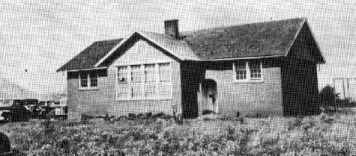
The first Lugert School was a one room building of wood located near the railroad tracks. When Lugert out grew the building, a new one was built.
The second building, located north of the business district was constructed of Brick and rock. It was a story and half, the two rooms on the lower floor housed 70-100 students. This building was destroyed by the Lugert tornado.
The district built a third building in the same location. It was a brick two story structure with the upper floor used as an auditorium. Lugert had it’s fourth school as a result of the building of the Dam. The building was dismantled and the new school was located a half mile east on what is now the Christian Retreat grounds. The churches used the school houses for their services.
Except for 5 years, Lugert was a 2 teacher school through 1946-1947. It was transferred for 1 year in 1948. Lugert was annexed to Lone Wolf and City View district in Greer County in 1948.
Babbs Switch School, District 42
See: Babbs Switch School, District 42
Prairie Dell School, District 43
Prairie Dell was a one teacher school through 1941-1942. It transferred for 6 years.It was the usual frame building with the usual activities. In 1948 it was annexed to Hobart and Roosevelt.
Queen Esther School, District 44
Queen Esther School was a one teacher school through 1925. It is thought to have started in 1903. It was then annexed to Gotebo. The school house was sold after it was annexed. It was bought by H. H. Wedel who tore it down and added to the Gunter house in Hobart.
Pleasant Hill School, District 45
Pleasant Hill was organized in the fall of 1902. The one room building was built on land donated by George Shepard, 9 miles northwest of Mountain Park. The first few years there was only one teacher, then grew to 4.
Not long after the school opened, Alvin Mullins opened a general store nearby. A Post office served the community from Nov. 1903 to July 1904. The school was used for community gatherings and at the close of the 1928 term, was annexed to Mountain Park.
Odetta School District 49
The school was built in 1903, the usual one room building, 4 windows to the side, a front and back door and painted white. Early records were lost, so there is no history.
The school house also served as a community center. Sunday School was held on Sunday mornings and singing at night. There was a Thanksgiving dinner, box suppers, Christmas Program and treats.
Odetta was consolidated with Snyder in 1927.
Gold Hill School District 50
Gold Hill School was located about 3 miles east of Snyder. It was a one room school with about 60-65 students from the community. It served as a community center for activities, church and Sunday school.
Snyder School, District 51
(changed to #4)
Snyder’s first school was a small frame building erected in 1902. Nell Cotton, W. P. Evans, George Tallent and Charles Hibbard were early superintendents. Hibbard was killed in the 1905 tornado.
From 1907 to 1915 the school made rapid progress. In 1908 a new school building was erected and in 1910 the school received its accreditation with Oklahoma University in Norman.
In 1915 more classrooms were added, the grounds improved and a normal training course was added.
Kiowa Flat School District 53
The original school was a one room structure built around 1902, 3 miles west of Mountain View. Soon another room was added to keep up with the growing population. By 1917, there were 102 students. In the ’20’s another room was added for a two year high school. This building was destroyed by fire in 1939, and was replaced with a native stone two room building built by the W.P.A. Kiowa Flat School was transferred to Mountain View and Gotebo in 1946
Grandview School, District 54
During the early days of pioneers settling in Kiowa County, a Mr. Dryer deeded the site to the proposed District No 54, with the condition that if the district was ever to be consolidated, the land would revert to him. Grandview began in 1902 or 1903 on land donated by a Mr. Dryer. The first teacher was Mrs. Anna Ross. No other information available. The building was sold and moved to Snyder and made into a dwelling.
Union Dale School, District 55
Union Dale was located 3 miles north and 1 east of Cooperton on the southwest corner of land of Mr. And Mrs. James A. Campbell. Mr. Campbell drew and homesteaded the land. When the need for a school arrived, Campbell gave the acre where the school building was erected.
The first Union Dale School was held in one room of the Campbell’s 3 room house. Louis Grant Van Ben Theusen was the first teacher, known as Mr. Van and boarded with the Campbells. When a death occurred, Campbell gave an acre of land for the cemetery, just east of the school site.
The building served as Community center with such activities as Sunday School, church, children’s programs, pie and box suppers, literaries, singing on Sundays and funerals.
The school closed in May 1925, when patrons voted to consolidate with Cooperton Valley School, District #10. The school building is gone, but the cemetery is still there.
Each year since 1961, former students of Union Dale have gotten together for a reunion. They meet in the Community building in Cooperton the last Sunday in April at 12:00 Noon. Everyone is invited to attend, bring a basket lunch and enjoy the program and the fellowship.
Rainy Mountain School, District 57
On July 9, 1904, Richard B. Williams gave one acre of his land to the district for a school as long as it was needed. The community men went to work, with the help of A. J. Spice, who was a carpenter, and had it ready for school by cold weather. Charles Pever helped to paint the school in the cold weather and almost got pneumonia. The year before, 1903, some of the settlers in the north end of the district hired a man to teach and used a vacant house south of the Jarvis home on the Kerr place.
The school was named Rainy Mountain because a tributary of Rainy Mountain Creek flowed around the edge of the bluff and on north from the school ground. The water came from Eagle Top Peak about 3 miles south. The tributary almost surrounded the school site.
The district was almost 5 ½ miles long. It was the largest one room school in the county, with attendance varying from 60 to 70 students. Because of the large number of students, the school board added 3 twelve foot long desks and benches.
One of the favorite activities was getting permission to carry two buckets from a well almost a quarter mile away. The desks were long and set 2 students. One of the students favorite teachers was Clayton Rogers who taught 1924-25. The students played “Tic-Tac-Toe” and timed Arithmetic problems on the blackboard at noon. At recess he had surprise games as well as the usual anti-over, hide-and-go-seek, and treks into the nearby pastures to look for rocks and plants. When one recited well he was allowed to sit with a friend.
The desks were long and accomadated 2 students. If a boy misbehaved, Rogers made him sit with a girl. One of the students, Marvin Parr, always seemed to excel in geography, finish first, and spend the rest of his time secretly trying to roll apples to the girls when Rogers wasn’t looking.
The building was replaced in 1932-1933 and school continued till the end of 1945-46 term, when pupils were transferred for 3 years. In 1949 the district was annexed to Cooperton, Gotebo, Hobart and Roosevelt. Activities through the years were the same as other country schools.
Acitvities through the years were literary societies, box suppers, programs, spelling and ciphering matches, church, Sunday School, singing school, and W. O. W. lodge meetings. The building was finally moved to Gotebo.
Also see: Rainy Mountain Kiowa Indian Mission School
Winthrow School, District 58
Winthrow was first a one room school, but later it became necessary to have 2 teachers. For part of those years, the ninth grade was taught, the 10th grade was taught one year for one student. Many school programs were held, regular literary society meetings, Sunday School and church services of various denominations, and at least one wedding.
Union School, District 59
The first school building was a mere shack about 12′ x 16′, with a shed roof and native sod floor. There were no desks, only benches for the students or their books. The school opened in the fall of 1902. In the fall of 1903, school opened in a new building, 8 miles south and 1/4 miles east of Hobart. The new building was 24′ x 48′, painted white, with regular school desks and nice furniture.
Kenney School, District 62
Kenney School was 3 miles east of Snyder. It was named for John Kinney who operated a store across from the school. It was usually a 3 month school. In the fall of 1908 a small pox epidemic kept the school from opening until January 1909. It was a tiny box frame building and was never painted. There were no desks, the students sat on homemade benches and wrote on slates they held on their laps. The teacher’s desk was a homemade table with a cane bottom chair.
In 1908 there were more than 60 students in the one room. The younger children were placed on benches against the wall as a place for them to lean.
The school held debates and spelling bees. At recess time the older children played all kinds of ball games; the younger ones played “Anti-over”, “Blackman”, and “Dare Base”.
Star Valley School, District 65
Star Valley was organized by J. C. Adams and Martin Donley who donated the land. The school was originally on the front porch of Donley’s home, starting in the fall of 1902. The first building was frame, about 24 by 36 feet with the chimney in the north and door in front. At different times Star Valley was rated a model school. In 1938-1939 it not only re-acquired her rating as a model school but secured accredited rating as well. In 1939 there were 15 pupils.
Wichita Valley School, District 66
The Wichita Valley school was located 3 miles south of Cooperton. Before the school building was built, Hugh Francisco, thought to be the first teacher, held the school in the lower floor of his home, while he lived upstairs. A one room school was built and about 1917 another room was added. The school building was used for Sunday School, church and school activites. It consolidated with Cooperton in 1925.
Gladson School, District 68
Gladson was, in area, one of the largest rural school districts in the county. It began as
a one room, but when attendance reached 80, another room was built.
Frisco School, District 69
Frisco School originated in 1902, through the efforts of Thomas Cotter and Dave Whitaker. Up to this time there had been no school and they felt there was a need for one. The parents hauled the lumber and the two men built it, donating there time and labor. W. A. Bailey furnished one wagon and with 2 wagons and teams, they managed to haul the lumber. A Mr. Allen, who was a carpenter, built the school, with help from Tom Cotter and the boys. It was finished after January 1903.
It was a one room building located 2 miles north of Hobart. Whitaker donated the land. The building was used as a school, community center, Sunday school and the usual activities as box suppers and debates. Later it was annexed to Hobart and the building was used as a club house.
Olive Branch, District 70
Olive Branch was a one teacher school through 1910-1911. It was located one half mile north of the Con. 8 gin. In 1911 it was consolidated with Mackey and Lone Star. When it was time for the consolidation, the new building was completely destroyed by fire. School was delayed for another year while a new school, an exact replica of that one was built. Since it was not ready for the 1912 term, the Olive Branch building was moved to the site, divided into 3 rooms by cloth curtains until the following spring when they could move into the new building.
Hilltop School, District 71
Hilltop School was in Kiowa County before Hunter Township was transferred to Tillman County. The first school was held one mile west and 1 miles north of Snyder. It was a one room residence building. Later the school house was built facing south-west. It was used until 1932 when a new and larger building was erected, still a 1 room school. It was well equipped with playgrounds, equipment, cellar and cistern.
The last term of school was held in 1942 with 7 students. From then the building was not used much and was sold in 1947.
Mount Teepee School, District 75
Mt. Teepee School was located 9 miles south of Lone Wolf on the John Hoskin Farm. There was no church in the neighborhood, so the school was used for church services and social gatherings. Mt. Teepee was consolidated into Lone Wolf in the 1940’s.
Mullins School, Pleasant Hill District 80
Pleasant Hill District 80, better known as the “Mullins School” was first organized in the fall of 1902. A one room school building was built on land donated by George Shephard located 9 miles northwest of Mountain Park..
The first few years the school operated as a one teacher school, then two, then three and finally four. Subjects offered were orthography, reading, arithmetic, grammer, penmanship, history, geography, and physiology. 35 students were enrolled for the first term from Nov. 17, 1902 through March 20, 1903 with Carrie Street as teacher.
Shortly after the school was established, Alvin Mullins opened a general store nearby. From that time on the school was known as “The Mullins School”. A postoffice also named Mullins, with Mr. Mullins as postmaster served the community from Nov. 11, 1903 through July 17, 1904 at which time it was discontinued and effective Aug. 3, 1904 the mail service was given to Mountain Park.
The school house served a large area for community gatherings such as literaries, magic lantern programs, box suppers, a place to vote, and also for church services and weddings. Feb. 23, 1908, following the morning service, Miss Elsie Urbach became the bride of John McDonald and Miss Claudia Bennett became the bride of Roy Urbach. Following the evening services, Miss Jennie Smith became the bride of Will Bennett.
Enrollment continued to grow and a new 2-story building was built in 1917. At that time, the school district furnished a house for the teachers which was located in a pasture back of the Tom Brannon home.
IN the spring of 1921, 3 districts, Pleasant Hill (Mullins) #80, Rockdale (Lick Skillet) #79 and Shiloh # 81, voted to become Union Graded #10. Under this arrangement, Mullins became to central school, with 4 teachers, 2 for grades and 2 for high school. One teacher was maintained at each of the other schools to teach the first 6 grades.
In 1926, the girls basketball team won the Kiowa County championship. Instead of 2-court divisions then, there were 3, with forwards, centers and guards all staying in their area. Parents took the players to all games which were played away from home.
At the end of 1927-28 term, the parents petitioned to have Union Graded #10 disbanded with Rockdale and Pleasant hill annexing to Mountain Park and Shiloh annexing to Con. 8.
West Park (West View) School, District 82
West Park school was located 4 miles west of Mountain Park. It was built in 1902 by Alex Reed, who also taught the first term of school in 1902-1903. He was paid $45.00 a month. In 1912-1913, he taught another term.
The old school house was sold to a Mr. Webb and a new one built. The new one hosted many community activities, such as singings, literies, school programs, box suppers and the community Christmas tree.
West Park was annexed into Mountain Park in 1925, and the building sold to Robert Sockwell.
Tripp School, District 83
Tripp School was located 6 miles due west of Snyder. A Mr. Tripp donated a corner of his property for school purposes.It started in 1903 as a one teacher school and later expanded to 2 teachers.
The school was the usual type frame building painted white with 4 windows on each side and 1 door in front. Between 50-60 students attended in 1903-1904.
Yale School, District 93
Pearl Walker donated a copy of the 1909-10 graduation booklet that belonged to her Great Aunt, Elsie Reeves. Thank you, Ms Walker.
Pleasant Valley, District 95
The first school in Pleasant Valley was located on the SE corner of Louie Lanig’s farm, in a tent. Nobody remembers how many students there were or how much the teacher was paid. The children sat in cane bottom seats and had slates for writing.
Later a frame building 32 x 50 feet was erected on the SW corner. Within the next 10 years the students outgrew the building and an addition was added on the west side. With the school growing it was decided to make it a two room school and two teachers were hired.
Lawrence School, District 96
In 1901, a meeting of 4 school districts, later known as Martin, Gentry, Pleasant Valley and Lawrence, was called . The meeting was at Komalty and was to discuss Consolidating the four districts or build separate buildings.Income from the railroad helped finance Gentry and Martin, but the other two had only the land school tax. It was voted down because of transportation.
A tent was first erected, and every child had to bring something to set on. Walter Standevan taught the first three months, then a one room building was erected and named ofter his father Lawrence Standeven.
A Sunday school was organized and met at the school. It later became a Baptist Denominational school.
A second room was added in 1919, two teachers were hired. By 1923 the enrollment was down and only one teacher was needed. In 1945, only 14 students enrolled and the school was closed, the students sent to Hobart. The school building, two outbuildings, a shed and water pump were sold at auction. The building brought $455.00 and the other items brought $71.50.
Gentry School, District 97
Gentry was organized in 1902 as a one room school for primary through 8th grade. It had one door in front five windows on each side, no opening in the back, a big pot belly stove for heat and kerosene lamps hung from the ceiling.
In those days every school had a big cistern for drinking water. In later years a teacher died from typhoid fever. It was believed it came from the water at Gentry school, so the cistern was condemned and water was hauled. There was a big water keg with spigot and tin cups to drink from.
There were a lot of activities, baseball team, basketball team and some of the games they played were jump rope, anti-over, crack the whip, red rover, high jump, and broad jump. Marbles was always a big game.
The students brought their lunches, usually in a bucket, using a Lard or Mary Jane syrup bucket. Later they organized a lunch program. The teachers and older girls purchased the food and did the cooking. The children were served at their desks and were instructed in proper table manners.
There was Sunday School and Church meetings in the school house on Sunday afternoons, but it discontinued after a while. Later it was re-organized, but since everyone was of a different religion, each Sunday a different one would get his pastor to come and hold services.
Gentry School was in operation until the early 1940’s when it was closed. A few years later the building was sold and moved into Hobart, converted to a home.
Mountain Valley District 98
This school was located 3 miles east of Cooperton on the land of Walter White. It was annexed to Cooperton in 1925.
Mackey School, District 104
Mackey was a one teacher school through 1910-1911 when it became one of 4 districts going together to form Con. 8. It was located 1 mile west and 2 south of the Con. 8 gin. Started in 1901, it was on the northeast corner of Troy Guy’s farm.
Surprise School, District 105
Surprise, also known as Dick was located Southwest of Gotebo. It was a one teacher school until 1937 when it was transferred for 4 years and annexed to Gotebo in 1941.
Koonkazachey School, District 109

Koonkazachey was plotted as a town, 12 miles south of Hobart and 6 miles east of Lugert , but it never developed. The school was started in 1907. It was named after a Kiowa-Apache chief named Koonkazachey who was a government scout. Because of his service to the government he was buried with military honors at the Post Cemetery, Fort Sill.
This small school sat on the plains at the foot of the Wichita Mountains. Although the official name of the school was Koonkazachey, it was known more by “Koon Con”, the Con standing for Consolidated.
The school had lots of honors in county meets of scholastic activities, field and track, softball and basketball. It was one of the first in the county to become a model school. It had a hot lunch program without Federal help. It remained a school until about 1946..
When money became a problem patrons held a box supper. This was necessary when money was needed for a Christmas tree, a new piano, stage curtain or library books. It was not unusual to make as much as $300.00 at one of these suppers.
For a long time there was a male quartet with Mrs. Pete (Erma) Barton, as accompanist and the members differing from time to time, but usually consisting of Homer and Pete Barton, Roy Wadlow and Aubry Howl. This quartet was in great demand for the entire area and often sang on the radio.
The school boasted an unusually good library for a rural school with 300 or more books. At the termination of the school, about 1946, some of the books were sent to Soldier Springs. A number of the graduates returned to teach at the school.
Rocky Hill School, District 110
Rocky Hill was located 6 miles north and 2 miles east of Cooperton at the foot of a small Rocky Hill. The school site was selected within one half mile of the center of the district to build the building and was one square acre
This acre of land was a part of the US Government allotment to Eunoch, an Indian named Ah-tone-ah. In order to obtain clear title to the land, the district had to go through the process of condemnation. When approved, Eunoch was paid $50.00 for the acre of land. This legal order was notarized May 31, 1910 by Corwin Boake. At the time Boake owned and operated a trading post named Tokio, which was 3 miles north of Rocky Hill School. As the district had a lot of Indian land, which paid no taxes, it only had enough money for a six month term.
After the Rainy Mountain Indian School closed, some of the Indian students attended Rocky Hill. One former student recalls there were more Indian than white students part of the time.
Like other one room schools, it served as the community center with Sunday School and singings, pie and box suppers and school programs. District 110 was one of the youngest schools in the county, being established in 1910. Only 2 were organized later. As with other one room schools, it was consolidated . In 1929, most of the district went to Sedan school, Con. #9, while a small part went to Cooperton, Con. #10.
Unknown District Schools
Long Valley School
Long Valley was in the far SW corner of Kiowa County. One of the early teachers was a Mrs. Weir who had taught in Mexico. She lived with her four children in a one room teacherage. The school served as a community center, with writing schools, singing schools, Sunday school, preaching services, box suppers and magic lantern shows. One of the former teachers tells the story of one little boy who refused to bathe at home during the winter. When she finally resorted to having the county superintendent ask him to take a bath, his sister explained, “He’s tallowed for winter, and all sewed in.”
When 6 miles of Kiowa County, the strip from highway 62 to Otter Creek, became a part of Tillman County, Long Valley School District consolidated with several other districts to form Laing Consolidated School.
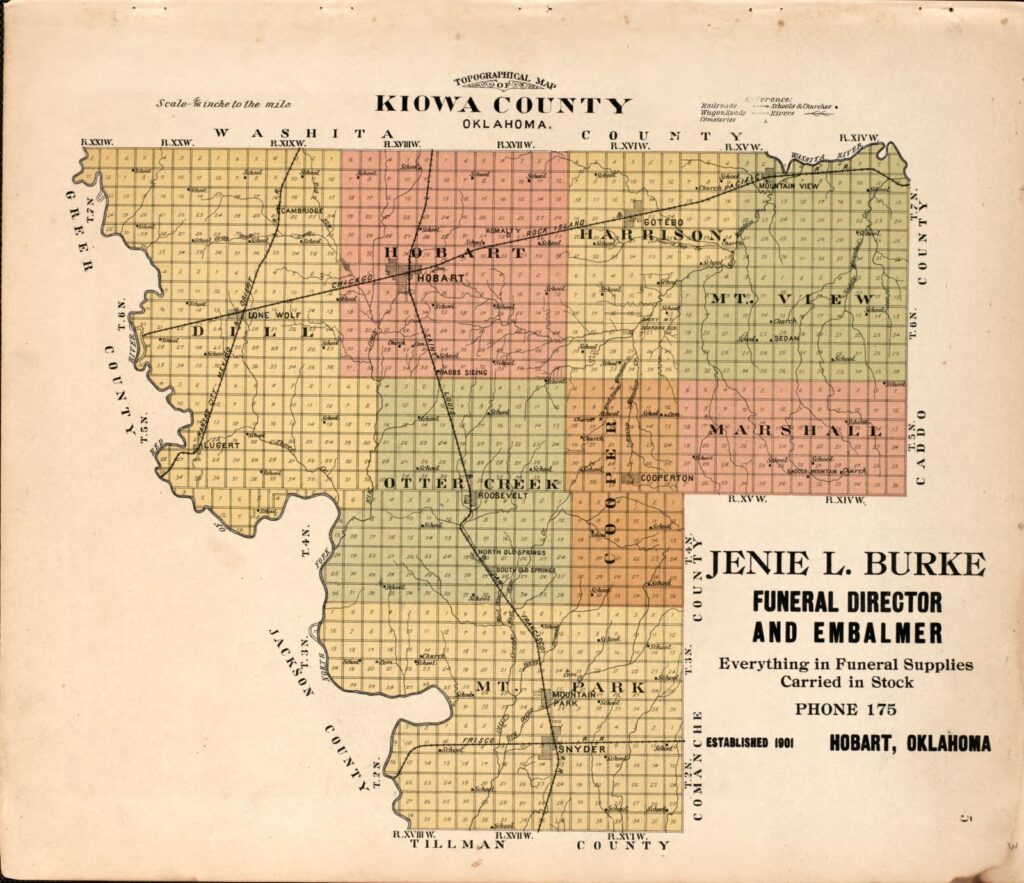
1913 Map of Kiowa County
The Map of Kiowa County by William Wangersheim shows the location of over 75 schools found in Kiowa County in 1913.
Back to: Kiowa County History & Genealogy
Any information compiled, prepared and submitted to this site by Ethel Taylor remains the property of the submitter. Ethel Taylor grants that this information and data may be used by non-commercial entities, as long as this message remains on all copied material, for personal and genealogical research. These electronic pages cannot be reproduced in any format for profit, can not be copied over to other sites, or other presentation without written permission of Ethel Taylor.