
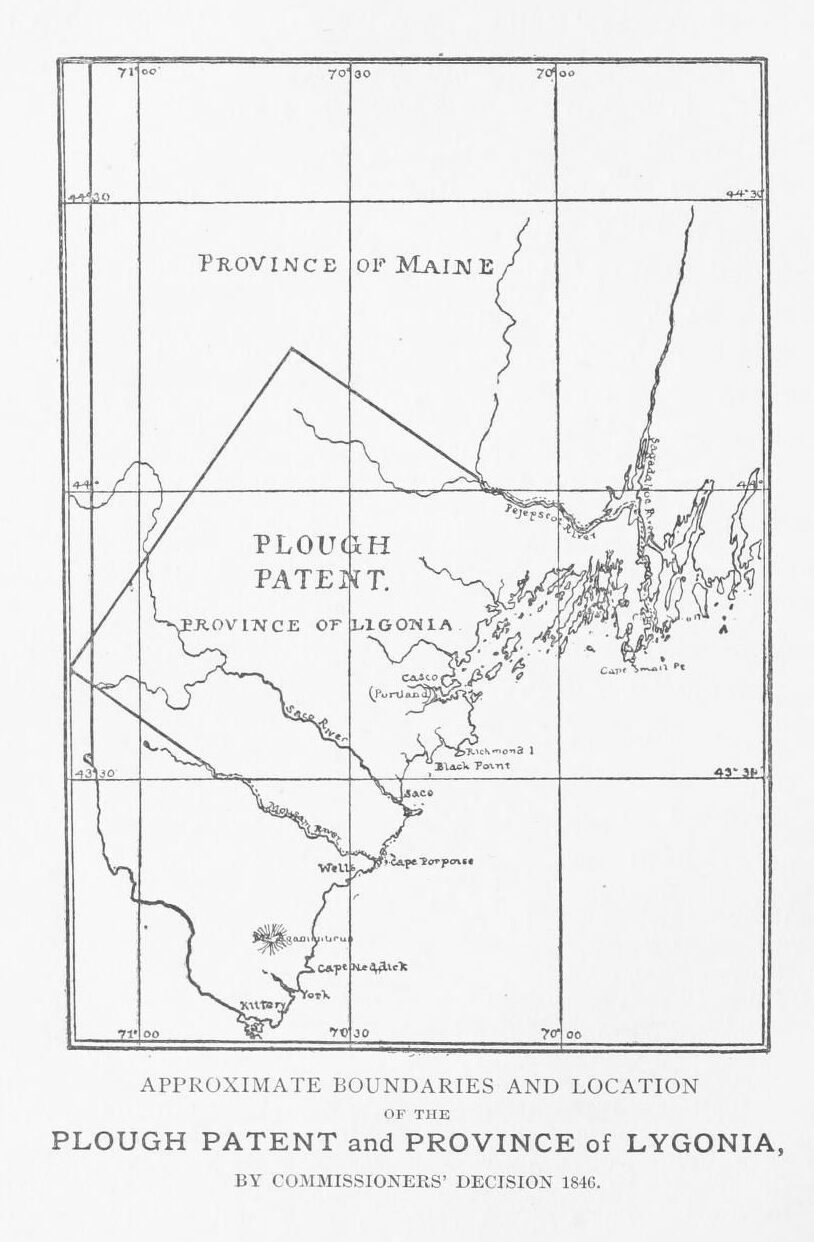
“The Plough Patent which I esteeme no better than a broken tytle.”
Richard Vines to John Winthrop, 9 January, 1643.
On the 6th of July, 1631, Governor Winthrop made the following entry in his Journal: “A small ship of sixty tons arrived at Natascott, Mr. Graves master. She brought ten passengers from London. They came with a patent to Sagadahock, but, not liking the place, they came hither. These were the Company called the Husbandmen, and their ship called the Plough.”1 We are here first introduced to a body of emigrants constituting the advance guard of a society of religious fanatics who intended to establish a colony on the new English shores where they hoped to be freed from the persecutions which had followed them at home. This “Company of Husbandmen” brought with them a patent from the Council for New England, dated 26 June, 1630,((This date is taken from a contemporary manuscript in the possession of the Maine Historical Society, and, to my knowledge, has never before been published.)) which granted unto Bryan Bincks, John Dye, John Smith, Thomas Jupe, John Crispe, and their associates, a tract of land forty miles square.((The loss of the original patent (and no verbatim copies are known to be in existence) precludes the formation of any definite knowledge of the boundaries of this patent. Hubbard locates it “south of the Sagadahoc River” and “twenty miles from the sea-side.” (History of New England, 510.) Maverick writing in 1660 says “there was a patent granted to Christo: Batchelo” and Company in the year 1632 or thereabouts for the mouth of the River [Kennebec] and some tract of land adjacent.” (Egerton MSS. 2395, folio 397.) An anonymous writer, about 1638, speaks of “a patent of Sagadehock granted to Crispe and others” (MSS. No. 3448, British Museum) and another contemporary alludes to it as “a Pattent for M”” Crispe and others for Sagadahock.” (Colonial Papers, Public Record Office, ii. 16.) “Two Islands in the River Sagadahock, near the South Side thereof about 60 miles from the Sea,” were included in the grant, but it is not possible to locate such islands in this river2, though it is evident that the council supposed them to be there. In the minutes of their proceedings they decided to reserve “for the publike plantation . . . the two great Islands lying in ye river of Sagadahoc.” (Colonial Papers, ii. 6.) )) The location and extent of this grant were never distinctly understood, and from the first the indefinite terms and description became frequent sources of controversy and misunderstanding between the grantors and grantees of the patent. The partners remaining in London wrote under date of 8 March, 1631-2 to the colonists as follows:
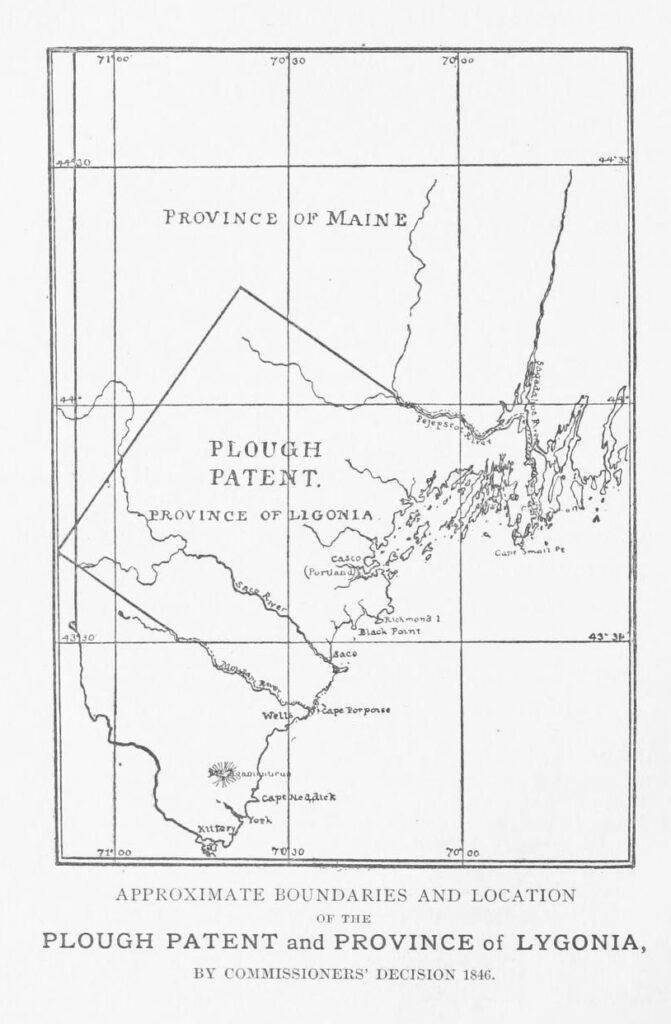
” We gaue you notes by Mr. Allerton,((This was Isaac Allerton of the Pilgrim Colony at Plymouth.)) and wee hope you haue long since receiued it, that wee haue had much ado about our patent, and that there was one Bradshaw that had procured letters patent for a part as wee supposed of our former grant, and so wee think still, but he and Sir Fferdinando think it is not in our bounds.((Richard Bradshaw was granted a patent for 1500 acres of land “above the hedd of Pashippscot on the north side thereof,” 2 November 1631, having been “liveing there some yeares before.” (Minutes, Council for New England.) Bradshaw, however, was given possession of this amount of land at the Spurwink river by Captain Neale, and afterward sold his rights there to Richard Tucker, who settled thereon and, with his partner George Cleeve, tried to maintain this claim against the Trelawny Patent, but unsuccessfully. (Trelawny Papers, 32, 207, 229, 308.) )) He was frustrat of his first purpose of coming over, but is now joyned with 2 very able captens and marchants, which will set him over, and wee suppose will be ther as soon as this shipe, if not before. Wee can not possible relate unto you the labour and truble that wee have had to establishe our former grant:((This would indicate the existence of a prior grant which became void, and may account for the allusions to the various patents “for Sagadahock” spoken of in a previous note.)) many rude words wee have had from Sir Fferdinando at the first, and to this houer he doth afferm that he never gave consent, that you should have above forty miles in length and 20 miles in bredth, and sayeth that his one hand is not to your patent if it have any more: so wee have done our good wills and have procured his love and many promises that wee shall have no wrong. Wee bestowed a suger lofe upon him of some 16s prise, and he hath promised to do us all the good he can.”((4 Mass. Hist. Coll. vii. 94-96. The Company further say respecting the difficulty about their grant: “Wee can procure nothinge under his hand, but in our hearinge he gave order unto Mr. Aires to write unto Capten Neyle of Pascatoway that Bradshaw and wee might bee bounded, that wee might not trouble ech other, and have given the Capten comand to search your patent, what it is you have under my lords hand and his. Wee need not Counsell you what to do in that case, only wee give you notes of it, desieringe God to direct you that no just occasion may be given on our parts to be evell spoken of. Wee gave Sir Fferdingand this reason why wee desired so large a patent, because that the greatest part of it was not habitable, being rocke, wer no man could live; and he answered wee should not doubt but be allowed enough for us all, and in the best part of it, accordinge to our desire; but if wee should have so much as wee say they have granted us, then do wee include divers of ther former plantations, which they never intended. This controversy must be ended between your selves and such governers of them of Pemequed as they have appointed.”))
The owners of this patent with its perpetual lease to heirs and assigns were members of the strange sect of religious enthusiasts called the Family of Love or Familists who flourished in Holland and England during the latter half of the sixteenth and first half of the seventeenth centuries. The founder, Henry Nicholas, a native of Westphalia, originally an Anabaptist, taught that religion consists wholly in love, and as the apostle of this creed claimed superiority over Christ on the ground that Moses only preached hope, Christ faith, while he preached love. Their doctrines seem to have been a species of pseudo-spiritual sentimentalism, inevitably resulting in gross immorality, and Fuller in his “Worthies” calls them the Family of Lust. Queen Elizabeth instituted an investigation into their practices, which resulted in their dispersion and the burning of their books and property. They continued to flourish, however, in a precarious way for about a century, but finally expired under a continual battery of ridicule in prose and verse.”((Interesting particulars concerning this peculiar sect may be read in Knewstub’s “Confutation of Monstrous and Horrible Heresies taught by H. N &c.,” London, 1579; Rogers’ Displaying of an horrible Secte, &c., London, 1579; Baxter’s Autobiography, 77; Strype’s Annals, ii. 57; Mosheim’s Ecclesiastical History, chap. xvi. § iii. p. xii.; Collier’s Ecclesiastical History of England, vi. 609; vii. 311; Hardwicke’s History of the Reformation, ch. 5.)) The London partners allude to this persecution when they adjure the colonists to be united and “put to sham and silanse many that do now shamefullie rise vp against vs.”((4 Mass. Hist. Coll. vii. 94-96.)) Such were the Company of Husbandmen who came to our shores in the “Plough,” and their proposed colony was to be operated upon the communistic principle of equal division of expenses and profits and would become in time an asylum for the oppressed brethren in England.((The “ten passengers” constituting the first lot of colonists cannot be all identified. So far as determined they were Bryan Binckes, Peter Johnson, John Kerman, John Smith, “Mr.” [John] Crispe, and the “sons” of “Goodman Tamage.”)) The conditions of membership in this adventure were religious affiliation and a subscription of £10 to the common stock, but though the former was not strictly essential, the latter was a necessary requisite. The business management of this religious scheme was conducted by members of the society in London, principally by John Dye, “dwelling in Fillpott Lane,” Grace Hardwin, Thomas Jupe and John Roch, “dwelling in Crooked Lane,” but it may here be said in anticipation, that their part in the affair became a mere probate proceeding in bankruptcy, for the colonists never settled on their patent. Before the brethren in London could hear from their friends in the Plough the obituary of the colony had been written by Winthrop.((A contemporary manuscript in the possession of the Maine Historical Society, which was drawn up by the attorney for the Rigby heirs, contains the following statement: “In the year 1630 The sd Bryan Hincks, John Smith & others associates go personally into New England & settle themselves in Casco Bay near the South side of Sagadahock & lay out considerable Sums of Money in planting there & make laws & constitutions for the well ruling & governing their sd Plantations & Province.” With the positive statements of Winthrop, Hubbard, Maverick, and other contemporary writers to the contrary it is not probable that this authority is entitled to full credit.)) It would be unnecessary to occupy further space than to record their epitaph did not the letters of the London partners written to the colonists, in ignorance of the collapse of the scheme, unfold to us the elaborate preparations made by them for securing a permanent establishment, and sending reinforcements to it. Under date of 8 March, 1631-2, they say “our tim hath bin taken vp with fordringe, hellpinge and providinge thinges fittinge for these our bretheren that are now to come vnto you,” and we are informed therein that two vessels with colonists were to be dispatched forthwith. These two vessels the “Whale” and the “William and Francis,” both of London, set sail March 9th and April 8th, 1632, respectively, bearing in addition to the colonists a number of distinguished persons. In the “Whale,” which arrived May 26th, came John Wilson and Richard Dummer (who held a commission from the London partners) “and about thirty passengers, all in health”; in the “William and Francis,” which arrived June 5th, came Governor Edward Winslow, Thomas Welde, (who published twelve years later “A Short Story of the Rise Reign and Ruin of Antinomians, Familists and Libertines that infested the Churches of New England”), Stephen Bachiler, their aged pastor in London, transferred from thence to missionary labors in the colony, and about “sixty passengers.”((Winthrop, Journal, i. 92, 93, 94. Speaking of the coming of their venerable preacher, Stephen Bachiler, then 71 years old, they say: “furst let us not forget to remember you of yours and our date that wee return humble and harte thankes vnto All mighte God, that hath filled the hart of our reverent pastor so full of zelle, of loufe and extreordenare affection toward our pouer sosiate, that not with standinge all the oposition, all the suttell persawations of abundens of oposers, that hath bin sturd vp against us, partly through sellfe loufe, not affectinge this generall serfetud, and partly through that untimly brech of our brother Cermen; yet he remayneth constent, perswadinge and exortinge you and as much as in him lyeth, constrayninge all that lufe him to joyn together with this sosiate; and seinge the cumpane is not able to bere his charges ouer, he hath strayned him sellfe to provid prouision for him sellfe and his famally, and hath dun his uttermost indever to hellp ouer as many as possible he can, for your further strainketh and incurigement.”)) In the cargo of these two vessels came invoices of merchandise for the use and profit of the colony and an enumeration of some of them will be the best evidence of the ignorance of the business managers of the conditions necessary to the success of their venture.
| ” The goods you shall receve in the William and Frances that is the cumpanes, is 4 hogshds of pese, which cost, cask and all 6li-5s-0d; the caske as markt with 2 plouse markt one one hed, wher as all ther goods have 1 plou on ech hed; and 12 yards of brod cloth at 5s 6d cums vnto — | 3 — 6 — 0 |
| 200 yards of list at 7s 6d per hundred, which lest we think may be good to mak Indian breches or blankits I pray send word if it be a comodete worth sendinge anne mor — | 0 — 15 — 0 |
| 1 fryes coat, 1 payr of briches, boath at | 0 — 19 — 0 |
| 5 — 0 — 0 |
When we contemplate the wild Indian in broad-cloth breeches and listing blankets we may see the absurdity of anticipating success upon such a basis. Nor was the financial standing of the company in London such as to warrant a belief in the stability of the corporation. They wrote to the colonists: “forasmuch as ther is oughinge 200 li by the Company in London, upon bond upon our securitie, and is yearly a great burden unto us; wee desire you therefore that our goods may not be there retayned any longer, for the debts upon bond the Companys goods must paye,” and elsewhere say “Wee are constrayned to mak vse of the tunige mone(y) of 20 pasingers to pay oulld dets.” The second lot of emigrants were not of the right stamp to become the founders of a colony, and the London partners felt constrained to apologize because “the men look aged and the chilldren younge,” but still supposed they would not prove burdens to the plantation. Some of them however were skilled laborers, one being “experensed in the makinge of sallt,” and it was hoped that the others would be put to work, “accordinge to ther strainckte.”((4 Mass. Hist. Coll. vii. 94-96.)) The selection of such persons is to be explained upon the ground of necessity, for they were in most instances wives, sons, daughters, or relatives of the first lot, and the London partners allude to their importunities to be allowed to join the colony.((” There is allso a vcrc pour Yarksher man his name is John Banester : he hath mad such extreordenary mone to cum ouer, that Mr Bachellr and Mr Dumer hath had sum compasion, and payd for his pasage; if you thinke you be able to receue him, and do so think good of it, wee then do desier you to let him be the cumpense saruent, and put him to such emplyment as you thinke good, and vpon such conditions as you shall see mit.” (Company Letter 8 Mch 1631-2.) )) This however was only one of the many causes operating in this adventure toward the disastrous result, and we must look to a combination of circumstances, the objects and aims of the Familists, their character, the location chosen by them, probably about Cape Small Point, to account for the climax of their expedition before the end of three months.
Maverick writes that the colonists “soon scattered, some for Virginia, some for England, some to the Massachusetts never settling on that land.”((Egerton MSS. 2395, ff. 397-411.))
With commendable promptness one of the colonists, John Kerman, proceeded to save to himself something out of the general wreck, and on 18 October, 1631, secured the following order from the general court:
” There shalbe taken out of the estate of M” Crispe & his company the some of xij” j” v”, & delivered to John Kirman, as his pp goods, & after the whole estate to be inventoryed, whereof the s” John Kirman is to have an 8″‘ pte; this to be done with all convenient speeds by theis 5 comission'””, or any 3 of them, vz: M” John Masters, M” Robte Feakes, M” Edward Gibbons, Epharim Childe, Dan” Fynch, &c.”((Mass. Col. Rec. i. 92. It is not clear why Kerman was given a dividend in advance.))
Those of the colonists who remained in Massachusetts also took steps to have the estate of the company distributed in a legal manner and the affairs of the defunct corporation administered for the benefit of the creditors. Accordingly on 5 June, 1632, the day of the arrival of the Whale with the new colonists, the General Court passed the following:
” It is ordered that the goods of the company of husbandm shall be inventoryed by the beadle, & pserued here for the vse and benefitt of the said company.”
This was supplemented shortly after by three more legislative orders as follows:
” Peter Johnson and Bryan Bincks were bound in the sum of £10, as security, not to leave the jurisdiction of Massachusetts until they should render an account of the affairs of the company.
” John Smyth hath likewise bound himselfe in x li to be accomptable for his companyes goods nowe inventoryed, & remaineing in his hands.
” It is likewise ordered, that those goods w”’ were sent ouer with the said John Smythe shall remaine in the hands of M” Wilson, for w”’ hee is to be accountable to those y’ sent them ouer.”3
For some reason, which is not apparent, the London partners were not informed of the collapse of the plantation for many months after the event, and not till 1 December 1632, did they send over to Governor Winthrop a statement of the company’s estate. This property according to their inventory amounted to about £300 as appears by their letter of that date, in which they ask that justice be meted out to all parties:
| ” Those thinges that are there of the Cumpanies to our knowledge are these: first, there is the 6 ordnance with there carriges, 4 ankers and cables, which stand us heare in England in little lesse then | 160- 0- 0 |
| There is alsoe a parsell of munizion sent by Mr Allerton | 030- 0- 0 |
| A parsell of pease | 013- 0- 0 |
| And a parsell of broade cloth and a coat and list | 05-10-0 |
| And a parsell of plate waire of Thomas Juppes owne perticuler adventure | 011-16-8 |
| And a parsell of Master Hardings goods | 016- 0-0 |
| There was a parsell of the Companies goods imbezled by one Muzze | 010- 0-0 |
” There is much other goods there of the Companies, which wee cannot give you notice of. Wee desire you to call John Smith to account, by his owne letter hee hath 20 li worth of the Companies estat, which although wee desire not that it should be presently taken from him, because wee pitty his poore estate, yet wee leave it unto your wise consideration to order, or to dispose towards the payment of Master Batchellor if you see fitt, unto whome wee doe ough 60 li; it was sumethinge more, but the rest wee haue layd out for him in his frayt to the vallewe of 7 li; wee therefore desire that he should bee payde 60 li. There is goods allsoe to the vallewe of 40 li, as wee are informed, that Mr. Dummer hath taken from Bryan Binkes and Peetter Johnsonn; there is alsoe the ould shipp, and divers debts oughinge us which wee intreate you to call John Smith to account for.”((4 Mass. Hist. Coll. vii. 94-96. They thus relieve their minds concerning the collapse: “Beinge now certified that Bryan Binkes and Peetter Johnsonn are gone to Vergenia, accordinge to the Companies order Heare hath binn a greate deale of complainte, and much euell sermizinge of the dealeinge of our brethren departed to Vergenia, but we wish we may haue noe worse from thence. Wee haue faire accound and good reason for what they did, and for profitt or losse. Gods will bee done. Wee hope wee shall find that that part of our estate carried away to Vergenia shalbee as well improued for all the Company, accordinge to that proportion, as they will improue ther owne in New England that doe soe surmize of there brethren. Time will try all things.” (4 Mass. Hist. Coll. vii. 94-96.) ))
The London partners were strongly of the opinion that Richard Dummer had been guilty of sharp practices in connection with his stewardship. It appears that they regarded him as of good material for a convert. “Mr. Dummers promise,” they wrote to the colonists, “is allso to joyn with you if ther be anne reson for it,” and having become a subscriber to the scheme, he was intrusted by the London partners with power of attorney, and in this capacity brought over the original patent.((“John Dye aforesaid and his partners took in another as partner and associate with them, Mr. Richard Dummer of Newbury in New England in the year 1638, to whom they delivered the original patent.” (Hubbard, Present State of New England (ii.) 9, 10; comp. Sullivan, Maine, 313.) In a petition dated December, 1683, Jeremiah, son of Richard Dummer, says that the Plough Patent was “ordered home for England” and that the Patentees gave his father a grant of 800 acres in Casco Bay for his “trouble and charge in the management of their concerns.” (Folsom, Saco and Biddeford, 326.) The Patent was sent to England where Rigby purchased it and ought to be found among the Colonel’s papers, if any exist.)) In their letter to Winthrop they are unsparing in their denunciation of Dummer’s duplicity.((“Wee desire you farther to take notice that when Master Batchelor dubled his adventure and made his adventure upp 100 li, it was uppon condition that wee and Master Dummer should doe soe likewise. Wee at London did duble our adventures and wee received alsoe 40 li of Master Dummer for his duble adventure; yet, after some farther consideration, Mr. Dummer sent his money into the hands of a freind, that would not deliver it us, without bonde to paye it againe. Nowe Mr. Dummer promisinge, as well as wee, to duble his adventure, and to have a part of losse, if it soe fell out, as this inclosed letter will testifie, beinge the letter of his owne hand, sent with the mony: wee desire to referr ourselves unto you, there to judge what is fitt for him to have.” (Mass. Hist. Coll. vii. 94-96.) )) For the actual loss of money they profess not so much grief as for the failure of their religious colony and bemoan the legal controversy likely to arise, “which is a greater griefe vnto us than all those other croses that hath befallen us.” Their closing aspiration and injunction to the scattered colonists is written in a worthy spirit: “Althoueh wee lose all, lett them not dishonor God and disgrace Religion.” The process of settling the affairs of the company proved to be a slow one, and although Winthrop says that most of the colonists “proved Familists and vanished away,” yet one remained to get his share in the final division, 7 April, 1635, being none other than the John Kerman, who was, as we have seen, the first in October, 1631, to draw a dividend.((John Kerman seems to have been in the favor of the authorities and was elected a deputy to the General Courts of 1634 and 1636. (Mass. Col. Rec. i. 135, 185.) )) The General Court ordered on that date “that Capt [William] Traske shall pay to John Kirman, out of the estate of the company of husbandm, the some of ffoure & twenty pounds eleven shillings & fyve pence, being the remainder of the eight pte of the said estate, w”’ was by order of Court gyven the said John Kirman. Provided, if hereafter it shall appeare, that there is not soe much due to y” said John out of the said 8th pte, that then hee shalbe accomptable for the same.”((Mass. Col. Rec. i. 143. Kerman received upon the two Court orders above cited, £36 12 10, and upon the supposition that it represented an eighth of the property it will be seen that the appraised value of the estate would be £300. This was substantially the amount reported by the London Partners. In their letter to Winthrop 1 Dec. 1632 they make this further statement of their assets: “There was, in all, 140 li in jointe stoke; of this but the vallewe of 250 li caried to Vergenia, accordinge to your praiseinge when you paid Carman.” (4 Mass. Hist. Coll. vii. 94-96.) ))
This record is the last that we shall meet concerning the coming of the “Companie of Husbandman,” their abandonment of the patented territory about the Sagadahoc, “not liking the place,” and the division of the assets among the few who had not “vanished away.” It is an interesting topic for speculation as to the results which might have followed had these strange religious fanatics succeeded in establishing themselves in the Province of Maine on the shores of Casco Bay, but the conclusions that may be formulated are not profitable enough to occupy any space here. Suffice it to say that when the colonists became scattered throughout the different settlements of New England they failed to leaven the great Puritan lump of theology and were soon lost in the crowd.((The members of the “Companie of Husbandmen,” as far as has been determined, comprise twenty-three names, viz.: John Dye, John Roach, Grace Hardwin, Thomas Jupe, John Robinson, Roger Binckes, Nathaniel Whetham, Henry Fowkes, Brian Kipling, Nathaniel Harresse, John Asten, Peter Wooster, Thomas Payne, Stephen Bachiler, Richard Dummer, John Kerman, John Smith, Nathaniel Merriman, John Banester, Peter Johnson, Bryan Binkes, “Goodman” Tamadge, John Crispe, the last eleven of whom were colonists.)) Yet one of their number maintained his individuality and his tenets, though in a disguised form — the aged pastor, Bachiler, who undertook in the fall of 1632, to gather a church at Lynn, employing these colonists as a nucleus. The General Court on the 3 October required him “to forbeare exerciseing his guifts as a pastr or teacher publiquely in or pattent, unless it be to those hee brought with him,” but removed the injunction at the next court.((Mass. Col. Rec. i. 100, 103.)) In the winter of 1635-6 he was again in trouble, and “the cause was,” says Winthrop, “for that coming out of England with a small body of six or seven persons,” he made enemies in the church at Saugus, which he had gathered and “with the said six or seven persons presently renewed their old covenant, intending to raise another church at Sagus.”((Winthrop, Journal, i. 210-211. This “old covenant” was undoubtedly the “family of love” doctrine.)) In 1638 he settled at Hampton and three years later, at the age of fourscore, committed an offence against good morals, “with his neighbor’s wife.” His after life was clouded with the ban of excommunication, and he led a wandering career, for a while in Maine, then in New Hampshire, finally returning to England, and dying at Hackney, at the round age of one hundred years. Thus ended the career of the “Company of Husbandmen,” and their adventure was soon an almost forgotten incident in the annals of colonization, while the patent itself became to be considered “no better than a broken tytle.”
The next and concluding paper on the Province of Lygonia will relate the more stirring events which followed upon the resuscitation of the patent.
Back to: Maine History & Genealogy Project
Source
Banks, Charles Edward, Colonel Alexander Rigby : a sketch of his career and connection with Maine as proprietor of the Plough patent and president of the province of Lygonia, (Repwrinted from the Maine Historical and Genealogical Recorder), Portland, Me. : Privately printed, 1885.
- Winthrop, Journal, 3d edition, i. 69; comp. Hubbard, New England, 141, 142. There was a ship called the Plough, 160 tons, owned in 1627 by James, Earl of Carlisle, and afterward sold (1628) to Captain Thomas Combes and Morrice Thompson, who were granted letters of marque that year. The next year (12 Nov. 1629), William Cock, master of the “Plough of London,” relates the circumstances of the capture of the Island of St. Christophers by a large Spanish fleet. (Calendar, Domestic State Papers, 1627-1629.) The Plough which carried the Husbandmen left Boston for St. Christophers a few weeks after her arrival, but was compelled to put back on account of stress of weather, “and was so broke she could not return home.” (Winthrop, Journal, 3d edition, i. 72.) Hubbard adds, “they laid her bones there.” (History of New England, 141, 142.) [↩]
- Sullivan, History of Maine, 310 [↩]
- Mass. Col. Rec. i. 96, 98. An incident of collateral interest took place at this time (5 July 1632), when the above-named Smith was bound out to Rev. Mr. Wilson by order of the General Court, in the following terms: “John Smythe is bound as an apprentice with M” John Wilson for fyve yeares from this Court, dureing w”’ tearme M” Wilson is to finde the said John Smythe meate, drinke, & apparell, & att the end of the said time is to give vnto him the some of fforty shillings.” (Mass. Col. Rec. i. 98.) It appears, however, that Smith’s principles, imbibed from the “Family of Love,” were not stifled by the good Parson Wilson, his master, for on 3 Sept. 1635, the General Court “Ordered, that John Smyth shalbe sent within theis 6 weekes out of this jurisdicon, for dyvers dangerous opinions, w”’ hee holdeth, & hath divulged, if in the meane tyme he removes not himselfe out of this plantacon.” (Ibid. 159.) Probably this is the same John Smith who raised a religious disturbance at Weymouth in 1639, and subsequently figures in the Court records therefor. (Ibid. 252, 254, 258.) [↩]