
Great on the bench, great in the saddle,
That could as well bind o’er, as swaddle.
Hudibras, I. i. 23–24
Alexander Rigby, one of the most notable persons in Lancashire during the civil war, was a man of active, daring, and versatile character, who was brought into notice at that crisis. He was lawyer, justice of peace, legislator, committee-man, colonel, judge of assize, and president of a colony during an active public career of less than ten years. He belonged to the Rigby family of Wigan, descended from Adam Rigby of that town, and Alice Middleton of Leighton. Their two sons were — John of Wigan (who married a cadet of the Molyneux family of Hawksley), and Alexander of Burgh (in the township of Duxbury, parish of Standish), the ancestor of the Rigbys of that place, a family much devoted to the Earls of Derby, and on the side of the royalists in the civil war. Of the sons of John of Wigan the most notable was Alexander (father of the subject of this article) of the same town, who seems to have accumulated property in various places, including an estate in Goosnargh, called Middleton Hall.1 Alexander, whose name frequently appears in public documents, married Alice, daughter of Leonard Asshawe or Asshal, Esq., of Shaw Hall, an old mansion yet standing between Flixton and Stretford.2 Alexander, his eldest son and heir, was born 1594, and received a liberal education, probably at the Wigan school, which served as the foundation of his legal knowledge, obtained later as a bencher at Gray’s Inn, to which he was admitted 1 November, 1610.
Rigby became connected with several families of consequence in the two counties of Lancaster and Cheshire. About 1619 he married Lucy, second daughter of Sir Urian Legh of Adlington, Cheshire; and when that knight died in 1627 the herald recorded at the funeral on 6 July that four children were the issue of the marriage, viz.: Alexander, Urian, Edward, and Lucy.3 Alexander was born in 1619. Urian was baptized at Eccleston, where Adam Rigby his uncle was beneficed, 2 Feb. 1621–2; and Edward was baptized at Preston 15 April, 1627.
Shortly before the civil war Alexander Rigby was living in the neighborhood of Rigby, or Ribby, a hamlet in the parish of Kirkham, where he had property; and as one of the “sworn men” of that town, he took part in parochial matters, but no events of importance in his career are worthy of record until later, when he came into public notice on the calling of the Short Parliament, when he was returned for Wigan, April, 1640, being styled an Esquire “of Rigby in Amounderness.” His colleague was Orlando Bridgeman, son of the Bishop of Chester.4 There were then 293 burgesses on the roll, and a keen contest took place on Monday, 26 Oct.; 112 votes were polled for Bridgeman, 104 for Rigby, and 72 for Mr. Robert Gardner.5 Parliament met on 3 November; and the member for Wigan was not long in coming to the front. On 10 November he declared in the house that a letter had been discovered in which the Roman Catholics were required to fast for the support of the queen’s “pious intentions,” viz., that her husband might return safely from the war with the Scots.6 On the 17th he was one of a committee to inquire into a monopoly. On 1 December he was added to the committee for recusants. Two days later he was placed on the committee to take into consideration the petitions of Prynne, Burton, etc.; Calvin Bruen and Peter Leigh and Golborne of Chester; and to consider the abuses in the High Commission Courts of Canterbury and York in connection with the visit of Prynne to Chester, and the punishment of his sympathizers in that city. On 16 December Rigby was one of the committee who prepared the votes on the Canons of the Convocation of 1640; and on the following day he was put on another committee to inquire into some abuses in Emmanuel College, Cambridge. He was indeed one of the most active of the committee-men.
His reputation with his party was raised by his action in the debate concerning the Lord Keeper Finch, who was chiefly obnoxious on account of the support he had given to ship-money. On 21 December the House, at Finch’s request, gave leave that he should be heard. The occasion was memorable. A chair (the Journals, vol. ii. page 55, tell us) was set for him to make use of if he pleased, and a stool to lay the purse upon a little on this side the bar, on the left hand as you come in. He himself brought in the purse and laid it on the chair, but would not sit down himself nor put on his hat, though he was moved to it by Mr. Speaker, but spake all the while bareheaded and standing; the sergeant-at-arms standing by him, with the mace on his shoulder. He pleaded eloquently for his life and fortune. “I do profess in the presence of him who knoweth all hearts, that I had rather go from door to door and crave Da obolum Belizario, etc., with the good opinion of this assembly, than live and enjoy all honour and fortune under your displeasure.” When Finch retired Rigby rose, and made a speech which showed his readiness in debate. “Had not this syren,” he said, “so sweet a tongue, surely he could never have effected so much mischief to this kingdom.” Touching mercy, for which Finch had pleaded, the speaker argued that there was a cruel mercy. “The spirit of God said, Be not pitiful in judgment; nay, it saith, Be not pitiful of the poor in judgment. If not of the poor, then, a latiori, not of the rich; there’s the emphasis. We see by the set and solemn appointments of our Courts of Justice what provision the wisdom of our Ancestors hath made for the preservation, honour, and esteem of Justice: Witness our frequent Terms, Sessions, and Assizes; and in what pomp and state the Judges in their Circuits, by the Sheriffs, Knights, and Justices and all the country, are attended,— ofttimes for the hanging of a poor Thief for the stealing of a hog or sheep — nay, in some cases for the stealing of a peny, and Justice, too, in terrorem. And now shall not some of them be hanged that have robbed us of all our propriety [property], and shear’d us at once of all our Sheep, and all we have away, and would have made us all indeed poor Belizarios — to have begged for Half-penies, when they would not have left us one peny that we could have called our own?”7 The feeling roused by these and other speeches was so strong that Finch thought it prudent the same day to quit the woolsack, surrender the seal, and embark for Holland.
Rigby’s speech was widely dispersed in manuscript, and it is now found in many collections.8
The zealous Wigan member frequently traveled between Lancashire and London, and being a man of marvellous activity, he sometimes seems to have been in both places at once. It is, perhaps, as a justice of peace that at Wigan he attached his signature to some “orders” made 23 November, 1641, by Lord Strange and his deputy-lieutenants and the justices in reference to the trained bands and their ammunition.9 The name of “Mr. Alexander Rigby, of Preston,” was on 24 March, 1641–2, added by parliament to the list of the deputy-lieutenants of Lancashire, along with Sir George Booth, Mr. John Moore (M. P. for Liverpool, whose wife was a Rigby), and Sir Thomas Stanley.10 At this time Rigby had sufficient influence to cause the removal of Lord Strange as Lord Lieutenant of Lancashire, and to have Lord Wharton appointed in his place.11
On 9 June, 1642, Rigby was sent to Lancashire with three other members, viz., Mr. Ralph Ashton (M. P. for the county), Mr. Richard Shuttleworth (Clitheroe), and Mr. John Moore, all deputy-lieutenants, to see the ordinance of the militia put in execution in the county. The lawyer himself was appointed to draw up the instructions for the Commissioners.12
When Rigby and Shuttleworth arrived in Lancashire they learned that the High Sheriff, Sir John Girlington, had summoned a meeting on Preston Moor, on 20 June, to hear the king’s answer to the Lancashire petition, and two other declarations; and on their way to Preston they dissuaded persons from going thither. Lord Strange and his adherents and about 5000 persons assembled on the moor. Rigby and his friends urged the sheriff to forbear reading the documents. Some wrangling ensued, and the assembly was gathered into two groups; and when those for the king had left, Rigby read the parliamentary declarations to those that remained. Rigby surveyed the crowds with a keen eye, and he wrote a letter to the speaker from Preston, with a postscript dated Manchester, 24 June, 1642, describing the circumstances and giving the names of the local gentry, chiefly his neighbors, who were most active in encouraging the sheriff. He was back again in his own neighborhood directly after, whence he was summoned in haste to meet the rest of the committee at Manchester on Monday, 4 July. His reply, stating that he would come, was seized by Sir Gilbert Houghton at Walton, who on Sunday sent for Rigby. On Rigby’s arrival Houghton told him he had a commission from the king to break open all such letters. “Master Rigby asked him if he had taken the Protestation, and he told him he had. Then he demanded the letter of him in the name of all the Commons of England; and further told him if he broke it open, it might be he might be the first man that should be made an example in Lancashire. And then he delivered him his letter unbroken up, and intreated him to stay and dine with him, which he did.” Rigby attended the meeting at Manchester as arranged, and remained in the town several days assisting in training the militia; and then he dropped out of notice for a time in Lancashire. His name does not occur in connection with the defence of Manchester when besieged by Lord Strange at the end of September. He left his Lancashire colleagues, indeed, to advance their cause in the House of Commons, putting aside his arma and donning his toga.
For several months Rigby was unremitting in his attention to public business; and it is to be inferred from the important matters committed to his care, as well as to the prominence given to his name, that he was one of the most trusted members of the House. He was an important member of the Committee, appointed 29 Sept., 1642, for enlisting and maintaining 1000 “dragooners” for service in Lancashire, and other Lancashire members were associated with him. This body of men was raised in a month, and sent to Lancashire under Seaton’s command. On the 10 October news of the 7th and 8th was brought from Manchester to the house about the siege of Manchester and the flight of Lord Derby to his house at Lathom. The same letter said “that the Milnes of the Town belonging to the Free School were in lease to one Prestwich a Malignant; that his Lease was ready to expire; and that the feoffees were Malignants.” Thereupon Mr. Rigby and Mr. White were appointed to prepare an order concerning the sequestration of the Rents and revenues of the School, which were subsequently sequestered into the hands of Rd. Holland and Peter Egerton to be employed for the use of the School.13
The author of the Discourse of the Warr in Lancashire, Major Edward Robinson, who himself served under Rigby, states (page 10) that after the siege of Manchester was raised colonels were appointed for every hundred in the county, and that Alexander Rigby was appointed for Leyland and Amounderness, and Mr. Moore and Peter Egerton for West Derby. Our lawyer-colonel was subsequently made one of the commissioners for executing martial law.
On 1 April, 1643, by ordinance of Parliament, Rigby became a member of the Lancashire Committee for sequestrating “notorious Delinquent’s Estates.” His associates were Shuttleworth, Moore, and Egerton.14 Mrs. Werden, of Farrington, addressed this committee about preserving some of the heirlooms of her house, the property having been sequestered. Rigby’s answer, dated 30 October, 1643, is preserved, and illustrates his stern character.15 On 1 May, 1643, he was appointed a commissioner for levying money for the relief of the commonwealth, by taxing such as had not at all contributed, or contributed according to their ability.16 Another ordinance created him a member of a committee for providing money for the maintenance of the army raised by Parliament and other great affairs, by a weekly assessment, beginning 3 August, 1643, of which the share of Lancashire was £500 per month.17
Before midsummer of this year, “Mr. Alexander Rigbie, of Preston, lawier, a Parliament man, came down into the Country with Commission from the Parliament to be Colonell, to raise Forces, to put the Hundreds of Laylond and Amonderness into a posture of Warr, which he was diligent to do within a little tyme.” “And before July Colonell Rigbie began to shew himself to bee a warrior,” continues the narrator, who accompanied the expedition; “for hee undertook the reducing of Sir John Girlington’s castle at Thurlum [Thurland, near Tunstall, Lancashire, the King’s last remaining stronghold in those parts], in which was Sir John, his wiffe, and many desperat Caviliers, having strongly fortified it with provision out of the country, as alsoe Ammunition. The Colonell, for this undertaking, had forces from Salford and Blackburne Mundreds, having companies newly raised within Preston, and some peeces of Ordenance. He about the begining of August marched his armie thither, setting them downe about it. The maine body of his foote or his mayne guard was at the house of Mr. Cansfield, about half a mile from the Castle. It was moited about so that it could not be come to. He planted his Ordenance on the East side of the Castle, in a very fair plot betwixt Cansfield and it. They plaied oft against it with litle execution. It was strong. . . . The Colonell himself did lye at Hornby Castle, and came every day to the leagers. . . . At last they had a strong allarum out of Cumberland [28 Sept., 1643], for Colonel Huddleston of Millame Castle [with Roger Kirby and Alexander Rigby de Burgh at the head of the Lancashire royalists] had raised forces, and was marching to raise the siege. But Colonell Rigbie, having intelligence of their marching against him, thought it not the saffest way to let them come upon him, but rather to prevent them and meet them on their way, and to that end drew from the Leguer as many forces as could be spared of keeping the castle in. And with the rest marched to meet the Enimie as far as Daulton [in Furness]. And there encountering with them God was pleased to give him the better, soe that the enemy fled [1 Oct.]. And in the pursuit Col. Huddleston himself was taken with some others of quality, and four or five ensignes or cullers of brave silk were taken with some [400] common souldiers. Then the Col. returned Victor to the Leaguer againe with his enimie his prisoner. . . . Within a short space the Castle was yealdid up. . . . Colonell Rigbie returned to Preston in Triumph. Thus he being much heartened and encouraged by this Victory and delivery of the Castle that he laboured much to putt the country in a posture of Warr, making choyse of such men to be Captaines under him [in Amounderness and Leyland] as he did especially confide in. . . . In Gosnarg Mr. Alexander Rigbie, the Colonell’s son, was Lieutenant Colonell under his Father, and raised a Companie within Goosnarg.”18
Thurland was besieged seven weeks. From Preston, 17 Oct., 1643, Col. Rigby wrote to Lenthall, the speaker, giving a relation of the campaign, whence we learn that the battle was fought on Sunday. The writer says that his men began their work with public prayers; “and those done we speeded up to the Enemy with such Resolution and Courage, in all the Captains and Common Soldiers, as by their deportment I might have rather deemed that they had made haste to have saluted their friends than to have encountered their Enemies.”19
Colonel Rigby interested himself in the settlement of ministers in his county in the room of those who had been displaced. He seems to have favored Independent ministers. On 19 October, 1643, the Rev. Isaac Ambrose, the well-known minister of Preston, thus wrote to the Rev. Elkanah Wales, then minister of Pudsey, near Leeds, on this subject: — “Our Colonel Rigby hath enjoined me to write to you a call unto these needful barren p’ts; and his desire is that you would please to settle yourself at Rufford. It is a place where his son-in-law [Robert Hesketh, of Rufford, Esq.,] and daughter [Lucy] are like to reside, and, therefore, he hath an especial respect to it.20 He is pleased to allow you fifty pounds per annum. For Tockholes if you can provide another able honest minister he will (so that he may obtain you) allow him as much there. Her father desired it that you would speak to some other honest ministers (to the number of six at least) to come into these parts, and they shall have a suitable competency to their deserts.”21
Episcopalianism and Presbyterianism were alike distasteful to Col. Rigby’s views of churchmanship; and in regard to the former, a disgraceful charge was brought against him which it is to be feared is too true. “One Rigby, a scoundrel of the very dregs of the parliament rebels, did at that time expose these venerable persons [some of the Heads of the University of Cambridge] to sale and would actually have sold them for slaves if any one would have bought them.”
Toward the end of the year 1642, Col. Rigby was residing with his family at Preston, of which he and his sons, as we have seen, were in-burgesses; and he was often styled “of Preston.” Major Robinson says, under date of 1643, that “his court of guard was kept in Preston in the Toy so-called, Mr. Robert Blundell’s house, Rowland Gaskell, Marshall, it having at that time [26 May] above 50 prisoners within it.”22 He was at Preston about Christmas, 1643, when some of the king’s ships, anchoring off Liverpool, put the country in fear. Hereupon Rigby mustered troops at Preston in case they were wanted at Liverpool; and many of the soldiers volunteering to accompany their colonel, they marched to the latter town with some enthusiasm on Christmas eve by way of Wigan, having first been “heartened” by a sermon.23
Rigby’s reputation as a military commander was lost at Lathom House, the mansion of the Earl of Derby, which his loyal countess had secretly garrisoned and heroically and successfully defended with 300 soldiers. With her were Capt. Chisenall (who married one of the Layton Rigbys), author of the Catholike History; Capt. Rawstorne, William Farrington, Esq., the Rev. Mr. Rutter, and Edward Rigby, impropriator of the Rectory of Brindle, and others, who
—– raised midst sap and siege
The banners of their rightful liege
At their she-captain’s call;
Who, miracle of woman-kind,
Lent mettle to the meanest hind
That mann’d her castle wall!
The siege lasted about eighteen weeks, and the Fairfaxes, Cols. Rigby, Ashton, Moore, Holcroft, Egerton, and others, took part in it. The undertaking was very costly; much ammunition was wasted, and the loss of life was large. The investment of the house was brought about by Sir Thomas Fairfax, who, after recovering Cheshire for the Parliament by his victory at Nantwich, proposed (15 Feb., 1643–4) to the deputy-lieutenants, colonels, and other gentlemen of Lancashire, that, in regard to the late outrages by the Lathom garrison, “some course be thought of to prevent further mischiefs and secure the well-affected in those parts.”24 Accordingly, at a council of “the Holy State,” at Manchester, on 24 Feb., it was resolved that “Mr. Ashton of Middleton, Mr. Moore of Bank-hall, and Mr. Rigby of Preston, 3 parliament colonels,” should go against Lathom. Their army was chiefly made up of relays taken out of Leyland and Amounderness. On the 27th Fairfax established his quarters at New Park, near Lathom House;25 and on the following day the countess was asked to surrender. She delayed compliance, and negotiations took place, Ashton and Rigby being admitted into the house on 2 March to discuss terms with her ladyship, but with no result.
In the meanwhile Rigby’s wife died, and was buried at Preston on 5 March. In the same week Fairfax, leaving the operations in the hands of his cousin, Sir William Fairfax, with Ashton and Rigby under him, was called away into Yorkshire,((Markham, Life of Sir William Fairfax, 133.)) glad to leave an employment where no glory was to be gained. Sir William began hostilities on the 6th. On the 12th there was a sally, and sixty of the besiegers were killed. Rigby, who was, says the Journal of the Siege, restless in his malice against Lady Derby, urged Colonel Egerton to put a line of circumvallation round the house, and soon after took occasion to accuse him of neglect and indolence; and Sir William Fairfax having left, Rigby was commissioned to be commander-in-chief. “To give him his due,” says Seacome, “though a rebel, he was neither wanting in care or diligence to distress the house. He denied a pass to three sick gentlemen to go out of the house, and would not suffer a midwife to go in to a gentlewoman in travail, nor a little milk for the support of young infants, but was every way severe and rude beyond the barbarity of a Turkish general.” Rigby’s quarters were constantly at Ormskirk, and he came daily to the leaguer. On 20 March a letter from the Earl of Derby was sent into the house by a messenger, “one Jackson, a sawcy and zealous chaplain to Mr. Rigby.”((Journal (1823), 33.)) On 5 April, Ashton and Moore, by a letter dated from Ormskirk, urged all ministers and parsons in Lancashire to pray for success in the siege. On 12 April there was another successful sally, when the batteries of the besiegers were destroyed. On the 25th a furious summons was sent to Lady Derby, who, calling the drum into her presence, and tearing his message into pieces, threatened to hang him up at the gates, saying, “Tell that insolent rebel, Rigby, he shall neither have person, goods, nor house!” On the following day there was a sally, and a large mortar was captured. The condition of affairs on 1 May is revealed by a letter of Colonel Rigby’s, dated from Ormskirk, addressed to the deputy-lieutenants of Lancashire, and preserved in the Fairfax correspondence.((Fairfax Correspondence, III. 91.)) Rigby urges his need of assistance, and says he was “enforced to borrow great and considerable sums of money, both upon my word and bond, for the public use.” “We have had many nights together alarms, and beaten them into the house six or seven times in a night, and by these alarms and great numbers in the house, and by our losses, my soldiers have been enforced to watch and stand upon the guard in the trenches for two nights together, and others two nights in four, in both which kind my son hath performed his duties as the meanest captain; and for myself I almost languish under the burden, having toiled above my strength. The length of the siege and the hard duties have wearied out all the soldiers; many have departed without licence, many of the volunteers of Leyland and Amounderness (though called) have forborne to come to my aid; and divers of Col. Moor’s soldiers here with me have refused to do duties in times of necessity; and want of pay was their pretence.” The colonel finally hints at “waiving” the work, unless he was assisted. On the matter of money, here introduced, the author of the Journal of the Siege says that when the besiegers would have mutinied, Rigby quickened them “with some small pittance of their pay, declaring it had cost him £2000, who was never knowne to bee worthe one till hee became a publike robber by law; but you must remember that hee had been a lawyer, and a bad one.” Meanwhile no help arrived to the besiegers, and the garrison was less harassed. Rigby’s name, as one of the committee at Manchester, is at the head of a list of seven others, who from that town, on 16 May, wrote to the Earl of Denbigh in reply to his requests for assistance. The committee say that the “siege at Lathom House, having a desperate and too well provided enemy within, continues still not to be broken up, unless we will resolve to begin the whole work anew. The Earl of Derby in Wirrall and that part of Cheshire, even all along the river over against us, is very potent,— makes inroads upon us, and keeps us in continual alarms. . . . We make bould further to give intimation to your Lo’pp that wee feare wee have armed divers amongst us who are enlisted in severall companies whom (if we should remove our old tryed souldiers out of the county) we durst not trust either in our garrisons, siege, or confines, especially if the Erie of Darbie should appeare amongt us.”((Memoir of James, Earl of Derby, civ., cv.)) On 23 May, Capt. Mosley took in a last summons from Cols. Holland and Rigby. But the approach of Prince Rupert and the Earl of Derby broke up the siege. On 25 May this relieving army crossed into Lancashire at Stockport, and thereupon the Colonels before Lathom dispersed. Holland returned to Manchester, Moore to Liverpool; and on the 27th Rigby drew up his army of 2000 or 3000, and marched to Eccleston Green, where he halted, irresolute which way to retreat. He would have gone to Manchester, had Rupert not been in the way. At last he decided for Bolton. The author of the Discourse (page 49) says that Rigby in this emergency was in great fear for his family at Preston, and that he sent them word to pack up his goods and flee into Yorkshire, which they did. Meanwhile Prince Rupert and Lord Derby, passing over the Mersey near Sir Cecil Trafford’s house, and avoiding Manchester, successfully attacked Bolton on 28 May, when, it was computed, 1200 of its defenders were slain, a large number of them being Colonel Rigby’s soldiers belonging to Amounderness. The colonel himself narrowly escaped. He was on horseback, and in the mêlée he thrust himself among the enemy, and having learned their watchword, just about the time when Prince Rupert’s horsemen were entering the town, he put spurs to his horse, “springs up before them, like a resolute commander, calls them up, saying, ‘March on! the town is our own!’ and so riding and bestirring himself amongst them, there was no notice taken of him; but when he saw a fit time for him he tooke it, and with one man went his way towards Yorkshire.”((Robinson, Discourse of the Warr, 52.)) Such was the termination of the Lathom campaign. The cavalier Blundell heard the Countess of Derby say that year that “since miracles ceased in the church she thought there had not been a more wonderful thing than the preservation of Lathom House. It was then newly relieved from a long siege, in which her ladyship made a most noble resistance.”26
After this disaster we lose sight of Rigby for a time, during which he, or his son, joined Sir Wm. Waller in the west, with Sir Wm. Brereton.((Whitelocke, I. 268.)) We again meet with the colonel in London, where his former activity as a legislator was not forgotten. On 12 July, 1644, the House of Commons referred it to the Committee of Sequestrators of Middlesex, London, and Westminster to provide a convenient house for Col. Alexander Rigby and his family.((Journals, House of Commons, III. 559.)) In his straits at Lathom the colonel, amongst other liabilities, had become bond for £300 for powder taken up in Warrington, and on 24 September the House of Commons ordered the deputy-lieutenants to pay that sum to him out of the first moneys coming in.((Ibid.)) We frequently meet with his name, as heretofore, on new committees. On 18 October he was one of the Lancashire assessors for raising relief for Ireland, by which the county had to contribute £83 6s. 8d. weekly.((Husband, Collections (folio), 563; comp., Civil War Tracts, 91.)) On 20 February, 1644–5, he was one appointed to raise money in Lancashire towards the maintenance of the Scottish army, of which the share of the county per month was £730 1s. 4d. His son Edward and others were associated with him in this heavy and unpopular tax.((Husband, Collections, II. 613.)) The pay of Rigby’s old regiment being much in arrear, a hateful plan was adopted to raise funds. On 15 May, 1645, Major Rigby and Major Robinson, two officers of Col. Rigby’s regiment, were permitted to make discovery of any Papist’s or Delinquent’s Estates.((Journals, House of Commons, IV. 143.))
Col. Rigby’s devotion to the revolution induced the House of Commons, from 25 March, 1645, to allow him £4 weekly for his maintenance; and William Ashurst, John Moore, and about seventy other members received the same gratuity on the ground that all had lost or been deprived of the benefit of their estates, or were in such want that they could not without supplies support themselves in the service of the House. The order, which was originally drawn up for the House by Rigby himself, was discharged on 20 August, 1646.((Ibid., iv. 141, 161, 649.)) When the ordinance of Parliament, 20 June, 1645, associated the northern counties against “Papists and other ill-affected persons,” Rigby and his usual associates were made commissioners for another burthensome tax, to raise in Lancashire 438 horse.((Husband, Collections, 666–668.)) On 1 July he was on a committee to consider the propositions for the speedy relief of Ireland.((Meanwhile the second siege of Lathom, then held by Capt. Rawstorne, was taking place, and in the service against it the younger Alexander was engaged, under Colonel Egerton. By some means Alexander was taken prisoner, and was kept in Lathom House for a few months. A resolution of the House of Commons, 27 Feb. 1644–5, was passed to the effect that the House approved of the exchange of Lieutenant-Colonel Uriah Leigh, prisoner to the Parliament in Peter House, for Lieutenant-Colonel Rigby, who was to give bond to Colonel Rigby and agree to other conditions for the due completion of the exchange. The negotiation about the two prisoners, who were kinsmen, was a long affair. On 3 May, 1645, another resolution approving of the exchange was passed by the House, and it was ordered that Mr. Rigby be enjoined to put in suit for the advantage of the public the bond entered into by Sir Bevis Thelwall for not performing the condition thereupon touching the enlargement of Mr. Alexander Rigby, eldest son of the said Mr. Rigby, and to do all acts for the speedy recovery of the same (Journals, iv. 63, 131). The younger Alexander was at length freed; and it was he who, on 6 July, was at Manchester, where, with Cols. Stanley, Holland, Egerton, Hyde, and Raphe Ashton, he signed a letter to the Speaker, carried up by Samuel March, stating that though, except at Lathom House, there were no visible forces in the county itself, danger was to be expected from the Earl of Newcastle’s great force at Bradford, near which it seems a large quantity of arms and ammunition, which the Lancashire colonels had sent thither, had been captured. The writers also fear the “abundance of Papists and malignants swarming amongst us,” and beg for assistance in the present “bleeding condition” of the county (Local Gleanings, 11).))
On 29 August, 1645, a parliamentary ordinance appointed Col. Rigby a committee-man to assess the already over-taxed county for “the soldier’s lay,” the amount not to exceed £300 per month. Besides the usual persons, this committee included Edward Rigby, Esq., Alexander Rigby the younger, Esq., Nicholas Rigby of Harrock, Esq.; and Alexander Norris of Bolton, gent., was treasurer.((Husband, Collections, 718; comp., Civil War Tracts, 210.)) The colonel was in Lancashire again for a period, and fate once more took him to Lathom House, not yet surrendered. In some parleys which the besiegers had with the garrison, Col. Rigby prognosticated the surrender from “the smell and taste” of the garments of the latter, as Major Robinson relates (p. 62). On 3 December the House surrendered.
When the Earl of Warwick, 21 March, 1645–6, was constituted Admiral and Governor-in-Chief of all foreign plantations, planted by the English, Alexander Rigby was among the members of Parliament joined with him for aid and assistance.((Husband, Collections, 829, 830.)) Of trivial matters which came under the cognizance of the lynx-eyed member, one should be mentioned connected with Lady Grosvenor, wife to Sir Richard Grosvenor. On 1 May, 1646, Rigby and others were appointed to examine information given concerning words spoken in Lady Grosvenor’s chamber; and she, Eleanor Windell and Elizabeth Cotton, two waiting maids, and Dr. Biron, were arrested for the purpose.((Journals, House of Commons, IV. 529.))
On 15 May, 1646, Col. Rigby had leave of the House to go into the country. The mention of his name in the Journals soon after, shows that he did not go. On 11 July he was one of the Commissioners for the conservation of the peace between England and Scotland, and among the other names were Sir William Brereton and Mr. Ashurst.((Husband, Collections, 905; comp., Rushworth, Collection, IV. 313; Thurloe, Collection, I. 79.)) In February 1646–7 his son Edward, who inherited the father’s activity and ambition, was arrested and imprisoned for debt by William Porter and Thomas Turner; whereupon Col. Rigby on the 15th brought the matter before the House, declaring that his son was his servant “for these three months past,” and that the arrest was contrary to the privilege of members. The committee of complaints were ordered to enquire into the matter; but it was not till 18 January, 1647–8, following that the report was received and proceedings at law were stayed.((Very shortly after this discreditable transaction the petition of Edward Rigby of Gray’s Inn, junior, son of Alexander Rigby, Esq., was read to the House, 25 Feb., 1647–8, begging for the office of Clerk of the Crown for the County of Lancaster during his life, void by the delinquency of Alexander Rigby of Burgh, Esq.; and a motion to give him the office was negatived, Mr. Wm. Ashurst being appointed (Journals, v. 471–2).)) Colonel Rigby was a member of the committee to relieve persons sued for any act done by authority of Parliament, 21 May, 1647.((Scobell, 122.)) As one of the Sequestrators of Lancashire, his name is attached to a letter, dated 28 August, 1647, concerning Lord Derby’s estate.((Seacome, 148.))
On 20 December, 1648, Colonel Rigby signed the remonstrance against making a treaty with the King in the Isle of Wight. On 25th Colonel Moore signed the same paper.((Walker, Independency, ii. 48.)) To prevent the Treaty the King’s person was seized, and when it was decided to bring him to trial, Cromwell nominated Col. Rigby as one of the judges. Much as Rigby hated the King he declined to act. “In 1648, Rigby, who was still acting as Colonel in Lancashire, joined the High Sheriff in signing the warrant for apprehending and committing Col. John Booth to prison at Liverpool, from whence he was afterwards sent to the Tower on a charge of favouring the Duke of Hamilton’s rising.”((Robinson, Discourse of the Warr, 128.))
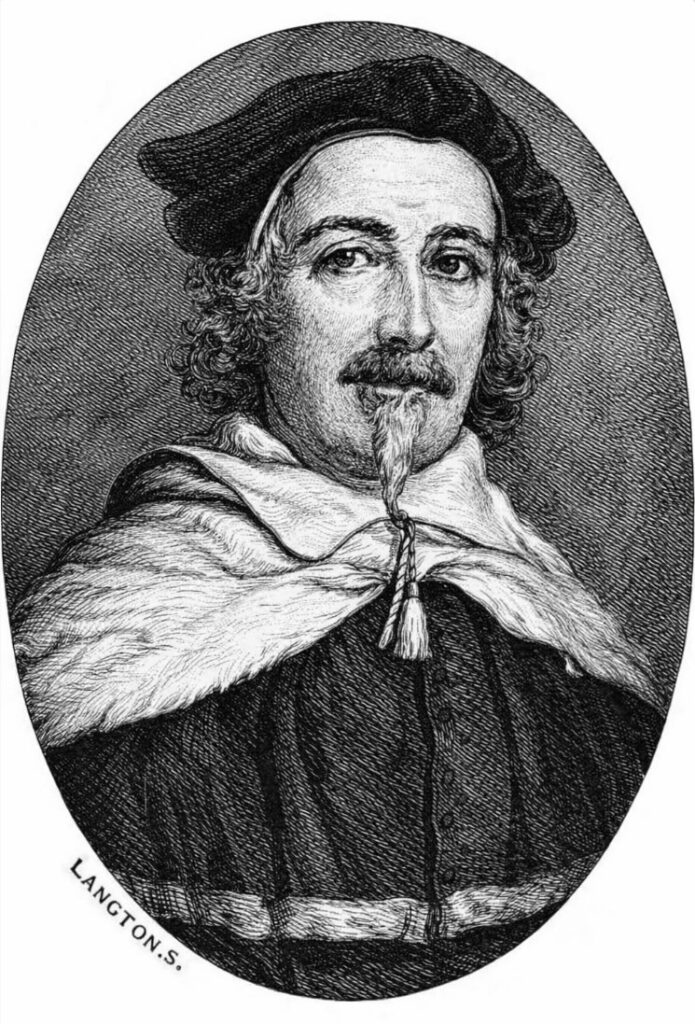
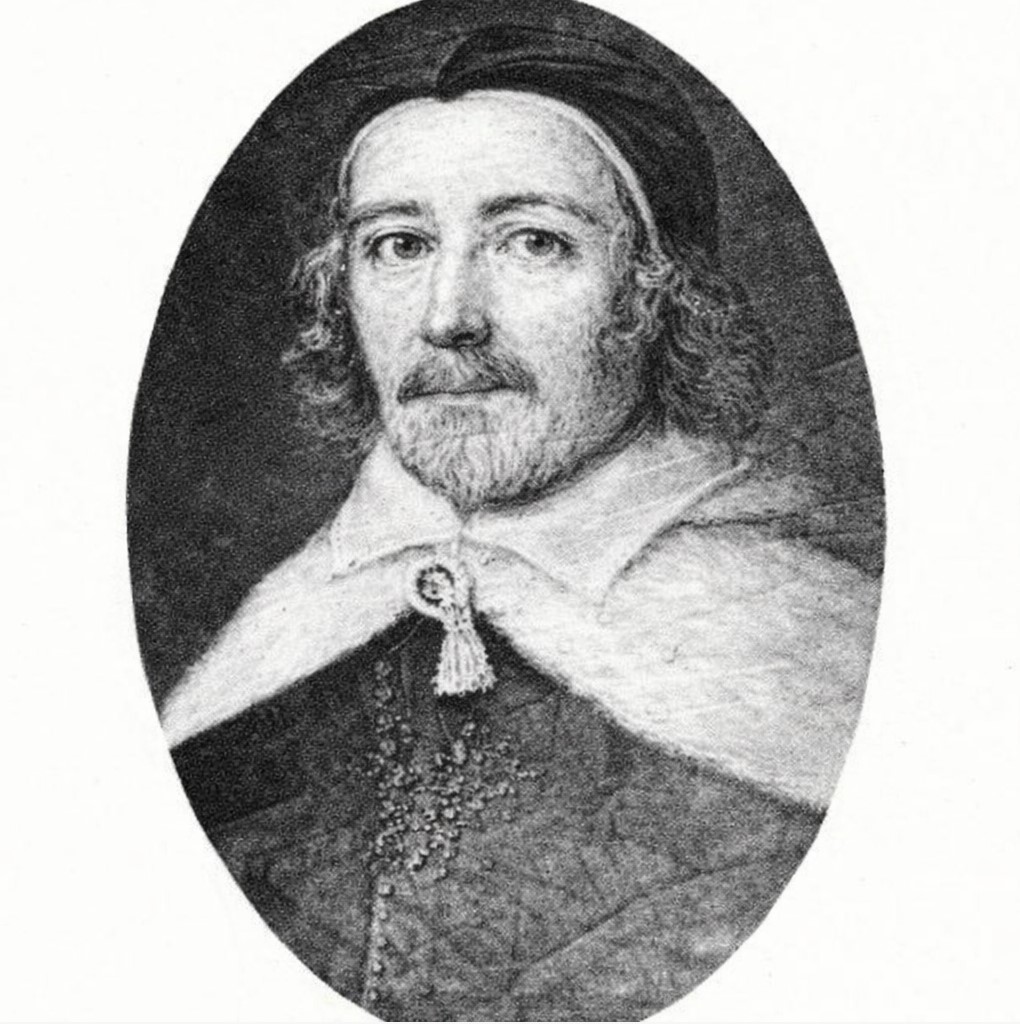
Amongst the legal promotions in 1649 Col. Rigby comes into notice. On 1 June the “merits and deserts” of Mr. Sergeant Bradshaw were ordered to be considered by the House. It was next resolved that the House approved of Peter Warburton, Esq., to be one of the Judges of the Court of Common Pleas; and of Alexander Rigby, Esq., to be one of the Barons of the Court of the Exchequer. Writs were then ordered to be issued for calling Warburton and Rigby to the dignity and degree of a serjeant-at-law; and an act was brought in for making the writs returnable immediately.((Whitelocke, Memorial, III. 43. The portrait to illustrate this article was undoubtedly made at this period of his career, as he is depicted in his judicial robes and wig, and by close inspection the cap may be seen. This is the only picture of any person connected with early Maine history known to be in existence.))
Henceforth the quondam colonel is called Baron Rigby, and the remaining events of his life are connected with his judicial duties. The Judges of Assize were then appointed by the Lords Commissioners of the Great Seal, who, in conjunction with the House of Commons, made at this time some necessary alterations. An Act was introduced 15 June, 1649, for enabling the judges that went on the northern circuit to hold an assize at Durham, in reference to which Baron Thorpe, who that year took the northern circuit, was ordered to consult with Baron Rigby how to continue the proceedings in the co. Palatine of Lancaster as formerly.((Journals, House of Commons, VI. 233.)) On 21 June another act was introduced for keeping a session or assize in the Castle of Lancaster on 7 September ensuing, and it seems likely that Rigby presided at this assize. Baron Rigby is returned in the Church Survey of 1650, as one of the impropriators of the tithes of Barton in Preston parish, and of Poulton. On 1 April he and Thorpe, as two barons of the Exchequer, were two of the Commissioners named in the act for establishing the High Court of Justice.((Council of State Proceedings, 73.))
Judge Rigby’s last appearance at an assize was in August, 1650, at Chelmsford in Essex, where a sermon was preached before him on Luke xvi. 2. Soon afterwards the judge fell sick, and the assizes were adjourned, promise being made to come back and finish them there after the Croydon Assizes were over. Rigby sat at the latter place, where his sickness so much increased, and where Judge Gates, his colleague, was also attacked in the like manner, as well as the High Sheriff of Surrey, that “all three were speedily conveyed away thence to London, where they all three died immediately after, even within a seven-nights space or thereabout, of a most violent pestilential fever; and very many more of their clerks, officers, and attendants on the said assizes died also at the same time, as was generally and most credibly informed and reported.”((This relation is taken from John Vicars’s Dagon Demolished: or, Twenty Admirable [Wonderful] Examples of God’s Severe Justice and Displeasure against the Subscribers of the late Engagement against our Lawful Sovereign King Charles the Second… published to reclaim such fanatique persons, who have been too forward to promote this Wicked Destructive Engagement, 4to, 1660. The writer adds that Rigby was “a most desperate enemy to the Presbyterians’ Church Discipline, as being a great Independent,” this being the cause of the Divine displeasure; and he also says that he himself knew “one Capt. Hindley, one of Judge Rigby’s chief clerks or officers, who died at the same time, immediately upon the very same time of these Judges’ deaths, a most remarkable and fearful example of God’s wrath upon engagers and sinful Complyers with workers of iniquity.” Fuller in his Church History, ed. Oxon., iv. 402, who discusses gaol fevers, confirms the extraordinary account of Vicars, when he relates that “a great depopulation happened” on this occasion.)) The date of Rigby’s death was 18 August, and Baron Gates died on the following day.((Peck, Desiderata Curiosa, II. (xiv), 532.)) Gates was interred at the Temple Church. Rigby’s remains were said to have lain in state at Ely Place, Holborn, and the interment took place at Preston, on the 9 September.((Fishwick, History of Goosnargh, 147.)) The Cavalier Blundell, like Vicars, noted the “Example” of the death of Judge Rigby, but it affected him in another respect. “There died in the compass of about one year, four of our chiefest Lancashire colonels of the Parliament party, viz., Ashton [Ralph of Middleton, died, says Dugdale, in February, 1650]; Dodding [George of Conishead, died in 1650]; More [John, M. P. for Liverpool, died in 1650]; and Rigby [died 18 August, 1650], of which the last was thought, as his nephew told me, to be certainly poisoned.”((Blundell, Cavalier’s Note Book, 29.)) Although Rigby made such a mark in the country, he seems to have been almost as obscure in Goosnargh as his residence was. No story and no memory of him has survived amongst a people, who are naturally fond of traditionary lore, and there are the descendants of many of Rigby’s contemporaries still inhabiting the locality. This is probably in Rigby’s favour, for
The evil that men do lives after them,
The good is oft interred with their bones;
and this would lose none of its force amongst a race of people who are prone to say much about “seed, breed, and generation.”
The authorities consulted in the preparation of this article include the following works:
- The Moore Rental, viii;
- Seacome, Memoirs of the House of Stanley;
- Foss, Judges, IV. 490;
- Visitation of Lancashire (1613), 65, and (1665), 145;
- The Civil War Tracts, passim;
- A Discourse of the Warr in Lancashire, passim;
- Notes and Queries, 4 S. viii. 247;
- Lancashire Lieutenancy, pp. 275–8;
- Fishwick’s Hist. of Goosnargh, pp. 140, seq., with a portrait, likewise engraved in The Reliquary, xi. 247, and in Croston’s Nooks and Corners of Lancashire and Cheshire, p. 333;
- Halley’s Nonconformity in Lancashire, vol. i. 308 seq. and passim; &c.
Other sources of information are mentioned passim, as above quoted. This biography is compiled from a sketch of Rigby’s life published in the Palatine Note Book by its editor, John Eglington Bailey, Esq., F.S.A., of Stretford, Manchester, England, to whom full credit is due for the collection of original material and procuring a copy of the miniature portrait at the head of this article.
Back to: Maine History & Genealogy Project
Source
Banks, Charles Edward, Colonel Alexander Rigby : a sketch of his career and connection with Maine as proprietor of the Plough patent and president of the province of Lygonia, (Repwrinted from the Maine Historical and Genealogical Recorder), Portland, Me. : Privately printed, 1885.
- Middleton Hall is a solitary farm in the township of Goosnargh, situate about seven to eight miles north of Preston, about three miles east of the Preston and Lancaster turnpike-road, and about a mile northwest from Goosnargh church. The history of this place is told in Fishwick’s Goosnargh, pp. 141 seq. The present hall is a most substantial structure of brick and stone, built probably about the end of the last or beginning of the present century. It is more pretentious than the ordinary farm-house of the neighborhood, but lacks that ornamentation of grounds which it deserves, and may at one time have possessed. The oldest part of the existing premises is the barn, which is a century or more older than the present house, and has the reputation of containing as many loop-holes for ventilation as there are days in the year, a spot very unlike the abode of an iron-heeled warrior, a prating politician, and a grabbing lawyer of the days of the Commonwealth. — Palatine Note Book, III, 198. [↩]
- His will, as Alex. Rigby de Wigan, is dated 11 April, 1621, and it was proved 26 April, 1632. The testator directs his body to be buried in the parish church of Wigan; and he leaves his son Alexander his heir. [↩]
- Funeral Certificates, 126. [↩]
- These two lawyers were likewise candidates for the same borough on the summoning of the Long Parliament. [↩]
- Sinclair, History of Wigan, i. 226. [↩]
- Gardiner, Fall of the Monarchy of Charles First, ii. 19. [↩]
- Rushworth, Collections, iii (i), 129. [↩]
- Harl. MSS. 813, 7,162; Lansd., 493; Lord Leconfield’s lib., VI. Rept. Hist. MSS., 306 b. It was twice printed in 1641 (4to, no place). [↩]
- Farington Papers, 75. [↩]
- Journals, House of Commons, ii. 495; Civil War Tracts, 2. [↩]
- Memoir of James, Earl of Derby, lxxiv. [↩]
- Journals, House of Commons, ii. 619. [↩]
- Journals, House of Commons, ii, 806. [↩]
- Husband, Collections, 13; Civil War Tracts, 90. [↩]
- Farington Papers, 96, 98, 99. [↩]
- Husband, Collections, 169. [↩]
- Ibid., 4, 5, 9. [↩]
- Robinson, Discourse of the Warr, 40. [↩]
- West’s Furness, 4to, pp. lii.–liii.; Civil War Tracts, 148–151; Baines’ History of Lancashire, new edition, i. 221. Whitelock (i. 226) says that “the feat was more discoursed about, because Rigby was a lawyer.” [↩]
- An indenture dated 9 Nov., 1641, relates to this marriage of Lucy Rigby and Robert Hesketh. The parties were Robert Hesketh of Holmes Wood, Esq., and Margaret (née Standish) his wife, and Robert Hesketh, son and heir-apparent of the said Robert Hesketh, on the first part; and Ralph Standish of Standish, Esq., Thomas Tyldesley of Myerscough, Esq., Alexander Rigby of Rigby, Esq., and Alexander Rigby, gentleman, son and heir-apparent of the said Alexander on the other part. The indenture witnessed that in consideration of a marriage to be had between the said Robert Hesketh the son, and Lucy Rigby, only daughter of the said Alexander Rigby, the father, and for £300 paid by the said Alexander Rigby the father to Thomas Hesketh of Rufford, Esq., and Jane (née Edmondson) his wife, and for £1000 paid by the said Alexander Rigby the father to the said Robert Hesketh the father, that the said Robert Hesketh the father and Robert the son agree that within eighteen months after the said Robert the son shall be twenty-one years of age, he shall by fine, &c., convey to the said Ralph Standish, Thomas Tyldesley, Alexander Rigby the father, and Alexander the son, all the manor of Rufforth, Markesime, Harwood, &c., &c., to the said Thomas Hesketh and his heirs.
Colonel Alexander Rigby About the same time great endeavours were made to make a jointure for Lucy Rigby, and the family were advised that it could not be done except by Act of Parliament. The elder Rigby endeavored therefore to obtain the Act, and brought a bill into Parliament for that purpose, but the death in 1646 of Thomas Hesketh before named, heir to the estate, put an end to the design; and not long after Col. Rigby himself died. The inheritance of the Rufford estate subsequently came to the children of Lucy Rigby, who afterwards married John Molineux, son and heir of Sir Francis Molineux, of Tevershall, near Mansfield, county Notts. In 1661, she, as Lucy Molineux, and her son Thomas Hesketh, infant, petitioned Charles II. for a writ to the judges at the next Lancaster assizes to permit a recovery of part of the estates of Thomas Hesketh, to be settled as jointure on Lucy Molineux, according to former indentures with her father, Alex. Rigby, but her husband died before completion of the same. The matter was referred to the attorney general, who reported in favor of the petition. [↩]
- Halley, Lancashire II. 503; comp., History of Garstang, 164. In 1643 Alexander Rigby de Burgh was named one of the committee for the punishment of scandalous clergymen in Lancashire (Husband, Collections, fo. p. 131); but there is little doubt that the parliamentary colonel is meant, as he is associated with his usual Lancashire colleagues; and the de Burgh Rigby, discharged from the Commission of the Peace 24 Oct., 1642, was a Royalist. Nicholas Rigby of the Harrock family was also on the same committee. Life of Berwick, p. 42; Walker’s Sufferings, i, 58; Notes and Queries, 1 S. ii. 253; Dugdale’s Short View, p. 577; Querela Cantab., p. 184. [↩]
- Robinson, Discourse of the Warr, 49. [↩]
- Ibid., 45. [↩]
- Fairfax Correspondence, III. 77. [↩]
- Ibid., III. 85. [↩]
- Blundell, Cavalier’s Note Book, 295. [↩]