
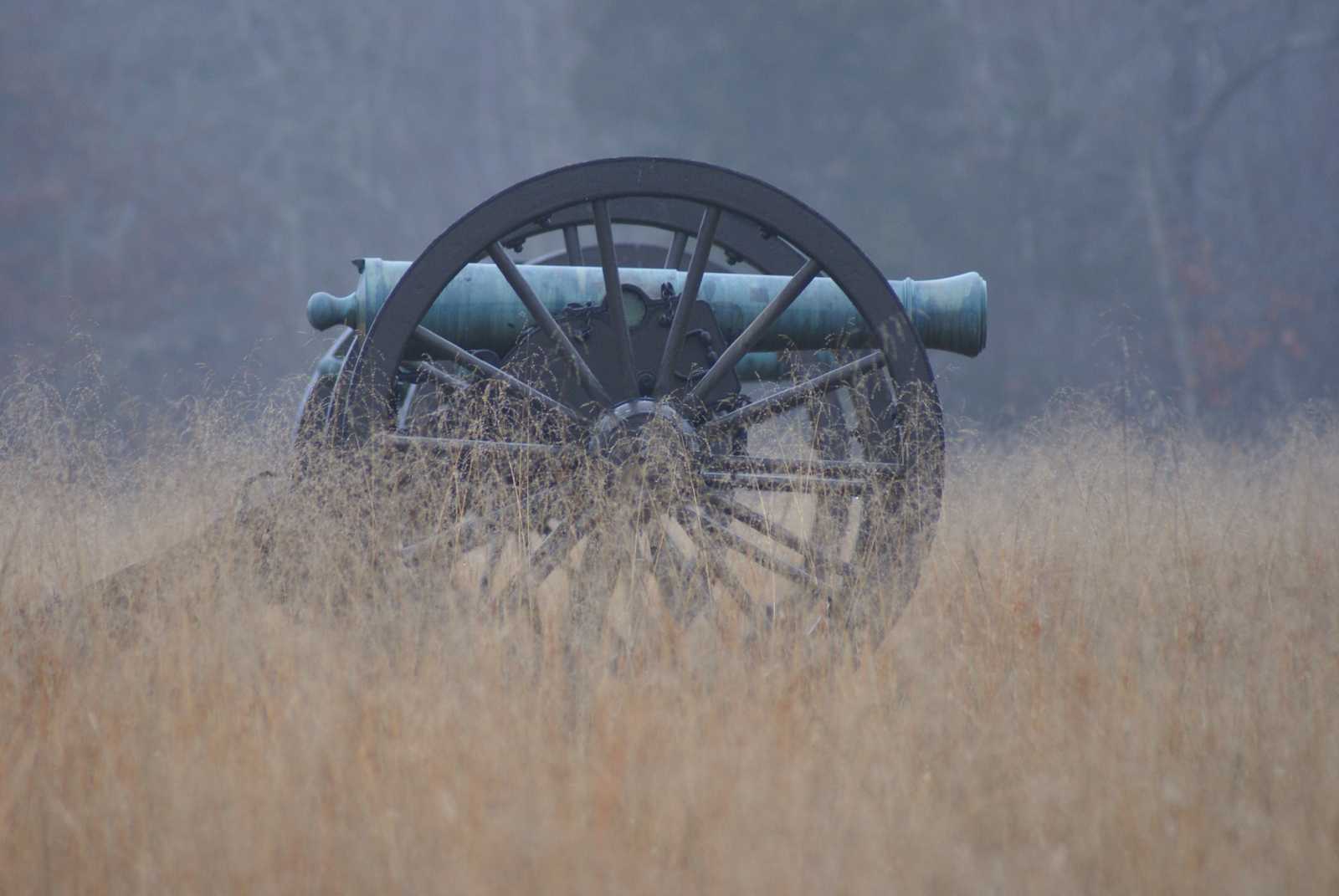
The War of the Rebellion, from 1861 to 1865, tried the patriotism and endurance of the people of Dearborn County more than any former sacrifice they had been called on to make. Its mutterings had been heard for several years, but had been little heeded. No preparation whatever had been made. Aside from those few who had seen service in the war with Mexico, not a man in the county knew the manual of arms or any of the duties of a soldier’s life. The indignation on account of the insistence of the erring and misled friends in the South grew until, when Ft. Sumter fell and Abraham Lincoln gave the call to arms, they came from every farm, hamlet, crossroads and town, in such numbers that it was impossible either to equip, feed or drill them. The first seventy-five thousand, called for the three-months service, was filled almost as soon as it was asked for and thousands more offered.
No one realized that it was to be more than four years ere the last man to resist the authority of the United States was to lay down his gun. None of the many offering their services thought that many of the sons of Dearborn County would go to the front, there to be laid low by disease or the bullet of the foe. The government, throughout the long struggle, again and again called for more troops, but every time the county responded promptly and heartily. Company after company was recruited as the war progressed, until in some localities there were scarcely enough able-bodied persons to carry on the affairs of life. Farm help was in demand. Those who stayed at home could get easily three dollars per day for their services in the harvest field. The days of the self-binder had not yet come and the work of harvesting the grain required more help than now. Even the “dropper” had not been introduced. The machines for cutting wheat were the old-fashioned cradle or, in a few places, a machine on which were a driver and a man behind to rake off the grain, the latter to be bound by the men following. Yet, Providence seemed to be with the Union. The crops were abundant; the harvest was cared for and at no time were provisions or supplies for the army scarce.
RESPONSE TO FIRST CALL TO ARMS
The first call for troops was for seventy-five thousand men for three months. So many were offered that a few of the more insistent of the overflow were organized and mustered in for one year. About the time of the Bull Run disaster, President Lincoln called for three hundred thousand for three years, or during the war. This call was filled promptly. Dearborn County sent out one company for the Eighteenth Regiment, Indiana Volunteer Infantry, one for the Twenty-sixth Regiment, two for the Seventh Regiment, two for the Thirty-second Regiment, one for the Thirty-fifth Regiment, one for the Thirty-seventh Regiment, one for the Forty-fifth Regiment, and one for the Fifty-second Regiment—ten companies in all. Besides these who went as a body, numerous of her young men enlisted in companies organizing in other counties.
In the summer of 1862, President Lincoln again issued a call for three hundred thousand men to serve for three years, or during the war, and again the country responded. Dearborn County, always patriotic and always ready to answer the call of her country for service, gave up her young men cheerfully. The reverses to our arms had brought the exultant enemy to the water’s edge on the Kentucky side of the Ohio River during August, 1862, and the Confederate soldiers could be found just across the river securing cattle, horses and other supplies much needed for their use. Their troopers could be heard at all hours of the night by the home-guard sentinels, who were vigilantly guarding the river front. It is said that at one period, for a month or more, the sentinels of the Union home guards constantly walked their beats from the Big Sandy River to Cairo. This condition of affairs encouraged enlistments. Men past the age for army service mounted their horses and assisted in urging the able-bodied and the young to enlist.
In a few weeks Dearborn County had recruited three companies for the Eighty-third Regiment and seventy-five other men who enlisted in the same regiment, in companies raised over the line in other counties, one company for the Fourth Cavalry and two for the Sixty-eighth Indiana. Later on, in 1864, two companies were raised for the hundred-days service, and two for the one-year service.
ONE THOUGHT WAS PARAMOUNT
At the first and second call to arms, in the first and second call for troops for three years, or during the war, in the summers of 1861 and 1862, the men paid no attention to either the conditions for which they enlisted or what would be their fate if wounded and discharged helpless. They only thought of the one fact: that the government was in danger and that it must be saved.
Later on, matters became reduced to more of a business proposition, and while none the less patriotic, yet the impulsive rush of indignation that the old flag should be assailed had cooled down to that of firm resolve. Some must stay at home to look after and care for the wives and children and to produce what was just as necessary as men at the front—supplies to feed the latter while battling for their country.
Dearborn County offered bounties to encourage enlistments; organized help was created to look after the wife and family of the man at the front; societies were organized to prepare needed articles for the boys on the battle line; the Sanitary Commission and the Christian Commission had its branches in every neighborhood, and the whole country, by the summer of 1864, had become an organized body to further the cause of the Union and to crush rebellion.
To bring to the people of the county of the present day some idea of the cost of the war to the county during the four years, aside from the loss of her young men, it may be stated that the county paid out for bounties to enlisted men during the struggle the sum of two hundred and ninety-five thousand three hundred and five dollars, and it paid out of the public funds for relief to the families of the soldiers the sum of ninety-three thousand three hundred and thirty-five dollars, besides an amount for miscellaneous requirements of seven thousand three hundred and seventy-five dollars, making a grand total of three hundred and ninety-six thousand and sixteen dollars for all demands.
Dearborn County has for its part in the great war an Honor Roll of one thousand nine hundred and forty-six men who were enlisted in the country’s service. Besides these, numbers went to other counties and enlisted, for which there can be no proper account given here.
EQUIPPING EARLY COMPANIES
The work of recruiting, equipping and preparing for the field so many men was heavy and took much of time and money. Indiana had no militia system, and people did not even know what officers were necessary for an organized company. The details of drill, discipline and equipment were unknown and unappreciated, because unknown.
In the pioneer days of Indiana a good militia system was in vogue. It was well organized and systematized into companies, regiments, brigades and divisions, with commands officered throughout, so that men could be rapidly mobilized and made ready for any emergency. But the Indian had gone to the West and, the menace of the red man no longer existing, people were lulled to the entertainment of a feeling of security not justified by existing conditions.
At the birth of statehood and for some fifteen years afterwards, even up to 1832, the route to much political preferment was through the titles obtained in the militia, and captains, colonels, majors, and even generals, were plentiful. This, however, ceased about 1832 to 1836, and men looked to other fields as a better route to preferment in politics. Hence, when the Civil War came on, the material was here, but it was in a state of nature and had to be constructed into a military machine. This took much labor and money. However, at no time during the struggle did the people of Dearborn County ever shrink from the outlay of either men, money or labor. Patriotic throughout, her citizens lived up to the reputation of their pioneer forefathers who had fought the battles of the Revolution and had conquered the red men and the wilderness.
THE SEVENTH REGIMENT
In the call for troops for the three-months service, Dearborn County responded and its men were assigned to the Seventh Regiment. Benjamin T. Spooner was appointed by Gov. Oliver P. Morton the lieutenant-colonel of the regiment, and David E. Sparks was made its quartermaster. Companies D, E and G were furnished by Dearborn County.
The officers of the three companies were as follows:
- Company D — John F. Cheek, captain; Jesse Armstrong, first lieutenant; Eli Mattock, second lieutenant.
- Company E — John H. Ferry, captain; Henry Waller, first lieutenant; Alexander B. Pattison, second lieutenant.
- Company G — Nathan Lord, captain; L. K. Stephens, first lieutenant; William Francis, second lieutenant.
Company D — Non-commissioned officers and privates:
First sergeant, Montgomery C. Howard; sergeants, James B. Dougherty, James McLeaster and Elsin B. Miller; corporals, Robert B. Huff, Liberty V. McLeaster, James F. Vaughn and Frank A. Epstein; musicians, Albert Kem and Jacob Orne.
Privates:
Minich Ahart, Daniel B. Allen, Charles Allen, Joseph Backert, John Bartholomew, Job Bench, James Boyd, Charles E. Brashear, John Breakey, Curry B. Brown, William Busch, Charles A. Burk, James Chapman, George W. Clermont, Ira D. Chamberlain, George B. Colt, David O. Crosby, Philip B. Crooker, William H. Daniels, Thomas J. Dawson, Charles Dougherty, James J. Foley, August Garnier, William Gabler, James Glardon, Cyrus S. Horton, William Howard, William H. Hudson, Abraham Junker, John Junker, Lewis T. Kern, James Keys, Eli M. Knapp, Cyrus L. Knapp, George W. Lambertson, Albert Lewis, Edward B. McAllister, Charles A. McCright, Charles M. McCright, John McClintock, William McGinnis, Jacob Meyer, John C. Miller, David L. Morris, Drury H. Nothern, Robert K. Purnell, Jacob Rief, James Reddens, Evan A. J. Sanders, Christian Seidel, Henry J. Seigfreid, Seth S. Simonson, Morgan Simonson, James Skelton, Christian Slonegar, Paul Truitt, George A. West, Henry White, Thomas Whiteford, Thomas Williams, Hiram S. Wiley, Charles J. G. Workhizer, William Young and Benjamin F. Worth.
Company E — Non-commissioned officers and privates:
First sergeant, Benjamin F. Burlingame; sergeants, Abner G. Withrow, George C. Watson and John W. Christy; corporals, Schuyler P. Shutts, Jesse B. Holman, William V. Hoover and Richard H. Foulk; musicians, George H. Durham and John S. Hope.
Privates:
James Abdon, George Anderson, George W. Angelo, John J. Bailey, Joseph Barnhart, Louis Beach, George Behrens, James Brown, James Bruner, James Burdite, Dudley H. Burlingame, Eleazer Cole, Jacob B. Cortant, Charles H. Cronley, George Daniels, John Denton, William H. Drake, Porter Durell, Edwin Ellis, Valentine Ewald, Harvey Fisk, Henry Fisk, Casper Flusch, Cyrus B. Goodwin, James N. Gould, Charles F. Gregory, John Hisey, Gastrous Hockstetter, James House, Archibald Johns, Levi B. Jones, George S. Johnson, Charles Kerchmer, Albert Kerr, William Kerr, Gottlieb Keiser, Charles Lacock, George W. Lowe, Wesley G. Markland, Charles B. Miller, Ernest Navel, James Nelson, Henry Niebaum, John Parker, James L. Passell, Richard Pattison, Henry Smitkin, William Shepperd, Henry C. Shepperd, Henry Shryer, Isaac W. Shutts, Henry J. Smith, Levi Smith, Theodore Sheldon, William Speer, Dunreith Stage, James C. Stewart, Washington Stockwell, Ebenezer D. Vincent, James Ward, William Wheeler, Henry Wheeler and Richmond Wymond.
Company G — Non-commissioned officers and privates:
First sergeant, Isaac D. Jones; sergeants, John Griffith, George Meyer and James M. Brashear; corporals, Solomon H. Hayes, Charles Bryant, John Low and John H. Wemke; musicians, George T. Harbold and Isaac Bolander.
Privates:
Joseph Ahart, Simeon Alfred, Frederick Amann, Michael Amos, Joseph Ashcraft, William Beggs, James Biddinger, Richard Bryant, Charles B. Burkam, James Callahan, James M. Christie, Charles G. Davis, Charles Degan, William H. Durant, Peter Emmert, Stephen Exceen, Frank Farrar, Edward Fasnacht, Charles Fasnacht, Lewis Hasbagh, Omar T. Hayes, Charles Hannesy, Christopher Hennings, Charles Hennings, Jack A. Hudson, Conrad Herzog, Edmond H. Kelso, John G. Kohlermann, Robert M. Kauffman, Daniel Leroy, Louis Lommell, Simeon D. Lowe, Henry F. Mason, Nicholas Miller, Thomas McBride, James H. McBride, Robert McBride, Myron McMullen, James McMullen, Charles Neff, Thomas Posey, Middleton Purnell, John Regairét, Michael Risner, John M. Robinson, William Ross, Frederick Schultz, Charles A. Simonton, John P. Smith, Peter C. Smith, George W. Smith, William Smith, Anthony W. Snyder, Benjamin Southard, Frank Shornhauser, John Stancombe, Thomas Sykes, Sebastian Tittel, Edward H. Taylor, John Vogel, Henry Williams, Charles Worth, Paul Weber and Mathews Weibel.
THE THREE-YEAR SERVICE
At the first call for three-year men, Dearborn County furnished two companies for the Seventh Regiment, the commissioned officers being as follows:
- Company A — David Lostutter, Jr., served as adjutant for a time and Benjamin F. Burlingame as quartermaster. The officers of Company A were: John H. Ferry, captain; Alexander B. Pattison, first lieutenant; and Benjamin F. Burlingame, second lieutenant.
- Company K — Jesse Armstrong, captain; Homer Chisman, first lieutenant; and James F. Vaughn, second lieutenant.
Company A — Non-commissioned officers and privates:
George C. Watson, first sergeant; sergeants, James C. Stuart, William Wheeler, Albert Kerr, and Richard H. Foulk; corporals, Palmer Chisman, Thomas Hess, James Wheeler, Austin Robertson, Ernest Noebel, Henry Fisk, Harry Fisk, and James Abbott; musicians, William H. Nelson and John Miller; wagoner, Daniel H. McMullen.
Privates:
John Anderson, Clarence Ball, Mitchell Bernard, Joshua Blackburn, Richard Block, James Brewington, Ellis Brown, William Buffington, William Burke, George W. Canfield, Robert Chancem, John Christy, William Clark, Joshua Clements, George Columbia, Samuel Cole, Jacob B. Coutant, John A. Ceigher, John Cure, George Curtis, Samuel Davis, James Davis, Lewis B. Day, William Edwards, Marion Elwell, Samuel Gillison, Ezra Gillingham, Henry Glismar, Warren Goodrich, Cyrus C. Guysinger, Thomas Holcomb, James Hundley, Asa B. Hubbartt, James Hubbartt, John N. Hubbard, George H. Husserman, William Tuman, Alfred James, John Ketcham, Sylvester Knapp, James Loundsberry, Charles Liebhart, William Luke, Martin Matting, William Marsh, Henry E. Miller, Levi Miller, Patrick Murphy, Clinton McAdams, Michael McGee, Fernando C. Nichols, Henry Pieper, Henry Pottebaum, William Ramsey, Lemuel Record, James Richardson, Oron Richardson, John Richards, Christian Schlereth, Mahlon Shaw, John Skelton, Henry J. Smith, Andrew H. Smith, James Stansfield, Gillette Stevenson, Enos Suits, Austin Sweet, Joseph Thompson, William Vincent, John Walker, Michael Whalen, John White, William White, John Whiteaker, Jesse Whiteaker, William Windsor, Benjamin Windsor, James B. Wills, Jehiel Williams and Oliver Worley.
Recruits:
William Armstrong, William Baker, Alzimo Buck, William Chamberlain, Charles Cole, Bonaparte Ewan, John D. Holcombe, John Little, Harvey Piatt, Jesse Stage and Henry Wheeler.
Company K — Non-commissioned officers and privates:
First sergeant, Peter Galen; sergeants, Seth S. Simonson, James Chapman, Thomas Williams, and Paul Truitt; corporals, George W. Lambertson, Volney McLeaster, Philip E. Crooker, James M. Boyd, Andrew J. Connelly, Daniel Allen, George W. Harding, and James Murray; musicians, Henry Pruitt and Minich Ahart; wagoner, James Skelton.
Privates:
William G. Abbott, Joseph Ahart, Hugh Alexander, Chris Y. C. Alden, Francis M. Brown, Jacob Bump, Henry Bull, William O. Butler, William W. Campbell, James Coleman, Isaac Crontz, John Crozier, Levi Culver, Jonathan Curtis, William B. DeHart, Henry Dennis, Alonzo Dixon, Asa C. Emerson, William W. Fitzgerald, Frank Funerheide, George W. Furgason, Thomas Godfrey, Isaac L. Goble, Thomas Grogan, Michael Gleason, John H. Groff, Philip B. Grubbs, James Hamilton, Jesse Harper, Theodore Halberstadt, Martin Hines, William Howard, John F. Isentrager, John M. James, John Westfall Johnson, Charles Jones, Mack Joseph, Abraham Junker, Andrew Kunkel, James Lambertson, David Lawrence, Merit Leming, Benjamin Marshall, George Marquett, William Merrill, Fletcher Meredith, John C. Miller, Nicholas Minich, Joseph Mitchell, John Myers, James McBride, Robert McBride, Charles A. McCright, Peter J. Newman, George W. Nevitt, Frank R. New, Jacob Orn, Aaron Osborn, Albert Parsons, Thomas Peak, Sidney Pile, John W. Pine, John Roark, William Ripking, James Robinson, John Roberts, James Ross, John Russell, Frederick Schultz, Christian Slonegar, James M. Smith, John Smith, George Smith, William Snyder, Leonidas Sowders, Robert Stack, William Standriff, John Tracy, John H. Weaver, Patrick Welsh and William Williams.
Recruits:
Jonathan P. Alden, John Chapman, Joseph Felix, John Gladwish, Vechel Hobbs, Peter Miller, Peter Parsons, David Rapp, Orland Stuart, Lewis Stone, Edward Taylor, Jacob Weber, Elliott Wainscott, John Brown, Harry Roberts, Charles A. Shepard and John Sturdeman.
The Seventh Regiment served in the Army of the Potomac during the whole period of its service. It was in every campaign that that army undertook, and suffered heavy losses, both from disease and battle.
- Company K, from this county, lost eight men killed outright in battle; seven wounded; four died from disease; and sixteen were discharged for disability.
- Company A lost nine killed in battle; had sixteen wounded; and twenty were discharged for disability, the company mustering out forty-six men at the end of the service.
- Company K mustered out forty-eight men at the end of the service.
THE SIXTEENTH INDIANA
The Sixteenth Indiana Regiment was mustered in for one year, April 23, 1861. It was made up from the overflow of men offered for the three-months service, along with five other regiments for a similar term of service—the Twelfth, Thirteenth, Fourteenth, Fifteenth and Seventeenth. In the one-year service, Thomas J. Lucas was commissioned the regiment’s lieutenant-colonel, and Edward Jones, of Aurora, its chaplain. Two of its companies were recruited in Dearborn County, Company G and Company I.
The officers of Company G were:
Albert G. Dennis, captain; William J. Fitch, first lieutenant; and Philip Dexheimer, second lieutenant.
Company I had the following officers:
John A. Platter, captain; William Copeland, first lieutenant; and Israel Phalin, second lieutenant.
Company G — Non-commissioned officers and privates:
First sergeant, Peter F. Glardon; sergeants, John Lemuel, George W. Robinson, Henry H. Robertson, and Thomas Clinton; corporals, Lewis B. Rounds, Henry J. March, John T. Pruett, and Henry Geisert; musician, Samuel Plummer.
Privates:
Amos G. Barrett, Thomas E. Blaisdel, Nicholas Brownagel, Virgil D. Bridges, Hiram Crist, John B. Erwin, Peter Fisher, Alfred Fisher, Charles Fisher, John Fitzpatrick, Peter Froyn, Habom Garrison, James N. Gregory, John Haas, John Hingstler, Jacob Howser, Lawrence Krieg, William Knapp, William Kress, Joseph Lansing, John Metzler, Rudolph Meyer, George Miller, John Miller, Thomas Murray, Patrick McCullough, John McGraw, John Oldenback, Jacob Orth, Jacob Obert, Peter B. Parsons, Robert Patterson, Henry Peppenhouse, Moses Preston, Joseph Posey, Michael Roth, Hezekiah K. Rounds, Henry Rosenbush, Solomon Scott, John Skelton, Joseph Sell, John Sullivan, George Sullivan, William Samitz, Charles Wells, Adam Whipple, Franklin Wright, and Steward Wilson.
Recruits:
John Burkhart, Enoch Blaisdel, James Bridges, Daniel Castorm, John Curtin, Jenkins Davis, Martin Doughty, William Hayman, George W. Hollis, Joseph Lemuel, Jesse Lee, John T. May, John A. Merrill, Benjamin Morgan, Hiram McCarty, Benjamin McCoy, Thomas Robinson, William Robinson, John Rodgers, and Amos Robinson.
Company I — Non-commissioned officers and privates:
First sergeant, Edward H. Green; sergeants, Curtis K. Enrie, James Stevenson, Charles C. McCreary, and Allen W. Lewis; corporals, William R. Milburn, Robert J. Bennett, John H. Thompson, Zarah Teany, Daniel Holbrook, James M. Davis, Edwin T. Gipson, and Benjamin F. Richards; musicians, James H. Bailey and Joseph L. Stilwell.
Privates:
Francis M. Abbott, Enoch Abbott, William H. Barker, Byron Brier, William H. Barnett, Joseph W. Britton, Mathew Burris, Franklin Burris, Asaph Buck, Algemore Buck, Manard Bell, Henry J. Boatman, Charles M. Bailey, William H. Connell, Wilford A. Connell, Joshua Conn, James H. Childers, William Chamberlain, David Criswell, George W. Cain, Jacob Deffner, George H. Davis, Michael Dunfrey, William B. Daniel, John H. Durbin, Christian Haller, George W. Harvey, Henderson Huffman, William H. H. Isgrigg, Allison Johnson, George Leslie, Mollika Loftus, William Loftus, William H. Masury, Reuben L. McConnell, Manius McDermott, Joseph T. Plummer, John Quinn, Elliott W. Rozell, Lemuel Smith, James R. Smith, Michael Skaal, Joseph Supernaut, Jesse Stage, James Stokes, Abram Seay, William H. Taylor, Albert E. Trester, Andrew J. Thornton, Patrick Tool, Varnal D. Trulock, Isaac M. Thompson, Edwin Woodward, David White, John Ward, Robert Walsh, Edmond Yocum.
Recruits:
Blythe W. Buffington, William Commons, William H. Conn, William V. Enos, Henry C. Hutchinson, William B. Huffman, John Q. Kelso, Peter F. Norris, Thomas D. Powell, Calvin D. Stodghill, Charles W. Ward, and John Vincent.
REORGANIZED FOR THREE YEARS
The Sixteenth, in the one-year service, served with the Army of the Potomac and took part in only one engagement, that of Ball’s Bluff, Virginia, where it was involved in a slight skirmish. After its return home and muster out, the regiment was reorganized and recruited for three years. Thomas J. Lucas was appointed colonel by Governor Morton; Benjamin F. Gatch, of Dillsboro, chaplain; and James D. Gatch, of Dillsboro, assistant surgeon.
The regiment had one company from Dearborn County, which was designated as Company E.
When the company was filled, the officers were:
William H. Terrell, of Manchester, captain; James Stevenson, of Aurora, first lieutenant; and William H. Jordan, of Manchester, second lieutenant.
Company E — Non-commissioned officers and privates:
First sergeant, Charles B. Miller; sergeants, John Simms, Lewis Van Wedding, William H. Barker, and John H. Whiteford; corporals, William W. Jennings, Theodora Cross, John Anderson, and Robert C. Williams; musicians, Oliver D. Piatt and Thomas F. Duncan.
Privates:
George Anna, John Bolley, David H. Bishop, David Barrows, Levi Brown, Charles W. Bennett, William Britz, Robert Beggs, Alexander Campbell, Patrick Carty, Henry Cortez, John Courtney, John Cunningham, George Defenbaugh, Frederick Dixon, Frederick Daymon, John Eikler, James Erkskine, William Felick, Thomas Fisher, Christian Gabler, Joseph H. Graham, George Gutzwiller, Jonathan H. Hutchins, Joseph Huber, Samuel Kittle, Edmund A. Kastner, William H. Lowes, Jacob Lament, William Lows, Francis M. Long, Andrew J. Larrison, Oliver Larrison, Philip Lantz, Claiborne H. Morris, Mahlon H. Morton, William Morton, Henry Morton, Lorenzo Manlief, Robert Manlief, John W. Manlief, Samuel McMullen, Robert McMullen, Daniel H. McMullen, Luther Mason, Frank Moll, George W. Mendell, Peter Mudica, John G. Miller, Henry Mintzman, Valentine Nead, John Oatman, Purdy Piatt, Lewis M. Piatt, Henry Palmer, James A. Parsons, Robert E. Russell, Joseph Russell, Jeptha K. Ruble, William W. Runyan, George W. Roesch, William Shafer, George W. Sawdon, Henry Sillett, Thomas Shanks, John F. Todd, William Tibby, Reuben H. Terrell, Joseph Weaver, John Weaver, Jeremiah Weller, Philip Weller, George W. B. Wertz, Joseph H. Wise, Talma Wilcox, Americus Walser, Perry Witson, and Frederick M. Zeh.
Recruits:
John Barrows, Edward Byron, Charles Bohlans, John M. Clark, Robert M. Clark, William Cline, Daniel Callahan, Maston Dashiel, William Eikler, Johnson J. Fiddick, Daniel B. Guernsey, Edward Holmes, Thomas J. Huffman, John Healus, Harmon Hilshir, Joseph Hilshir, Thomas Healy, George Morris, John Mills, Elymas S. Prall, James M. Ruble, James R. Sousley, Omar T. Tibbetts, William Wilson, Thomas E. Wallace, and Joseph T. Waters.
Besides these men there were twenty-three unassigned recruits from Dearborn County who were sent to the regiment, but were soon mustered out before being assigned to any company.
The Sixteenth Indiana, after being recruited for three years, saw much service. It took part in the battle of Richmond, Kentucky, in less than a month after it was mustered, losing nearly two hundred men killed and wounded. The company from Dearborn County was recruited mostly from Manchester and Dillsboro and it lost, by being killed in battle, six men. It had nine wounded and twenty-one who died on account of wounds or disease.
THE EIGHTEENTH INDIANA
The Eighteenth Regiment, Indiana Volunteer Infantry, was one of the first to organize under President Lincoln’s three-year call in 1861. Its colonel was Thomas Pattison, of Aurora, and Henry D. Washburn, of Newport, Indiana, was its first lieutenant-colonel, but Jesse L. Holman was afterwards promoted to that position. Andrew P. Daughters, of Moores Hill, was its surgeon at one time, and Peter M. Bigney, assistant surgeon.
The company from Dearborn county was raised about Aurora and Moores Hill, and the officers, when mustered into the service, were: James L. Holman, captain; Andrew P. Daughters, first lieutenant, and Robert G. Cunningham, second lieutenant. The non-commissioned officers and privates were: Judson B. Tyler, first sergeant; Sanford G. Given, Robert R. Pattison, George W. Brown and George B. Bruce, sergeants; George Bailey, Alfred C. Brumblay, Benjamin Draper and Michael Tearney, corporals; James Huffman and David H. Frazier, musicians, and Jacob Bedenger, wagoner. The privates were: Edward Abbott, David C. Alfred, Thomas J. Bailey, Omer T. Bailey, James Barkley, John Bailey, Hugh Barkley, Lawren F. Bailey, William M. Berry, Andrew Beinkamp, Freeman J. Bell, Ephraim J. Brunson, James Burns, Andrew J. Burlingame, George Brownack, James Byard, Sandford Carbaugh, George Carbaugh, Laban H. Cox, Thomas Cunningham, David Daniels, Henry J. Daughters, William DeSaune, George Degant, William Darby, James Dewitt, John Davis, Joseph Emberger, Philip Frank, Jacob Garth, Martin Garrity, Thomas Garrity, Thomas Gavin, Thomas C. Gillis, Ephraim Gooderson, John Graves, Albert Harding, David Harding, John M. Haught, John F. Hankins, Henry Hephentine, Oscar Henry, John Henderson, James B. Hunt, Aaron Hunter, Joseph Hill, Charles Keiser, William Kelley, Andrew Kemph, Samuel Knapp, John N. Lee, William Little, Adam C. Loder, Thomas J. Lowe, Daniel Maple, Nicholas Miller, Martin Mitchell, James Moore, Otho W. Moore, Robert W. Pendergrast, Robert Ramsey, Jackson A. Reed, Benjamin Roberts, James T. Robinson, James Schofield, John Sell, Harrison Smith, Norval G. Sparks, Frank Staker, William Stanton, Van Buren Straight, John C. Swift, Jesse L. Summers, James Thompson, William W. Thornton, Michael Trapp, Levi Wainscott, John R. Walser, James Wirts, Judson Williams, Lewis Winkley and George T. Wright; recruits, Elias Bridgewater, Benjamin Cobb, William Farley, Adolphus Mark, George Patterson, William Richards, Leonard Rigsby, Noah Tryon, William White and John P. Worley.
The Eighteenth Regiment was sent to Missouri as soon as mustered in and saw service west of the Mississippi and at Vicksburg and on Red river. In the autumn of 1864 it was transferred to the Shenandoah valley, where it took part in Sheridan’s campaigns up that valley. Company A, which was furnished by Dearborn county, lost five men by battle and seven mustered out for disability.
THE TWENTY-SIXTH INDIANA
The Twenty-sixth Regiment, Indiana Volunteer Infantry, was recruited in August, 1861, and Dearborn county furnished one of its regimental officers, in the person of Samuel R. Adams, president of Moores Hill College, as its chaplain, who gave up his life for his country, dying on December 19, 1862, in the service. Company K was recruited mostly about Manchester and Aurora. Alden H. Jumper, of Manchester, was its captain when it was mustered into the service; Abram Hill its first lieutenant, and Nathan W. Manning its second lieutenant. The non-commissioned officers and privates were: Thomas L. Hayman, first sergeant; Warren W. Morris, James Rodder, Thomas Whiteford and Thomas Elwell, sergeants; William H. Colsher, Robert Buchanan, Wilson H. Thompson and Attila L. Harding, corporals. The privates were: Peter Southard, Elisha Frazier, Charles B. McCoy, Hugh B. McMullen, promoted to corporals; Sylvanus A. Palmer and Edward B. Tibbetts, musicians; Oliver McCoy, wagoner; Charles S. Allemong, William H. Allen, Charles Allen, Mathias Buckle, Silas Barton, William H. Barton, Charles Bennett, Benjamin Bennett, Warren Bennett, James Burke, Joseph Baxter, William Beggs, Henry Chaisell, Seth Conner, Benjamin C. Colsher, Jacob W. Crosby, George W. Crawford, Charles E. Carr, Lewis Disbro, John W. Durkee, Peter Downey, Christopher Eighthart, William Engleking, Joseph Frazier, Jacob Firestone, John W. Givan, Charles Granger, John Grubbs, William Hicks, Christian J. Horeman, William J. Harding, David Harding, Thomas B. House, Jacob Hendrickson, Christian Holdendick, John W. Hamlin, Philip Hirsch, Conrad Hoosock, Jacob Ham, George W. Johnson, James W. Johnson, John Kyle, William J. Kennet, William Lange, Alexander Manlief, George W. McMullen, John W. McMullen, John S. McMullen, Ignotz Mosar, Owen McDonald, John A. Maxwell, Christopher Need, Lewis Noyes, Charles D. Noyes, Charles Neimeier, Jacob Palmer, William Piatt, William Posey, Joseph Posey, John W. Ross, Isaac Robbins, William Riggs, Christopher C. Ruble, John Rowin, Thomas Strong, Gilbert Smith, William Senior, Washington Sowers, George Spicknall, Levi Stevens, David Sloan, John Thompson, William H. Tulley, Richard Tenney, Valentine Volz, John Vogel, Anthony Walters, Charles Whitsel, George Wood, George Wayner, John Whiteford and Mathew Whiteford; recruits, William B. Anderson, William D. Alexander, Amos Anderson, Robert Bennett, William Bannister, William Burk, George M. Brooks, Edwin J. Clark, Erastus Ewing, John R. Edwards, Perry Elzy, Van Buren Ferris, Andrew J. Fleming, Hugh G. Glancy, Alonzo Graham, John Greek, Thomas Golding, Samuel Hupp, Joel Hunter, Thomas T. Hearse, William Hill, John W. Hughes, Christopher John, Leonard Johnson, Daniel A. Johnson, Benjamin S. Jumper, Jonas Kline, Peter Lacey, Daniel Leroy, Israel N. Morris, Daniel McPherson, Amos G. Morris, William Moody, Samuel S. Mitchell, Louis Nail, Thomas J. Oldham, Van Buren Phares, William Rolph, John Russ, Dayton Shannon, John Schubert, Rufus N. Stilwelt, Benjamin Sutton, John Stemler, John L. Stough, William Tommy, Richard E. Turner, Samuel Vesser, Henry White, James H. Walker, Francis M. Whittaker, Michael Wertsbarger and Casper Zulley.
Company K lost eight men killed in battle or died from their wounds; lost by disease, twenty-three, and there were discharged for disability and wounds, fifteen. The regiment saw much service on the western frontier in Missouri and Arkansas. Several lost their lives in prison at Tyler, Texas. Of the one hundred and fifty-three or more officers and men who went out in 1861 there were only thirty-eight mustered out on January 15, 1866. The regiment was mustered into the service on August 30, 1861, and those who veteranized were mustered out on January 15, 1866, serving longer, perhaps, than any other regiment in the service.
THE THIRTY-SECOND INDIANA
The Thirty-second Regiment, Indiana Volunteer Infantry, recruited in September, 1861, was called a German regiment on account of the fact that the officers and most of the privates were of German descent. Dearborn county furnished most of two companies for the regiment. Company C had for its captain, John L. Geigoldt, of Aurora; Max Sachs, first lieutenant, and Henry Bellman, second lieutenant. Company D had John Schwartz, of Lawrenceburg, for captain; Frank Knorr, first lieutenant, and Emanuel Eller, second lieutenant.
The non-commissioned officers and men of Company C were as follow: First sergeant, Charles Schulz; sergeants, Simon Peter, Frederick Gillett, August Schulz and George Hause; corporals, Henry Eisenbeis, Adam Mathias, Gustav Hochstetter and Charles Kretschmar; musicians, John Wenzel and Theodore Wittich; wagoner, Ernest Stelzner; privates, Gottlieb Weigle, Charles Miller, Ernest Goedike, F. R. Caden, John Adam, George Anderson, Moritz Anderson, August Bloom, Herman Braun, John Bleistein, Casper Bischoff, Louis Bietsch, Peter Buttner, Michael Boehin, August Defloe, Louis Ellerbruch, John Frey, John M. Fisher, Adam Fellenzer, Polycarp Guthermuth, Martin Goldschmidt, Joseph Grogg, Anton Grabhorn, Louis Gresholz, Henry Holtegel, Adam Heller, Frederick Habedank, Christian Kastner, William Kuepferle, Charles Knab, Henry Kunzil, Henry Kuhn, George Knoll, Frederick Koch, Louis Leonhardt, Henry Lohse, Gerhard Martin, Herman Milgers, Michael Miller, Henry Meyer, Henry Niebrugge, Charles P. Obendorf, Peter Oeth, Christian Petscher, Frederick Pepper, John Richter, Theodore Seldan, John Schroedoer, August Spaeth, Charles Staerker, Christian Scherger, Lorenz Scherger, Frederick Schumacher, Henry Schmiedel, Peter Schwamp, John Schwamber, Henry Schoppmeyer, Pius Schall, Louis Schuttendube, George Schmit, Frederick Siemer, Anton Schoenig, August Thomas, Louis Trebna, Charles Thum, John Unger, Henry Wunderlich, William Weber, Charles Walter, August Walters, Philip Wenzel, Richard Wehe and John Zink; recruits, Christian Aehle, William Ackerman, John Beer, August Baumeir, Charles Bulkhardt, Charles Brauchle, Herman Cohn, John Cripz, August Duttenhausen, William Degg, Charles Draeger, Henry Debbe, George David, Lonhardt Elsfelder, Mathias Enler, Jacob Erhard, David Fischer, John Fiehe, John Giebel, John Goray, Henry Grove, Joseph Gruber, John Gerlach, Charles Haak, Charles Hahn, Frederick Hettenbach, Henry Hausfeld, William Krieger, Frederick Kepler, Christian Lippert, John N. Long, John Miller, Royal Martin, Gustave D. Rinke, John Reuss, Samuel Spring, William Schmidt, Simon Schneider, Bernhardt Schmidt, Christian Sanders, John Stamper, Herman Saenger, John Schmier, Louis Vierling and Albert Wipp.
Company D had for its non-commissioned officers and privates: Henry J. Seifert, first sergeant; Valentine Koehler, Sebastian Tittel, John Becker and Nicholas Mueller, sergeants; Erhard Seidel, John H. Warnke, Charles Fasnacht, Martin Steinhilber, George Deuschle, Louis Jung, Mathias Fritsch and Henry Stahl, corporals; Edward Fasnacht and Peter Zwickel, musicians; Andreas Barthoolomoe, wagoner; privates, Adam Bauer, Adam Bauereiss, Joseph Betzer, Balthazar Binder, Michael Buetter, Charles Bulk, Charles Degen, Frederick Dorn, William Elker, John Elmer, John Faber, Christian H. Feuss, Henry Fischer, Jacob Foschag, Joseph Gardner, Frederick Goebler, William Goebler, Jacob Grojh, Joseph Gutzwiller, Frederick Harung, Peter Henks, Christian Hennings, John F. Hotz, Joseph Huber, William Huber, John L. Huber, William Huelpuesch, Otto Hunt, Dominic Ingenthron, Jacob Ingenthron, Frederick Jung, Frederick Just, Michael Kautz, John C. Keitel, Martin Kirsch, John Knoebel, William Koop, Charles Krell, Frank Lang, Albert Maus, George Meister, George Opp, Adam Petscher, John Pining, John G. Probst, John Renner, Joseph Resch, William Rettemeier, Charles Reidel, Casper Reidel, John Riegelroth, Michael Roeffner, Conrad Sanders, Henry Sandrock, Michael Schaeffer, Adam Schmidt, George Schmidt, John A. Schmist, William Schneider, Frank Schoenhauser, John C. Schrey, Michael Schech, Gustav Schwarzwelder, Constantine Schweizer, August Stemmler, Michael Stemmler, John H. Steuer, William Stigelmeier, George Sturm, Michael Sturm, Henry H. Toerner, Christian Unternainer, George Vesenmeier, Martin Vogel, Christian Weber, Adam Weiss, John Wemp, Abraham Weinacht, Gustav Wehrling, John A. Willers, Philip Wuest and Herman Ziegelmeier; recruits, Charles Buehler, John Berendes, William Conrad, Jacob Hildebrand, John Hengstler, Jacob Hauer, Joseph Heiser, Edward Hecker, William Hofswehlie, William Joergensmeier, Valentine Kirsch, John C. Kuhn, Louis L. Lain, Charles Laush, Jacob Lay, Philip Meader, Wilhelm Pierre, William Rose, Frederick Rinnicker, August Schaeffer, Fleming Smith, William Shiermeyer, James Wilson, Rudolph Weitzel, Jacob Zushann and Peter Zwickel.
The Thirty-second Indiana served in the Army of the Cumberland, taking part in the battles of Pittsburg Landing, Perryville, Stone’s River, Chickamauga, Missionary Ridge and the Atlanta campaign. Company C lost thirteen men killed in battle; five died from disease and fourteen were discharged, during their term of service, for disability. Company D lost seventeen men, either killed in battle or died from wounds received in battle shortly afterward. It had twelve men discharged for disabilities incurred in the service.
THE THIRTY-FIFTH INDIANA
The Thirty-fifth Regiment, Indiana Volunteer Infantry, was called the Irish regiment. Several of the companies in the regiment were made up of men of Irish birth, but the one recruited in Dearborn county, Company F, was not dominantly Irish.
Company F, of the Thirty-fifth Regiment, was officered as follow: Captain, Jonathan H. Green; first lieutenant, Abram F. Farrar; second lieutenant, James M. Brashear. The company was for the larger part raised in Lawrenceburg and out along the Manchester pike. Besides the one company, George H. Dunn was first lieutenant of Company H; George Bennett, second lieutenant of the same company, and Albert Tower was, later in the service, captain of Company K. The non-commissioned officers and privates of Company F were as follow: First sergeant, John M. Palmer; sergeants, John C. Hibbetts, Edwin Bowlin, John Bartholomew and James Keys; corporals, James Parker, Andrew J. Briddle, Edward J. McChester, Abram W. Watson, Santford Burton, George W. Barkdol, Marion L. Howerton and Nathaniel Wood; musicians, Thomas J. Palmer and Benjamin Holden; privates, Jacob Bonewitz, John Aukerman, George W. Bolin, John Brown, Stephen Bolin, John Bonewitz, George Bennett, William Blood, John Collier, Hugh Choat, Alvin Choat, Rolans S. Carpenter, David H. Clark, William Carbaugh, Regan W. DeHart, William M. Emerson, Gotthert Evenberger, Augustus D. Fairbanks, John T. Flora, John Farlow, Thomas Freeman, Franklin Freeman, John Goldsmith, John T. Hubert, Thomas B. Hamson, Aaron B. Henry, Edward D. Hulbert, Edward T. Hulbert, Jacob Haines, James B. Hibbetts, Martin Hill, Montgomery Kastetter, Aaron Kroft, Ebenezer Knox, Michael King, William B. Laird, John W. Low, L. David Morgan, Andrew J. Morgan, James W. Mefford, Benjamin McCutcheon, Thomas Morton, Samuel Mounts, William Martin, William Mock, Joseph P. Noftzger, Jacob Nagle, James Phinney, Samson Parker, Harley Parker, James P. Parsons, Henry P. Parsons, Harvey Richardson, William Smith, William Stoneking, George W. Shilt, John J. Sperlit, Aaron Schaeffer, Thomas B. Tanner, Albert Tower and John Wagner. Recruits were sent to the company as follow: Henry Appman, Martin Addleman, Charles W. Bennett, George Brown, August Burgsturf, Henry Bloom, Isaac Bennett, Greenville Boston, Clark Boyer, Henry Busche, Hermann Bulker, Robert Crozier, John Collier, George Collier, Merritt Dorsey, Lafayette Doe, John F. Dittman, James T. Esbery, Samuel M. Faugt, Francis French, Isaiah Fuell, George Gaff, Vinson Gaff, John Gwilt, George Harwood, Thomas Hornbeck, James Honaker, Joseph Hill, Peter Hill, Andrew Jackson, Amos Judd, Walter Knibbs, Abram N. Kneedy, George W. Knasal, Thomas McDowell, Samuel Maharan, Peter Marshnow, Francis M. Maple, James Newhouse, William Parks, Rucker Perry, John Perrin, Jacob Runstead, John Reynolds (1), William Russell, John Reynolds (2), John Reabe, Joseph Spires, William Sprout, Amos Sutton, Thomas Spaulding, Harvey Stagg, William Stoneking, Daniel Trowl, William Vassar, James L. Waller, Henry Wilson and James Younker.
The company lost seven men killed in battle; five died of wounds and disease, and twenty-four discharged for wounds and other causes.
THE THIRTY-SEVENTH INDIANA
The Thirty-seventh Regiment, Indiana Volunteer Infantry, was organized in the fall of 1861, and was mustered into the service for three years. Dearborn county furnished several of its field officers and the regiment, while being drilled, rendezvoused at Lawrenceburg. When it was mustered in, in 1861, Carter Gazlay was made its lieutenant-colonel; James S. Hull its major, and John H. Lozier its chaplain, all of whom were Dearborn county men. One company from Dearborn county was raised mostly in the vicinity of Dillsboro, although parts of several other companies were recruited in the county. Company F had for its officers, Wesley G. Markland, captain; John B. Hodges, first lieutenant, and Joseph P. Stoops, second lieutenant. Robert C. Pate, of Lawrenceburg, was, during the service, captain of Company C; John S. Henry, first lieutenant, and James M. Hodshire, second lieutenant. The non-commissioned officers and privates of Company F were as follow: First sergeant, William Speer; sergeants, William I. Hoover, Joseph I. Barnhart, James L. Passel and Eleazer Cole; corporals, William H. Wallace, John F. Spencer, Josiah Richardson, George S. Hoover, William Hundley, James Gray, William Ayers and John Pearson; musicians, Adam Meyer and Ezekiel Shott; wagoner, Aaron Shutts; privates, Jacob Ard, Thomas Acre, John P. Busby, Isaac Beall, Foster Beck, James L. Burroughs, George Burroughs, John T. Bruce, John Beall, James M. Carnine, Henry Craven, James Daniel, Robert Danford, William H. Gordon, William Green, Heartly Gankroger, William Gloyd, John F. Goddart, George Headley, Mathias Hess, David H. Hair, Samuel Herendon, Samuel W. Hess, John P. Heaton, Thomas A. Jennings, Robert T. Knowles, John J. Kirk, George Kinkead, Henry Kolkmire, John H. Kile, George Lenover, John T. Lemon, Benjamin Lenover, Elias Lazure, William F. Leiker, George S. Mitchell, Squire T. Moreford, John Martin, Jacob S. Morgan, Solon Martin, Alfred G. Munson, Philip McDonald, Edward Newberry, John Parker, John Palmer, James Palmer, Stephen W. Palmer, Thomas Proctor, Leroy Roberts, William Rowland, George Ruble, Samuel Roberts, Augustus E. Spencer, John G. Smith, James H. Shutts, Abram Shutts, George W. Sanks, William H. Sprong, Daniel Sanks, John M. Sweazy, Samuel C. Smith, Charles B. Smith, John M. Shepherd, John Stafford, Charles Stewart, William H. Shipman, William J. Shull, John Teake, George Tate, Thomas Thomas, Joseph C. Vandolah, Willis Vidito, Joseph Vandolah, John O. A. Withrow, John Wilson, William T. Wilson, Marcus D. Warner, William White, Henry F. Winter and Henry M. Weitzel; recruits, Charles W. Brumblay, John G. Godert, William K. Maritz and Johnson Shederick.
Company I was also recruited in Dearborn county, with William N. Doughty, captain; John Breakey, first lieutenant; James H. Connelly, second lieutenant. Its non-commissioned officers and men were as follow: First sergeant, George W. Meyers; sergeants, Jeremiah M. Bodine, Robert B. Huff, William A. Bodine and Isaac M. Dunn; corporals, Jacob Meyer, Joseph Backert, Robert K. Purnell, Theodore W. Ong, Eli Cox, John J. Owen, James B. Jones and Thomas J. White; musicians, John D. Pierce and Michael J. Christopher; wagoner, Harry James; privates, William Abercrombie, Frederick Aman, Joshua Alfred, James A. Bodine, John Burlbaw, John H. Burchard, Robert W. Brashear, Ezekiel J. Childers, James H. Cross, Henry H. Cuppy, Oliver Carpenter, Thomas J. Cox (1), John Camron, Thomas J. Cox (2), William A. Cox, Alfred De Armond, Isaac Dove, Samuel H. Dunn, Mansion Davis, Charles H. Gibson, Andrew A. Goss, John Gordon, John Hennessy, Daniel L. Hough, Levi Harrison, Charles F. Johnson, Jacob Johnson, Reuben Jones, John Kennedy, Barnard Kelly, Peter Longely, Littleton Lofland, Frederick Larman, Francis M. McClelland, Michael McKinney, Eleazer Martin, Levi Morris, Sterling A. Martin, Ephraim B. Maple, Drewrey A. Massey, N. Jerome McWethy, George H. Mitchell, Derastus W. Nelson, Thomas J. North, Joseph Nulker, William Payne, John Powell, Tyre Rees, William H. Straight, John G. Stoll, Daniel O. Stowbrig, Joshua Shaw, William H. Shively, John Spears, Daniel Sails, Joseph Shoure, John Snyder, John W. Smith, Eppenetus Smith, Marcus Thorp, William Tucker, William Travilian, John Taylor, Samuel H. Turk, Abram T. Widener, Leonard Widener, John Williamson and Lewis Whitcomb; recruits, John Bohlander, Evans Critchlow, Charles L. Dalrymple, Lewis Hornung, Andrew Hornung, John Kinney, Thomas Linville, John Long, Henry Maynard, James H. Mulkins, Daniel M. Bedloe, James Somerville, Eli F. Uppinghouse and John B. Uppinghouse.
The Thirty-seventh saw service with the Army of the Cumberland throughout its entire term. It was called to Kentucky soon after it was organized, and took part in the second-day fight at Pittsburg Landing. It also was at Stone’s River, at Chickamauga and in the Atlanta campaign. Company F lost nine men killed in action; eighteen from disease and wounds and eighteen discharged on account of disability during their term of service. Company I lost six men killed in battle; seven died from disease, and eleven were discharged on account of disability during service.
THE THIRD CAVALRY
The Forty-fifth Regiment, Indiana Volunteer Infantry, was known as the Third Cavalry. It had one company from Dearborn county, designated on the roster as Company D. The captain of this company was Daniel B. Kiester; first lieutenant, Mathew B. Mason; second lieutenant, Henry F. Wright. The non-commissioned officers and privates were as follow: First sergeant, John Parker; sergeants, James A. Kelsey, John D. R. Spencer, Daniel R. Cole and John W. Senior; quartermaster’s sergeant, James E. Bussell; corporals, George A. Golding, Pleasant Buchanan, James I. M. McConnell, George H. Porter, James Calhoun, Aaron Huffman, Bowman H. Younker and Augustus Wright; buglers, Rozel Bigney and Jacob Heck; farriers and blacksmiths, Robert W. Rea and Emsley Suits; saddler, John W. York; wagoner, Benjamin Howard, Sr.; privates, George W. Armstrong, John Barrington, David S. Benson, Joseph Baskea, Sanford W. Briddell, Cornelius Buchanan, John S. Barricklow, John R. Beach, Augustus S. Bryan, William Bromley, Thomas L. Baker, Elijah Barker, Joseph Clements, James M. Cooper, Thomas B. Connell, Josiah Dorn, George Day, Marmaduke Green, Henry Garrison, Henry Griffith, Benjamin Howard, Silas R. Hubbard, James Hatten, John Hofstetter, James House, Omar Howerton, John Jones, Jacob Kraus, Philip Kirsh, David Kert, George R. Kennedy, Sebastian Kalb, David D. Kerr, Charles F. Lycock, Hudson Lamkin, John B. Lynch, Joseph Mondary, Valentine Meier, John W. Morgan, Gillett Porter, Benjamin Porter, John W. Parmer, Franklin Powers, James L. Redding, Frederick Strouse, Abram Swang, Andrew Skirving, Oliver H. Trester, William Taylor, George Tupper, Alonzo Ward, James Ward, Henry White, Jackson Wheeler and Hiram S. Wyley; recruits, Benjamin Ahdon, Reuben Clements, George W. Chance, George R. Daniel, George L. Siemendel, William Shepherd, Enos White and Milton Wright.
The part of the regiment to which Company D was assigned served in the Army of the Potomac and took part in all the skirmishes and battles in which that army was engaged. The adjutant-general’s reports fail to give a detailed account of the losses the regiment suffered during its term of service, but these were heavy, since the regiment was in active service protecting the flanks of the army and took part in all the pitched cavalry engagements of the East. Thoroughfare Gap, Gettysburg and other places were engagements in which the company took part, and where it suffered losses.
THE FIFTY-SECOND INDIANA
The Fifty-second Regiment, Indiana Volunteer Infantry, was one of the later regiments organized under the President’s call for three-year men in 1861. It was first rendezvoused at Rushville and then was taken to Indianapolis, where it was consolidated with the Fifty-sixth Regiment, and was mustered in as the Fifty-second, about February 1, 1862. It was at once hurried to the front, where it took part in the capture of Ft. Donelson less than a month after it was organized. From that time on, until its discharge, it took a prominent part in the campaigns in the Mississippi valley, winding up with the pursuit and elimination of the command of the Rebel general, Price, and the battle of Nashville, in December, 1864. Two companies were furnished for the Fifty-second Regiment by Dearborn county, Company C, with George W. Tyer, captain; William Francis, first lieutenant, and Eli Mattocks, second lieutenant, and Company D, with William L. Guard, captain; William M. Raymond, first lieutenant, and Benoni N. Beale, second lieutenant.
The non-commissioned officers and privates of Company C were as follow: First sergeant, Alexander Edwards; sergeants, Thomas C. Simmons, Thomas D. Martin, Edwin H. Madison and Jacob L. Biddinger; corporals, David M. Tilford, Charles White, Richard S. Spicknal, Henry Becker, James Brown, Frank Schwing, Myron H. McMillen and John R. Stewart; musicians, Michael Regner and Daniel Thompson; wagoner, Hiram J. Palmer; privates, James Biddenger, Jesse C. Biddenger, George Christopher, Hiram Collier, Francis Corwin, Thomas Cox, William Curry, Patrick Davis, Patrick Dunn, John D. Edwards, William L. Edwards, John Eggatt, Lucius Fasnacht, John W. Faucett, Charles Failing, George Filler, John D. Filler, George Feist, Christopher Fryer, Littlebury Francis, Marcellus Francis, Joseph Gabel, Simon Gillo, George Green, Frederick Gemphf, David C. Hamway, John Harrington, George L. Hidely, William Hickay, Frederick Houk, John Hunt, John Hughes, William L. Isentrager, Edward P. Jones, Edward Kelley, Francis Lane, Charles A. Lanman, William Lawson, Wandaler Lethk, John P. Madden, Charles M. McCright, Thomas McDowell, August Miller, George Neifront, Michael O’Donnel, Patrick O’Flannegan, John H. Palmer, Obadiah B. Priest, John Proctor, Orwell Roosa, Andrew J. Rowin, William H. Richardson, Christian Rah, Dennis Suttler, James Shed, Michael Shoemaker, George Sits, Emanuel Smith, Henry Smith, Richard H. Smith, Robert L. Smith, William H. Smith, James H. Spicknall, William Todd, James R. Truitt, Anthony Welch, Edwin Welch, William H. Whitaker and John Williamson; recruits, Thomas Bailey, George Cook, Charles Campbell, Thomas J. Dawson, John L. Filler, John H. Levenburgh, William J. Lee, Jacob Miers, Levi L. Miles, Wilson H. Miles, Samuel Munson, Joseph A. Noble, John Oldfield, Austin Sammon, Josiah Thompson and John Young.
The non-commissioned officers and enlisted men of Company D were as follow: First sergeant, Joseph H. Smith; sergeants, James C. Kirkpatrick, Edward W. Golden, Uz N. Moak and Francis M. Watson; corporals, Thomas Houston, James W. Billingsley, Jeremiah M. Kellogg, Middleton M. Purnell, Joseph F. Bright, Mahlon B. Guard, Henry B. F. Baker and Benjamin M. Piatt; musicians, Robert Simmons and William H. Loper; wagoner, John L. Lambertson; privates, William B. Ake, John Allen, Otto Berens, Robert R. Billingsley, Simeon Bradley, Samuel W. Carr, John Cain, Thomas D. Clark, Matthew Clark, Frederick Cleckter, Robert M. Cole, William Conley, William Conner, George G. Collier, William H. Cox, Thomas Dougherty, James Dinan, Patrick Dinan, Thomas O. Dowdell, James E. Ehler, William N. Elliott, Thomas J. Ewing, Abram Ferrell, George W. Fletcher, Aaron L. Goble, John Godfrey, William Goodpasture, Gideon Hart, Alexander Harris, Henry Heckheiser, William Herseley, William Homer, Edward Keeley, Eli M. Knapp, William Lyon, Cornelius McGuire, John J. McLerter, Charles McDole, William R. McDole, Roger McHugh, Mathew McGowan, Adam L. Miller, Patrick Moran, Henry L. Nitmeyer, John Oldfield, John Osborn, Andrew J. Peters, John Peters, Andrew Pea, Jedediah Pea, Joseph Rigby, John W. Riley, Henry Schinnaman, James Sexton, Christopher C. Searcy, Thomas J. Shafer, George W. Smoot, Richard C. Sweazey, Charles Swift, William Tilford, Theodore L. True, Julius A. Victor, William W. Wheelan and Ezra W. Whitt; recruits, George T. Ewbank, William T. Kidd, William Parrott, Simeon R. Swift, Robert Wilson and Robert W. Wilson.
There were men from Dearborn county in nearly every company of the regiment, and it is impossible to mention only those who were members of the companies organized in the county. A number from Harrison township enlisted in Company H, of which at one time Oliver H. Ashby was captain and James A. Leonard, first lieutenant, both from Harrison township. Zalmon S. Main, at one time the lieutenant-colonel of the regiment, was also credited to Lawrenceburg.
Company C lost three men killed in battle; ten died from disease, and thirty-two were discharged on account of disabilities incurred during their term of service.
Company D served with the same gallantry as the other companies, and lost two men killed, and six from disease, but the adjutant-general’s report fails to show their losses. George P. Buell was colonel of the Fifty-eighth Regiment, Indiana Volunteer Infantry, appointed by Governor Morton, but no companies from Dearborn county were attached to the regiment. Colonel Buell was a native of Dearborn county and was afterwards promoted to brigadier-general, serving through the war. When the war was over he entered the regular army, serving in the West in the Indian wars, until his death, in 1876, at which time he was a colonel in the regular service.
THE SIXTY-EIGHTH INDIANA
The Sixty-eighth Regiment, Indiana Volunteer Infantry, was organized in August, 1862, under President Lincoln’s second call for troops for three years. It was rendezvoused at Greensburg, and Dearborn county furnished Cyrus B. Goodwin, of Aurora, for its adjutant, and Myron H. Harding for assistant surgeon. Two companies were recruited in Dearborn county, with the following officers and enlisted men: Company E — Captain, Alexander Beckman; first lieutenant, Charles H. Bryant; second lieutenant, George W. Sheldon. Company K — Captain, Hanson D. Moore; first lieutenant, Robert F. Brewington; second lieutenant, George H. Gould.
The non-commissioned officers of Company E were Oliver B. Liddell, first sergeant; Hiram C. Crist, Jeremiah Robbins, Charles Neff and James Terhune, sergeants; George W. Smith, Albert Lewis, Worden Babcock, Simeon Alfred, Lewis C. Stockman, Michael Eckert, Luallen J. Wade and Francis Wardell, corporals; Adair Goebler, musician; Austin McCright, wagoner. The following were the enlisted men: Joseph Alfred, James Baines, Lemuel Babcock, Lafayette Beggs, Chris W. N. Bohlander, Michael Borden, Henry Beanies, William Callahan, Hiram R. Clark, Martin Claspil, Robert M. Cady, James S. Campbell, John Donner, Michael Davern, Charles Darragh, Richard Daniels, Robert T. Ewbank, John A. Ewbank, John Goodwin, Jacob Godfrey, Peter F. Glardon, Richard H. Gould, Joseph Gould, Alonzo Graham, Asa Gibbs, Theodore Gibbs, Joseph Gruber, Jesse Haynes, Joseph Hohn, Nelson Hammel, Abram Hendrickson, Thomas L. Hall, William Hall, William Kleinman, John W. Koh, Amasa Knowles, Charles Lyons, Marcus Moore, John Morley, Rudolph Neff, Jacob Probst, Michael Rudelson, John Rinerson, John Ross, William Rockaway, Rudolph Sohn, John Skelton, Michael Shaffer, George Smith, John R. Sullivan, William F. Smith, Charles Snell, James A. Smith, Jacob Schmidt, George Schmidt, Levi B. Swan, Abram Snell, Christopher Texter, William Tuley, Elias Taylor, James Tuley, Hiram G. Walters, William G. Walters, Benjamin F. Weigart, Jacob Wyneman, William Ward and John Wilson; recruits, James Bennett, John R. Crawford, Stephen A. Dutton, William H. Dyke, Robert W. Ewbank, John W. Grove, Charles Irish, Jesse L. Laine, John A. Mavity, Robert J. Noble, Deforest Parker, John L. Smith, Isom Tull, David Weatherford and Caswell York.
The non-commissioned officers and men of Company K were: William C. Pierce, first sergeant; John H. Dawson, Edward W. Wood, Omar A. Arnold and Robert W. Wood, sergeants; Edward P. Johnson, Constantine Kelley, Monroe Abbott, Oliver C. Wilson, Benjamin F. Moore, Joshua Duncan, David H. Gault and Robert Todd, corporals; Melvin M. Riggin and John W. Moore, musicians; Harvey S. Loyd, wagoner. The privates were: George C. Arnold, William S. Arnold, Milton Arnold, Ithiel S. Arnold, Samuel L. Austin, Isaac M. Abbott, George L. Buhrlege, William G. Beggs, William W. Bowen, John E. Brooks, Stephen Burlingame, Henry Bohmer, Charles Cannon, William H. Cornell, Thomas Carr, Allen Craven, Benjamin Quids, Thomas Darby, William H. Frazier, Michael Grow, Josiah Gray, Elton H. Gualt, James H. Gualt, Samuel Halt, Jonathan Herndon, Curtis Hancock, John W. Johnson, John H. Jones, George King, John P. Knott, John W. Kidwell, David Laughlin, William S. Lewis, William F. Losey, Columbus Lippard, William McGehan, John M. Mulvaney, Benjamin Mills, John Mackey, James H. McKinley, Samuel B. Nelson, William Purnell, Monterville Robbins, Thomas S. Shuman, Conrad Shafer, John Shockley, William T. Stevenson, John Smith, Henry Strasinger, Henry P. Sutton, Francis A. Soper, Joseph Sitzger, Adam F. Stautsman, William F. Sedwick, John Todd, Martin L. Tanner, Alvah W. Tower, Robert K. Taylor, Thomas J. Truitt, Arvah D. Wilson, Moses P. Wilson and Henry E. Wood; recruits, Archibald Curry, Jared W. Hall, William H. Malott, Adam F. Stutsman, James H. Smith and William H. Tucker.
The Sixty-eighth Indiana served in the Army of the Cumberland in Kentucky and Tennessee in the Atlanta campaign and participated in its battles of Chickamauga and Missionary Ridge. In the battle before Nashville it suffered heavy losses. Company E lost in battle none; thirteen died from disease, and ten were discharged before their term of service expired on account of disabilities incurred in the service. Company K lost two men killed in battle; five died from disease and wounds and nineteen were discharged on account of disabilities incurred in the service.
THE FOURTH CAVALRY
The Seventy-seventh Regiment, Indiana Volunteer Infantry, or Fourth Cavalry, had one company organized at Aurora. Its captain, John A. Platter, afterwards became the colonel of the regiment, and the Grand Army Post at Aurora is named in his honor. Not all the officers of the company were from Dearborn county, and some of the privates were from other counties. The company was designated as Company B, and its captain was John A. Platter; first lieutenant, William H. Bracken; second lieutenant, John P. Wilson, the two latter from Brookville. The non-commissioned officers and enlisted men of Company B were as follow: First sergeant, William H. H. Isgrigg; sergeants, John H. Thompson, Oliver H. Williams, Henry H. Blackman, Philip B. Barker and Robert Walsh; quartermaster’s sergeant, Austin Andrews; commissary sergeant, Joseph T. Plummer; corporals, James R. Elrod, Banner D. Hall, Enoch Abbott, Leigh H. Haymond, George W. Newman, Ignatius L. Kohler, James R. Smith and Elijah P. Briddle; buglers, Lewis F. Rover and John R. Hope; farriers and blacksmiths, Elijah Scoggins and Robert M. Stoops; saddler, William H. Measury; wagoner, Andrew J. Heason; privates, James H. Abbott, Marmaduke Barman, John B. Bobe, William Baker, James W. Bell, Alfred Bedgood, Charles M. Bailey, Franklin Burris, William H. Berry, Joseph M. Clark, Wilford M. Connel, John D. Cook, George M. Cottingham, William Castle, Thomas A. Conley, Robert J. Cain, Frank Defenbach, Cassius M. Deyerman, Charles Disbrow, Charles M. Davis, George W. French, Henry B. Fenton, William Fogle, Frank Fox, John Gagle, Jonathan W. Green, Joseph B. Gray, Henry Gibeke, Cornelius C. Gooderson, Peter Garber, Judson Hayes, James Harris, Robert Hover, John Hine, George W. Hayman, Henry Hartman, Samuel Harryman, Thomas M. Isgrigg, Robert A. Jamieson, Ezra Keeler, William Keeler, William P. Knight, Hartzell Legg, William T. Lambdin, John Lackey, John F. Lewis, John Moulton, George Monroe, Clinton Misner, James Myers, James Miles, Edward McAllister, John Osborn, Samuel Roe, Henry A. Risk, William W. Robertson, Powell Stant, Isaac Spore, George Shouh, Hartzell Shepherd, George W. Smith, William F. Smith, William J. Stewart, Obadiah Stevens, John A. Thulkeimer, Stephen B. Tilley, Shelby Utsler, John Utsler, Isaiah Utsler, James R. Williams, John T. Whitlock, John Ward, Hugh West, James B. Wymond, Lewis Wagoner, William Yonge and John C. Young; recruits, William H. Bailey, Mathew Burris, Isaac Bowman, Robert H. Brooks, Jefferson M. Cox, John W. Durbin, Curtis K. Emrie, William L. Hunt, Albion Jackson, George W. Lemon, Thomas M. Lamkin, James R. Linch, John Mills, William Moran, George Monoleary, Jacob Neal, Oscar Parker, Eli S. Richmond, Washington Stockwell, Mahlon W. Scott, Samuel Spoore, John Stitt, Henry St. Clair, James W. Thompson, Robert W. Thompson, John Wells and James B. Williams.
Company B saw active service during its whole term. It was attached to the Army of the Cumberland from the first and lost one man killed in action, and eleven died from disease or wounds. Eighteen were discharged during their term of service for disabilities incurred during their term of service.
THE EIGHTY-THIRD INDIANA
The Eighty-third Regiment, Indiana Volunteer Infantry, was almost a Dearborn county regiment. Its colonel was Benjamin J. Spooner when it first went to the field and George H. Scott, of Dearborn county, later on. Jacob W. Eggleston, of Dillsboro, was its major for a time; George D. Tate, of Dillsboro, its quartermaster, and James M. Crawford, of Guilford, its chaplain; Henry C. Vincent, of Guilford, and Samuel M. Weaver, of Dillsboro, assistant surgeons. Company B was raised about Dillsboro; Company H recruited at Guilford and vicinity, and Company I at Wilmington. The officers of Company B, when they were mustered in, in 1862, were Jacob W. Eggleston, captain; Henry Gerkin, first lieutenant; Dandridge E. Kelsey, of Farmers’ Retreat, second lieutenant. The officers of Company H were, James M. Crawford, captain; John Rawling, first lieutenant; Ferris J. Nowlin, second lieutenant. Company I was officered with Henry J. Bradford, captain; William N. Craw, first lieutenant, and George W. Lowe, second lieutenant.
The regiment went into camp in the fair grounds at Lawrenceburg and was there until ordered to the front. Its quartermaster’s sergeant was Charles Crowley, of Dillsboro, and its commissary sergeant was John V. Rockafellow, of the same place. Its hospital steward was David C. Beach, of Aurora. Company B’s non-commissioned officers and men were: Stephen K. Cofield, first sergeant; James S. Sheerer, Perlee Rowland, William J. Randall and Stephen M. Bassett, sergeants; James Bruner, Henry Smithkin, Benjamin J. Wilson, John Opp, James Long, James T. Bailey, Ferdinand Sebring and William Lemon, corporals; Darius W. Cooper and Lewis B. Hunt, musicians; James Jewett, wagoner; privates, Ezekiel Abraham, Isaac J. Alfrey, Samuel K. Alford, James H. Abbott, Wash M. Barnhart, John Bennie, William H. Barnhart, Thomas Butt, Benjamin F. Berry, John Cravens, Andrew A. Coleman, Charles H. Clements, Edwin S. Cheeseman, Jesse Daniels, John V. Dennis, August Damann, Zachariah Ester, Thomas C. Fisher, Henry C. Foster, Richard Gray, Benjamin F. Girard, Joseph Gray, William H. Gray, William G. Green, Jonathan R. Green, David H. Helms, James M. Hunt, Joseph B. Hunt, John H. Hull, Davis Hess, John Hamilton, George B. Hess, Jacob Hoover, William Helms, Ulysses Johnson, Alex James, Nathan P. Johnson, John I. Johnson, Daniel E. Knowles, Derrick C. Kerr, John H. Lazier, John F. Linkmire, John W. Leach, James Lindsey, William Meeh, James G. Mathers, John I. McComas, David M. Minks, Neal Maginley, Francis M. Miller, Wallace M. McLain, Henry Parker, Demas Perlee, John Pendergrast, William Perlee, Amos Reymer, John V. R. Rockafellow, Frederick Roter, Henry Roter, Alford Suits, Joseph Sweezey, George Spangler, Reason K. Sanks, Amos A. Smith, George O. Sanks, William B. Suits, Joel Sheperd, Sullivan Smith, John Spangler, John Shutts, Henry Schmolsmire, Thomas S. Shepherd, William H. Smith, John D. Smith, Isaac Trader, John W. Toph, Hiram Thompson, John Thompson, William L. Wayt, Stephen Warner, Charles Wilson, George W. Young, James Young and Christopher Zeigenbein; recruits, James Churchill, David Chillas, James L. Cook, Joshua Cockley and Archibald Caldwell.
The non-commissioned officers and privates of Company H were as follow: First sergeant, George H. Scott; sergeants, Milton B. Wood, Jeremiah Boatman, Thomas Sykes and John P. Dowden; corporals, Daniel S. McCannon, Jonathan Nowlin, John H. Jackson, Paul E. Hiett, John Darling, George Herbert, Thomas Rawling and Alex Baldridge; musicians, Christopher Filones and George D. Horner; wagoner, Huron Blasdel; privates, Charles B. Blasdel, John Burbank, George F. Brinkman, William Broughton, William Boatman, Milton Bodine, Anthony L. Bledsoe, Thomas Blasdel, Thomas M. Craig, Robert Cassaday, Robert Cook, John J. Colwell, Robert Cox, William C. Campbell, Alex Cassaday, Joseph Cox, Christopher Ewbank, Benjamin Ellsing, George W. Ewbank, Lewis Etter, James W. Freeman, Franz X. Frie, Casper Feirstein, Jonathan Garrison, David Giffin, John Griffith, Philip Gahlert, John Gahlert, Henry Hensler, William Hornung, Timothy A. Hyatt, James Isgrigg, Alfred J. Knapp, Henry Kolb, James Kirkwood, Charles H. Kelso, William C. Knepp, Seth Kelso, John G. Kohlermann, Jonathan Lewis, Enoch Lynas, James Larry, James McDonald, James McCann, Jonas McKee, William Maynard, Elias D. Moss, Hugh Muldoon, Henry Miller, Raphael Miles, Samuel McClure, Jesse McCannon, John Probst, George H. Robinson, Richard Rawling, John Rinnert, Jacob Schelah, Richard M. Stater, John C. Smith, Henry Sykes, George Smith, Jesse H. Smith, Matthias Smith, James Starkey, George Seibler, George Schite, Frederick Stevens, Andrew Shipe, Simeon Umble, Abraham Volz, Joseph Weibert, Herman Weighmier, Joseph Weikley, Piatt Ward and Adam Zimmer; recruit, George Fulcher.
Company I had as non-commissioned officers and privates the following:
First sergeant, George S. Johnson; sergeants, John H. Durbin, John B. Erwin, James L. Smith and Joshua S. Christy; corporals, Charles Buffington, Erastus Vinson, Andrew J. Huffman, Hamilton P. Helphenstine, Howard Thomas, William H. H. Stalder, James Dunn and Oliver C. Mennach; musicians, John E. Baker and Thomas J. Spicknall; wagoner, James F. Winkleman; privates, James G. Adams, James M. Baker, David C. Beach, Benjamin Bainum, Joshua Bell, David G. Boardman, Amer Bruce, Henry Barney, David K. Bruce, Omer T. Canfield, Wesley Canfield, William Chisman, Clark Canfield, John N. Clements, George Colwell, Jackson Chance, Charles H. Crowley, Oliver P. Christy, Benjamin Dresser, William H. Dunn, James B. Flinn, James L. Frazer, Richard Falsum, John F. Goodpasture, Jacob Goodpasture, David G. Gay, Charles D. Griffith, Elvare M. Goodrich, William A. Griffith, John M. Glass, William F. Gillison, William H. Hutton, George House, Alfred Helphenstine, Philip Held, Vardeman Hamilton, John Howard, Charles H. Hollowell, Mahlon B. Hayes, Robert B. Kirk, Clark Lindsey, Charles Lindsey, William Lane, Paul Lemuel, Thomas W. Morrison, William Mendall, George Mondary, Joseph Mondary, Alfred Naylor, Jacob H. Oslage, Milton E. Roach, Thomas E. Rider, Charles B. Sparks, William P. Sparks, Virgil Shanks, Quincy F. Smith, John W. Spicknall, Theodore T. Stockdale, Eli Smallwood, Henry Shuter, Daniel Smith, Leopold Stall, John M. Taylor, Ebenezer D. Vinson, John Wellhoff, George Ward, Charles W. Ward, Christian Weisel and James Welsh.
The Eighty-third Regiment was sent to the Mississippi Valley as soon as organized. It at once took part in the operations around Vicksburg and was present at the surrender. It was then transferred to the Department of the Cumberland, where it took part in the battle of Missionary Ridge, the relief of Knoxville, and the Atlanta campaign. It went with Sherman to the sea and was at the surrender of Johnston at Raleigh, North Carolina. It took part in the Grand Review at Washington and was shortly afterward mustered out of the service. Company B lost seven men killed in battle; twenty-four men who died from disease and nineteen discharged on account of wounds or disease. Company H lost two men in battle; seventeen men from wounds and disease and nineteen discharged from the service on account of sickness or wounds. Company I lost one man killed in battle, seventeen men died from wounds or disease and eleven were discharged before their terms of service expired on account of wounds or disease.
THE NINTH CAVALRY
The Ninth Cavalry was organized in January, 1864, and Company K was furnished from Dearborn county, with the following officers: George R. Brumblay, captain; Henry Canfield, first lieutenant; Ira D. Chamberlain, second lieutenant. The non-commissioned officers and men of Company K were: John M. Adams, John Arbuthnot, James R. Allender, George R. Adkins, John Beckel, Valdesse O. Burns, James T. Burns, Thomas Blankenship, Ozro Baker, William Block, Hiram Bailey, Peter Barwinger, Conrad Baker, Henry A. Clubb, Ira D. Chamberlin, Thomas M. Canfield, Isaac T. Cottingham, William Collier, John Calloway, Andrew D. Debord, David Debord, Henry Dorman, John W. Emmons, John Ent, Abraham S. Foreman, John W. Foreman, Thomas J. Fish, George S. Fisher, Barnett Folderman, John Groat, Stephen M. Gaston, William Gorman, George D. Garner, John Garrigues, Seth J. Green, William W. Goble, Charles A. Goble, Curtis W. Hancock, Jacob Hurald, Harvey U. Haines, Franklin Hartley, John Heimberger, William Jones, John W. Johnson, Frank B. Keith, Peter Kessler, Louis Klingelhoffer, George Leslie, Thomas B. Laughlin, George Myers, John Madden, William W. Mendal, Thomas Mahoney, John G. Murray, Mitchell Mallett, Allen Miller, John McCoy, Charles Metz, James Nichols, Henry Newton, Henry Patterson, Thomas A. Pilbean, Thomas A. Putman, Joseph Ringer, William F. Rea, Robert Ramsey, Uriah G. Ross, James H. Ross, Jacob Russell, Independent Rork, Joseph Survant, Thomas D. Shuler, Thomas D. Shepherd, Dennis Satter, James E. Stokes, James K. Spencer, William Y. Sibert, George H. Shookley, James Scott, Frank Schwartzweller, Jacob Schmidt, Darius Stevens, Louis F. Schrader, Josiah Saucer, John Thompson, George W. Utter, Andrew J. Umphlett, George Vargeson, Charles M. Vargeson, John Vinson, Milton White, Thomas White, George Wilson, Jonathan Windhorst, Isaac T. Webster, John Warnkeenig, James T. Woods, William Woods, John Wesick, Edson S. Winkley, William F. Worley and Matthew Zix.
The Ninth Cavalry served in the Army of the Cumberland in Tennessee, Alabama, Georgia and Mississippi. Company K lost by death in battle three, by disease and wounds, six. Just about the close of the service Company K lost ten men on the steamer Sultana, just above Memphis, when the vessel’s boilers exploded, and some fifteen hundred men, just returning from Rebel prisons and convalescent hospitals, were drowned or killed by the explosion.
THE HUNDRED-DAYS SERVICE
Indiana furnished eight regiments for the hundred-day service, in the spring of 1864. Of these eight regiments, Dearborn county furnished two companies. One was recruited around Aurora for the One Hundred and Thirty-fourth Regiment, Indiana Volunteer Infantry, and the other was recruited about Lawrenceburg and was assigned to the One Hundred and Thirty-ninth Regiment. The officers and enlisted men from Aurora were assigned as Company I and were as follow: Captain, George Shockley; first lieutenant, Edwin T. Gipson; second lieutenant, George W. Wood. The enlisted men were, Henry Ashcraft, Frank Abbott, Nathaniel Abbott, Charles Bailey, Chris Baker, David Billingsley, Stephen Beardsley, Henry A. Burroughs, Charles G. Brooks, Charles Bruce, William Bennett, George P. Beahl, John Bittner, James Chance, William Chance, Alfred Cobb, John S. Cole, Joshua Conway, Charles Cadwell, Robert C. Cooper, Francis W. Cheek, Smith Cunningham, Frank Clark, Nathaniel Dresser, Nathaniel Dyke, George L. Durbin, William Durham, Thomas Darby, Henry Darby, Samuel Dean, Edwin Desiwo, Walter Denton, John W. Davis, William Dunkin, William Dougherty, George Dennerline, Joseph Ewan, Samuel Gardner, Edwin Griffith, John Gault, James H. Gaines, Julius Houk, William House, John E. Hayman, James Huffman, William Harshelroad, Henry Hann, Lewis C. Huckelberry, Anderson H. Huckelberry, Theodore R. Johnson, George W. Johnson, James Kates, Ezra Knapp, Charles Lamkin, Enoch D. Lamb, Robert P. Lewis, Elias Little, David Melson, Alfred Merrill, Jesse H. McIlvoy, Andrew J. Miller, James R. Miller, James Nelson, John W. Pool, Smith Pate, Charles Parker, Thomas A. Rees, David Rice, George Runyan, Edward C. Runyan, Joseph Smith, Eli Stout, James Schofield, Abraham Stalder, Virgil Shanks, Charles Small, Frank M. Soper, William Stanton, William Snyder, John S. Sparks, Denn Thompson, Milton S. Trester, John L. Taylor, Pinckney J. Trester, Joshua Thompson, David Thompson, Daniel Vaughn, Lorenzo Vidite, John Valentine, Thomas Ward, David Walser, Luther Williams, Celestine Wood, John Woolery and George L. Zeh.
The company assigned to the One Hundred and Thirty-ninth Regiment was Company C, of that command, and was officered as follow: Captain, Wellington F. Howard; first lieutenant, George W. Sutton, of Dillsboro; second lieutenant, Ezekiel Stott. The enlisted men were, Charles W. Ashley, George W. Allen, William B. Ake, Henry Ake, William Bryant, Theodore Byars, John Becker, Peter H. Bradley, Joseph G. Bradley, William Bruce, Samuel Badey, Ralph Butler, E. T. Crosby, Charles D. Crosby, Pendleton Cloud, John Cook, Francis M. Conaway, Amos Cain, John E. Callahan, Marion Douglas, Jonathan Dunn, Bruce Downey, John M. Diller, Andrew Ebert, Jacob Eggleston, Jesse Francis, James P. Frakes, Thomas E. Francis, John Gillas, Frank Glardon, Charles W. Greenfield, Charles H. Gysie, Henry Hall, Jackson Hall, William C. Harrison, Joel D. Hambre, C. D. Hankins, George Houston, Charles H. Hoover, George Ilif, William Johnson, Levi Johnson, Robert Johnson, Lewis Kyle, J. Ketcham, Henry Lancaster, James Liddle, Charles I. Love, Cornelius Luther, William Loper, Richard Merrill, John Myers, Morgan Mitchell, Samuel Martin, Robert McKein, William Moulton, Clinton C. Misner, John McComas, John Martin, Samuel Nulfk, Joseph Nevers, Walter F. Nothern, Omer Pierce, George Robison, Robert Ross, James Stockwell, David Sea, John H. Sackett, George Skelton, William E. Schrader, John G. Schrader, William Sparks, John Spooner, David A. Suits, William M. Shepherd, William Sweazey, Isaac Shutts, George Sweazey, Benjamin F. Shutts, James Shafer, James Taylor, William C. Truitt, Jacob Tucker, Owen Todd, Jacob B. Thompson, John Vanosdol, Wood W. Withrow, John B. Weitzel, Charles Walker, Abner Waldon, Myron Warner, Alfred Warner, Albert G. Withrow and George Weaver.
The hundred-day men were enlisted to take care of the work of the army in the rear; to look after communications and guard prisoners and other duties that would relieve veterans and permit them to go to the front. Few of them ever saw the enemy, except as a prisoner, but they served a very useful purpose in relieving the veterans so they could reinforce those at the front.
THE LAST CALL TO ARMS
In the closing period of the Civil War, men were called on to enlist for one year, and Dearborn county furnished two companies in part for the One Hundred and Forty-sixth Regiment. The officers of Company G were: Joseph Dorn, captain; Sanford Briddle, first lieutenant; and Enoch Allen, second lieutenant. George W. Sanks, of Dillsboro, was second lieutenant of Company I, and Peter F. Glardon first lieutenant of Company H. The enlisted men of Company G were: Marion Trow, first sergeant; James Huffman, James Humes, Isaac D. Robbins and Samuel Gardner, sergeants; Martin Garrity, Miller Jackson, George L. Durbin, James N. Kates, Jacob Kumply, George W. Seeds, Joseph L. Pool and Isadore Strawback, corporals; musicians, John Beahl and Elijah Christopher; privates: George H. Allen, William W. Anthony, John Aker, Nicholas Anderson, William Anderson, Benjamin S. Ayers, David Banfil, Harvey Bennett, John Bittner, Horace M. Burr, John Bush, Nathan M. Bryan, Henry A. Burris, John Cheek, James Collins, Henry Cleaver, McDonald Cheek, Samuel Campbell, James Chance, Josephus M. Clark, James Clark, John F. Churchill, Charles G. Crosby, Elias T. Crosby, John M. Dickerson, Valentine Ewald, Noah Fox, Titus Fasnacht, Albert Fly, Andrew Fyllenlove, Charles Gillison, Jacob T. Gallimore, William Hubbartt, Zachariah Holland, Jackson Horn, John Hayes, William H. Harwood, George Iliff, Thomas Judd, James W. Johnson, Austin Kerrigan, Charles H. Lamkin, William E. Lamkin, Henry Leap, Henry Lancaster, George Loffin, John A. Linniny, James L. Laird, William Miller, John E. Martin, Elmore McClain, James Murphy, John McClintock, William W. Miles, Barney Maroneu, James B. Newby, James C. Ogle, Rufus Pierce, James H. Perry, Charles W. Parker, Alfred M. Pate, William B. Pate, Henry Pollard, Milton Quick, Romanus Roach, William N. Ruble, John Settles, Moses Swango, John Snider, George Spangler, David K. Slusher, James Spencer, Jacob H. Teney, Franklin J. Ulrich, Arthur E. Ward, Charles R. Wolfe, Thomas Webb, William E. Willey, Charles W. Willey, John Williams, Celestine Wood, Chris Watson, William Werts and Albert C. Withrow.
SUMMARY OF THE COUNTY’S SERVICE
A number of enlisted men in the regiment were furnished by Dearborn county, but assigned to various companies, so that they can hardly be given here. This was the last full company raised in Dearborn county for the War of the Rebellion. It was mustered in near the last days of February, 1865, and near the last days of the rebellion. The rebel armies, while bravely keeping up a front, were sadly depleted and badly off for supplies. Six weeks after this last company of Dearborn county’s quota for this gigantic struggle was furnished, the opposition collapsed and the war was over.
It had been a terrific struggle, costly in both men and money. The county of Dearborn alone, besides the nearly four hundred thousand dollars of outlay in money, had been losing the labor of those who had gone to the field and the time of those who were busy caring for the sick and preparing supplies needed for the hospitals. By the time the war came to an end the whole country was an armed camp. Everything was given up to assist in carrying on the war. Anything that would assist was willingly sacrificed.
When the war commenced everything was confusion and waste. Men going into the army knew nothing of their duties. The first great law of war is for the men to take care of their health. This they knew at home, but army life was a different matter and the knowledge was gained at great expense in lives and money. During the closing months of the war the greenest private knew more when he enlisted than the soldier in the beginning after several months of experience.
The losses of Dearborn county were heavy. The toll of death never ceased. From the Potomac to the broad prairies of Missouri and Oklahoma the men of this county were busy in the struggle to perpetuate the Union, and every day came news that cast a shadow on some hearthstone.
The muster rolls of the companies sent from the county show a total of two thousand eight hundred and four men. Besides these, thirty-eight were furnished to the Seventh Cavalry and thirty-one to the One Hundred and Twenty-third Regiment and numerous others were enlisted from companies organized in other counties, which would swell the number of men furnished to the government for the perpetuation of the Union to more than three thousand.
The toll of death was awful. One hundred and seven were killed outright on the battle line, and two hundred and fifty-seven were called upon to meet the Grim Reaper, by reason of wounds or disease. Besides all this, many were discharged before their terms of service expired on account of sickness and disabilities. Some regiments suffered more than others, just as some companies suffered more than other companies in the same regiment; but the county may well be proud of its record in those trying years from 1861 to 1865.
CLOSING DAYS OF THE WAR
The closing scenes of the Civil War were fraught with tense excitement and deep feeling. The home-coming of many of the companies, battle-scarred and with thinned ranks, revealed that some had perished in the storm of battle and that others had fallen before the foe that is not so dramatic, but just as certain — fell disease. As the forces of the Union drew the lines closer and closer about the Rebel strongholds, it became more and more evident that the time would soon be at hand when the surrender would be inevitable. The following extract from the Aurora Commercial of April 13, 1865, will give to the present generation some little idea of the tense feeling of those closing days of a great civil war:
“Last Monday was a day of wild excitement in this city. The news of Lee’s surrender, following so quickly upon the capture of Richmond, was almost too much of a good thing, and produced demonstrations on the part of some of our patriotic citizens that would, under other circumstances, be disproportionate to their years. The cannons were brought out, the bells were rung, houses illuminated, and the town poured its population into the streets to witness the display and to exchange congratulations.
“Songs, speeches, and shouts of joy and praise were indulged to a late hour, when all retired to their homes to dream of the peace and prosperity in store for our beloved country.”
LINCOLN’S ASSASSINATION
Yet this great joy was in a day to be turned into grief and anger. For Abraham Lincoln, the beloved President, was assassinated and the country was turned from the highest pitch of joy to the profoundest depths of grief. The same paper of the 20th of April, 1865, refers to the President’s death in the following words:
“The news of the assassination of President Lincoln has produced a deep impression in this community; every person seems to feel as if he had met with a severe and irreparable loss. Last Sabbath was one of the most mournful and solemn days we have ever passed in Aurora. Wherever we would turn, our eyes would rest on troubled countenances, which bore the impress of a deep and abiding affliction.
“Men conversed with each other in undertones, and even the spirits of the children, too young to know sorrow, seemed to be impressed with the universal sadness. We hope we may never see such another day.
“Yesterday nearly our whole population attended the public exercises at the Methodist and Lutheran churches, to pay their last tribute to the memory of our late President. While eloquent speakers discoursed of the virtues of the deceased, and of the loss the country has sustained in his death, the sobs of women and the silent tears trickling down the cheeks of brave men, told how heavily the blow had fallen upon our patriotic people. God grant that they may never again suffer such an affliction.”
PEACE QUICKLY RESTORED
One of the proudest periods in the history of the county, state and nation was that following the close of the Civil War, when thousands of citizen soldiery returned from the four long years of strife and laid down their arms, took off their uniforms and donned the dress of the citizen. Not only that, but they resumed their places in the every-day walks of life. To be a patriot and respond to the call of the country in her time of peril was noble, but to return to the ways of peace, when the country was safe, after the results of their service had been secured, was a greater service.
Dearborn county’s men in the war returned home and quietly resumed their places, much the same as though it had been “a day off” from business. One man, when the call to arms came in 1861, had dropped the lines on the team he was driving and the next day was in camp. The war went on and he served his three years, meeting danger on many of the bloody battlefields with the Army of the Potomac. He returned to his home and family one evening and the next day he might have been seen driving the team for the same firm by whom he was employed when he enlisted three years previous. This could be multiplied a thousand times, for the Civil War soldiers were citizens first — soldiers if duty called them.
Back to: Indiana History & Genealogy Project
Source
Shaw, Archibald, History of Dearborn County, Indiana : her people, industries and institutions, with biographical sketches of representative citizens and genealogical records of old families, Indianapolis : B.F. Bowen, 1915.