
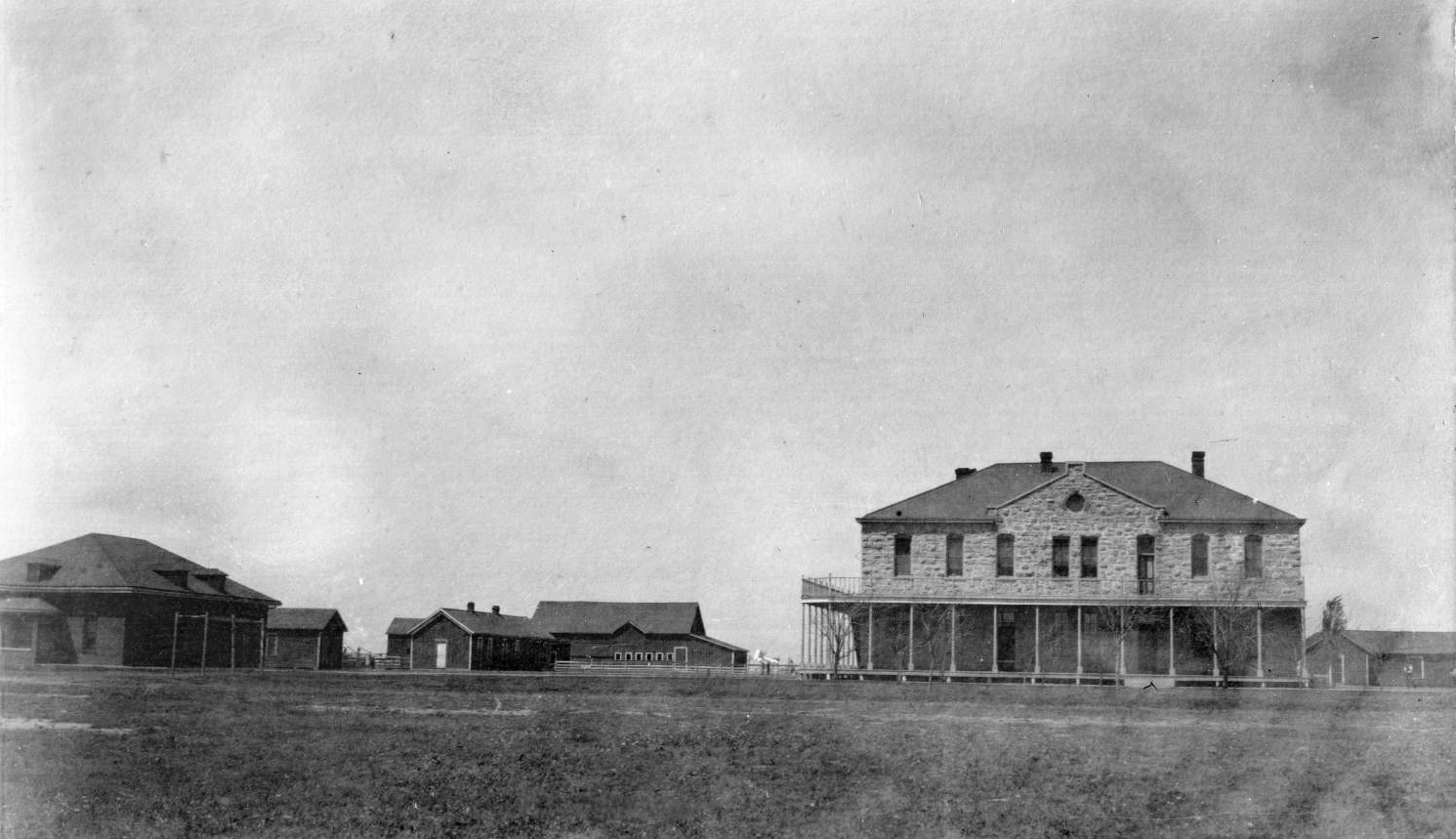
In 1892 the opening of the new Rainy Mountain U.S. Indian Boarding School opened a new era in the education of Kiowa children. It was located about 5 miles south of the present site of Gotebo, and made needless the smaller struggling schools of that region. The Indian school for the Kiowa at Anadarko was closed and the buildings moved. The director of the Lone Wolf Mission became the industrial teacher and farmer at Rainy Mountain.
For nearly 30 years until officially closed in 1922, this centrally located boarding school, well staffed and equipped, represented the main educational opportunity for the Kiowa. Enrollment was good.
As in most schools, the emphasis was on the practical arts, homemaking for the girls, and farming and shop for the boys. Learning to read and speak English was always an important objective.
As part of the government policy of decreasing the program of boarding schools and gradually getting the Indians into the public school \s of their communities, Rainy Mountain closed and most of the students went into public schools.
Origins
Founded in 1892 by the Methodist Episcopal Church, South, the Rainy Mountain Mission School emerged from a longstanding desire by missionaries to reach the Kiowa people with Christian teachings while also introducing Western-style education. Its establishment came after the Kiowa, Comanche, and Apache tribes had been relocated to reservation lands following decades of resistance and the Treaty of Medicine Lodge, signed in October 1867.
The school was built near Rainy Mountain, a site sacred to the Kiowa, which held deep historical and spiritual significance. This location was not coincidental—missionaries believed that their proximity to such a meaningful place would increase the mission’s acceptance among the Kiowa.
Daily Life
At its peak, the Rainy Mountain Mission School served dozens of Kiowa children, providing instruction in English, arithmetic, reading, writing, geography, and domestic skills. Boys were trained in agriculture and carpentry, while girls learned sewing, cooking, and housekeeping. The school operated much like other mission or government-run boarding schools of the era, emphasizing discipline, punctuality, and assimilation into Anglo-American cultural norms.
Children were often required to attend the school by pressure from Indian agents, and they frequently lived on-site, separated from their families for months at a time. They wore uniforms, were given Anglo names, and were punished for speaking Kiowa or practicing traditional customs. Despite these harsh realities, many former students later recalled their time at the mission with a mixture of hardship and gratitude, recognizing the education they received as a source of opportunity in a changing world.
Religious Mission
The Methodist missionaries who staffed the school were committed to converting the Kiowa to Christianity. Church services, Bible study, and hymn singing were integral parts of the daily schedule. Converts were baptized and encouraged to renounce traditional beliefs. For some Kiowa families, this was a source of deep conflict; for others, it was embraced as a path toward survival and advancement within a new social order.
The mission’s influence extended beyond education and religion. It became a community hub for meetings, religious gatherings, and social events. It also played a role in introducing Western medical practices and agricultural techniques to the area.
Decline
By the 1920s and 1930s, as federal Indian policy shifted away from religious boarding schools toward public education and tribal self-determination, the Rainy Mountain Mission School began to decline. It eventually closed, though the exact date varies in different records. The building itself stood for several decades and became a place of memory for many Kiowa families who had relatives attend the school.
The school is remembered in literature. N. Scott Momaday, a Pulitzer Prize-winning Kiowa author, reflects on Rainy Mountain’s sacredness and legacy in his acclaimed work The Way to Rainy Mountain, helping to preserve the memory of the place and its people for future generations.