
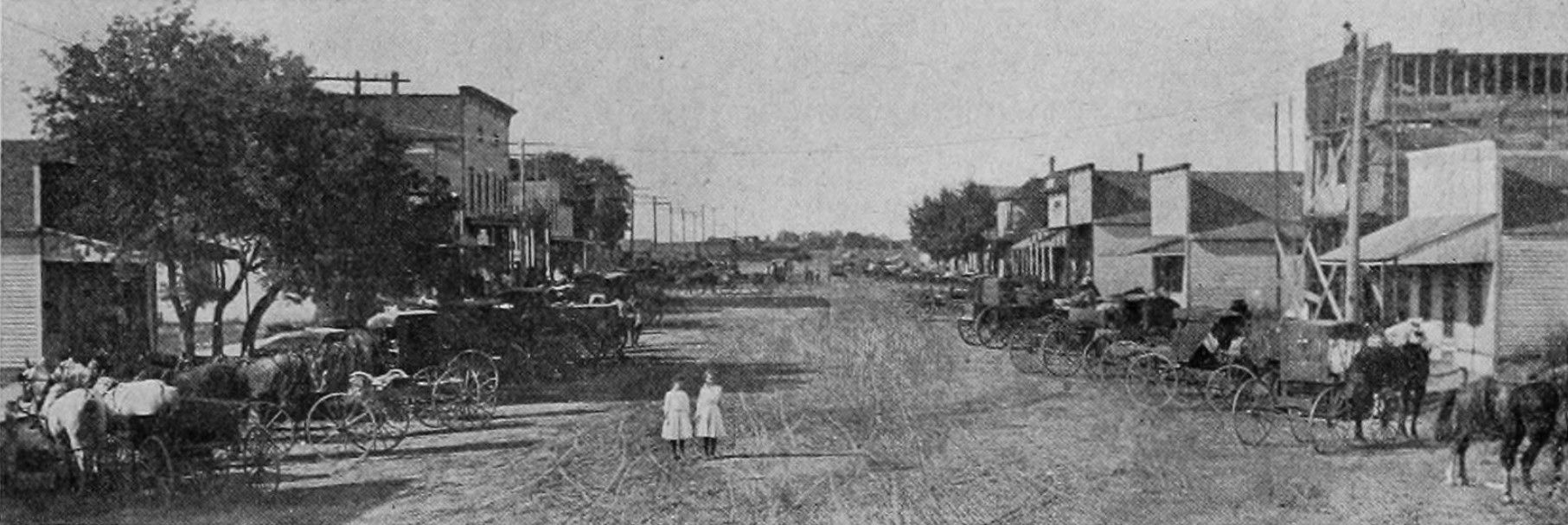
Cairo, Nebraska, was established in 1886 along the Grand Island Wyoming Railroad, with early businesses established by figures like Geo. Elfus and George W. Wingert, who also served as the first postmaster. The village incorporated in 1892, and numerous boards of governance followed, reflecting community development. By 1907, Cairo boasted various businesses, including the Cairo State Bank and the Cairo Hotel. The town’s continual growth included essential services such as a water plant and telecommunication facilities.
The history of this town comes from the 1920 History of Hall County and you should consider that date in context of the information presented. The words like “now” “today” refer to 1920, not today.
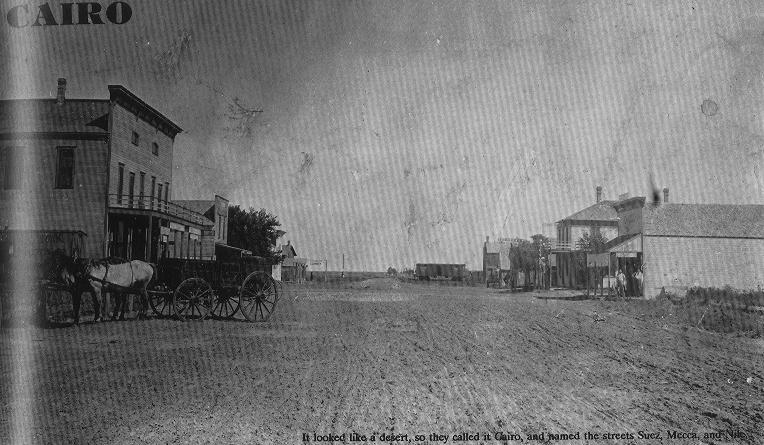
The founding of the town of Cairo long postdates the early history of Mayfield and South Loup Townships. When the railroad was surveyed the town of Cairo sprang up in the spring of 1886. Established on the line of the Grand Island & Wyoming Railroad, now the Chicago, Burlington & Quincy, this beautiful little town lies eighteen miles northwest of Grand Island. The National Lumber Company hauled in lumber and established small yards in anticipation of the town, doing this late in 1885 or early 1886. It was not long before the town had several business houses. Geo. Elfus had a grocery store, and George Willing a furniture store. George W. Wingert became postmaster. Mr. Wingert has been an active business spirit in the community since that time.
The Town Government
The village of Cairo was incorporated on November 18, 1892. The first board named to carry on the village government were: I.M. Cole, C.M. North, Geo. A. Dove, Geo. W. Wingert, Geo. F. Shindel. Later in the year, on account of resignations, Geo. Brewer, L. Watkins and W.C. Ofield took seats on the board.
The subsequent boards who have carried the responsibilities of the government and development of the community have been:
Board Members by Year
| Year | Members |
|---|---|
| 1893 | Jas. A. Veeder, I. M. Cole, John A. Kalus, Fred Spencer, Geo. Brewer. (Spencer and Brewer succeeded in Dec by Dell Thompson and W. C. Wingert) |
| 1894 | J. A. Veeder, Lafe Watkins, W. C. Wingert, I. M. Cole, Dell Thompson (succeeded by Grant Afflerbaugh) |
| 1895 | A. L. Barnaby, Lafe Watkins, W. C. Wingert, I. M. Cole, Wm. Moore (Moore removed; succeeded by C. M. North) |
| 1896 | C. M. North, S. M. Cole, F. S. Nicholson (mayor of St. Paul, Neb.), G. W. Wingert, Lafe Watkins |
| 1897 | North, Nicholson, Wingert, Watkins continued; W. C. Ofield returned |
| 1898 | Ofield, Wingert, Watkins continued; J. M. Cole returned; Ed Maxon elected (removed; succeeded by H. G. Still) |
| 1899 | I. M. Cole resigned, G. W. Wingert did not qualify; Chas. Shindel, A. H. Shull joined; served with L. Watkins, C. M. North, H. G. Still |
| 1900 | North, Shindel, Still, Shull, Watkins. (During this term, smallpox epidemic prompted a ban on assemblies Dec 20, 1900 – Jan 1901) |
| 1901 | North, Still, Shull, Watkins, W. S. Cole |
| 1902 | A. O. Powers, A. H. Shull, C. M. North, N. C. Nelson, L. Watkins (Watkins unseated by court decree; succeeded by I. M. Cole) |
| 1903 | Shull, Nelson, Cole, Powers held over; S. W. Snyder joined. (Cole resigned, replaced by W. S. Bellows; Powers moved, succeeded by H. G. Still) |
| 1904 | W. C. Ofield, S. W. Snyder, C. M. North, A. H. Shull, N. C. Nielson (Snyder moved in June; succeeded by C. A. Tiedeman) |
| 1905 | J. E. Cox, C. A. Tiedeman, Fred Ericson, C. M. North, N. C. Nielson |
| 1906 | Same five until Jan 1907, when Emery Peters succeeded C. M. North |
| 1907 | Cox, Tiedeman, Peters, Nielson, Ericson (Ericson replaced in Oct by A. H. Shull) |
| 1908 | Cox, Tiedeman, Peters, Nielson held over; A. B. Congrove joined |
| 1909 | Fred Erickson, C. A. Tiedeman, J. E. Cox, A. B. Congrove, Nielson |
| 1910 | Erickson, Tiedeman, Cox, Congrove, Nielson |
| 1911 | Cox, Congrove, Nielson, Tiedeman re-elected; E. Whitehead joined |
| 1912 | Cox, Congrove, Nielson re-elected; Whitehead, Tiedeman held over |
| 1913 | Cox, Whitehead continued; G. C. Raven, Wm. Schlund, Geo. Wabel joined |
| 1914 | Same membership as 1913 |
| 1915 | G. C. Raven, L. W. Thompson, J. E. Cox, Wabel, Whitehead |
| 1916 | Same membership as 1915 |
| 1917 | Cox, Wabel, Whitehead remained; H. T. Ingalls, F. W. Goodrich joined |
| 1918 | Ingalls, Goodrich held over; Cox re-elected; Harry Prohl, Geo. Whitefoot joined. (Prohl resigned Oct; succeeded by G. H. Vant. Cox resigned Mar 1919, seat vacant until spring) |
| 1919 | G. C. Raven, F. W. Goodrich, S. R. Benton, G. H. Vant, R. R. Thompson |
Village Clerk
The important office of village clerk was first filled in 1892 by John A. Kalus. In the succeeding years, the books were taken care of by Wm. Moore, 1893; F.W. Spencer, 1894–5; Geo. W. Hood for a few months; Chas. Shindel from 1896 to 1899; Geo. C. Adwers for about nine months; A.L. Barneby from February 1900 until May 1901; R.W. Wirt for a few months; A.L. Omer, 1901 to 1903; W.C. Wingert and J.H. Harrison in 1904; C. Blease, 1905; A.L. Barneby, October 1905 until May 1908; C. Hugo Hehnke became clerk in 1908 and held this position until June 1914. The next clerk was H.P. Bellows who served until the spring of 1919, when E.H. Whitehead, the present clerk, took charge.
Village Treasurers
L.W. Lyon first assumed the task of custodian of the village funds, serving from 1892 until June, 1898. W.C. Wingert assumed the office until in 1901. George W. Wingert then took up the responsibilities of village treasurer which he held from 1901 until October, 1905. J.H. Harrison then served until 1908, when Geo. W. Wingert again assumed the office and has held it continuously during the past eleven years.
Commissioner and Marshal
John Murphy took up the role of marshal in 1892 and continued in that service until June 3, 1901. During that time the duties of street commissioner were performed by Geo. F. Shindel and Jos. Hancock until 1900. D.C. Roush and John Stoeger were the next commissioners. Murphy returned to the duties of marshal in a short time and served until he again resigned on August 5, 1904. Geo. Wabel and J.W. Hancock served as marshal for short periods and Murphy served again in 1905. In 1902 and 1903 L.W. McCormick and H.D. McWilliams served as street commissioners. In 1904 Murphy was serving as both marshal and street commissioner, which he later did in 1905 and 1906. During 1906, C.F. Clark took over this joint burden and remained until 1910. Gust Erickson succeeded him, and in the latter part of 1910 added the duties of water commissioner to those he already had under way. Henry Thompson served in 1911 as marshal and Robert Day as water commissioner. But in 1912 Alfred Boyd had taken up the duties of street commissioner and marshal and Gust Erickson was water commissioner. Boyd continued his service until 1917, when A.B. Congrove succeeded him, and then E. Blauvelt came into office, but Alfred Boyd returned to the positions of marshal and street commissioner and now holds the same. Erickson was succeeded as water commissioner by Karl Rasmussen.
At an election held on May 18, 1909, Cairo voted bonds for the construction of a water plant by a vote of 82 for to 27 against. On the basis of an $8,000 issue, a contract was let to the National Company of South Bend, Indiana, for $6,735. In 1910 a jail was ordered built, to be 10 x 14 feet, with two cells.
Business Houses
Cairo has always been a good trading town and has at all times maintained a goodly number of prosperous business houses.
The store established by Geo. Elfers in 1886 came into the hands of I.M. Cole about 1891 or 1892. Hehnke-Lohman afterwards turned this business into the Cairo Mercantile Co., which is still managed by C. Hugo Hehnke.
The store established by Dell Thompson was at one time conducted by a Mr. Bristol. F.W. Goodrich once burned out with the stock. Dell Thompson rebuilt on the old site and handled hardware and later dry goods and groceries. Later Thompson Brothers conducted the business. The old established store of H.P. Bellows & Co. is now being closed out. Another stock in Cairo was formerly handled as Bellows & Goodrich, but is now the store of F.W. Goodrich. A stock handled by Chas. Wood burned out about 1892.
The pioneer hardware store of Geo. Williams established in 1886, was later handled respectively by Dell Thompson, Will Parker, W.S. Bellows, and while in the hands of E.W. McAllister burned out in January 1901. McAllister Brothers put in a stock of groceries, dry goods, furniture, and hardware which burned out in January, 1915. Lloyd McAllister rebuilt and restored a stock which later became the store of Dove & Son.
The first hotel in Cairo was built by Jim Irwin on the bank corner. Later this was handled by Hancock’s, by Grandma Stoeger, by Mrs. Carlson, but for the past ten or twelve years, A.R. Boyd has been “Ye Host.”
Scudder Brothers, of Doniphan, opened a livery stable early in the history of the town, but the North-Robinson barns afterwards acquired that site and another livery stable has since sprung up. The Isaac Dunlap stable has recently been converted into a garage. Frank Hilderbrand had the first meat market. Wingert Brothers conducted a market for some time, and Geo. Weibel and Emil Leucht were later market proprietors, and the present meat market owner, Adolph Runge, has built a new building for that purpose.
The Gazette was an early newspaper in the community. J.H. Harrison established the Record about 1902 and conducted it for about six years. His successors with the editor’s pen have been Elliott Harrison, A.C. Ofield, W.H. Daly, and A.C. Ofield again returned to the editorial desk and now J.W. Mahaffie publishes the Record.
Cairo has had telephone facilities since 1912. For the past three or four years, the Gem Theater has furnished moving pictures to the community.
1907 Business Directory
The business interests in Cairo in 1907 are: S.R. Benton, E.J. Peters, agricultural implements; J.H. Harrison, cashier Cairo State Bank; O.E. Littler, barber; Fred Erickson, blacksmith; A.L. Barneby, books and stationery; W.H. Harrison, building materials; Wm. D. Billis, Henry J. Cole, Jos. W. Hancock, Frank W. Keeley, J. Shaugnessy, contractors and carpenters; Dell Thompson, cement blocks; Hans Runge, cream station; John H. Pedley, dray line; Wm. Brand, The New Drug Store; Dr. Jas. M. Tische, drugs; Cairo Mercantile Co., Fred W. Goodrich, Wingert Bros., general merchandise; John E. Cox and Oscar Wells & Co., grain dealers and elevators; A.H. Simmons, groceries; E.W. McAllister and Cairo Mercantile Co., hardware; Henry Rathman, harness maker; Cairo Hotel, John Omer, proprietor; Commercial Hotel, Mrs. Emma Carlson; North & Robinson, horse importers and dealers; J.H. Harrison, law; Chas. D. Bowker, livery stable; W.H. Harrison, lumber; Cairo Opera House, Dell Thompson, manager; Lee Shouse, painter; Drs. M.R. Piersol and Jas. M. Tiesche, physicians; Philip K. Hile, plasterer; A.L. Barneby, postmaster; Cairo Record, newspaper and printing office; Henry Arff, saloon; A.B. Congrove, manager telephone office; L.L. Fowler, agent of C.B. & Q. Railway.
1919 Business Directory
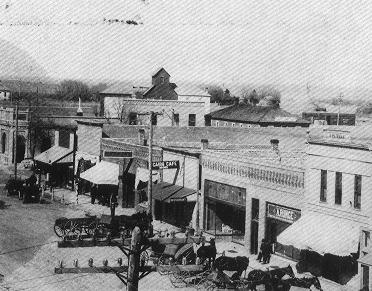
Automobiles: E.H. Whitehead (Boodry Motor Car Co. now out), Schlund and Tully, Earl Veeder; agricultural implements: Karl A. Rasmussen; banks: Cairo State, Geo. W. Wingert, cashier; Farmers’ State, G.C. Raven, cashier; Dye & Swan and J. Sorrenson, barbers; The W.H. Harrison Co. and Nelson Lumber & Supply Co., lumber; coal and grain: H.T. Ingalls & Son (for about six years) and S.M. Beadle & Co. until recently, but now Highland Grain Co.; creamery interests: formerly Beatrice Creamery Co. and Farmers Co-operative Co., but now Lincoln Pure Butter Co., F.E. Blauvelt, manager, and Harding Cream Co., Hans Runge; dray lines: A. Boyd and F.M. Alderman; drug stores: The Cairo Pharmacy, operated for the past 10 years by J.M. Ruth. Between Thos. Schurtz who established the first drug business in Cairo in 1886 and Mr. Ruth this line was handled at various times by John Boeck, Chauncey North, Dr. Milliken, Harry Wright, and Dr. Tish. The other drug store, the City Drug Store, formerly conducted by Opal M. Peirsol, is now operated by M.E. Tennant. The stores handling dry goods and clothing are Cairo Mercantile Co., Thompson Brothers, F.W. Goodrich and the H.P. Bellows Co., stock being closed out during 1919. Those handling groceries, in addition to the stores just named, are A.L. Barneby and Dove & Son. The flour mill industry is handled at the Ingalls mill. John Orndoff and J.R. Herrick are the recent livestock dealers; Adolph Runge, meat market; Mrs. Nettie Boyd, millinery; B.F. Clark and W.S. Veeder, painters; printing at the Record office; Dr. M.R. Piersol and Dr. Dodd, physicians; Dr. Earl Metheny went into military service and has not returned to Cairo. Frank R. Skupa, tailor.
Source: Buechler, August F., and Barr, Robert J., editors-in-chief; and Stough, Dale P., associate compiling editor; History of Hall County Nebraska: a narrative of the past with special emphasis upon the pioneer period of the county’s history, and chronological presentation of its social, commercial, educational, religious, and civic development from the early days to the present time, and special analysis of its military and civil participation in the late world war; Lincoln, NE: Western Publishing and Engraving Company, 1920.
Back to: 1920 Hall County History
Back to: Hall County History & Genealogy