
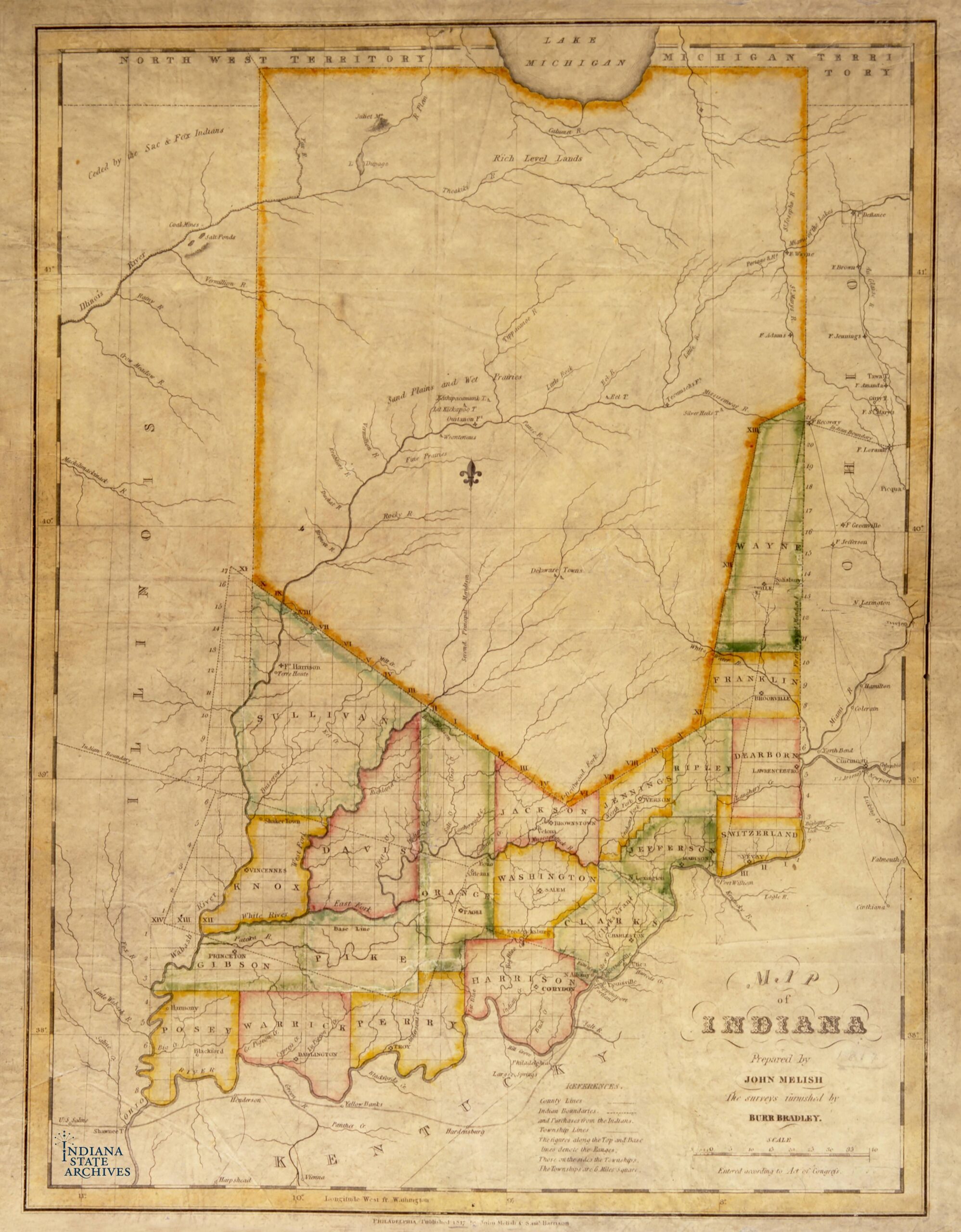
The Northwest Territory remained under the government of the first stage until September 16, 1799, when it formally advanced to the second or representative stage. In the summer of 1798 Governor St. Clair had ascertained that the territory had a population of at least five thousand free male inhabitants and, in accordance with the provisions of the Ordinance of 1787, was ready to make the change in its form of government. On October 29, 1798, the governor issued a proclamation to the qualified voters of the territory directing them to choose members for the lower house of the territorial Legislature at an election to be held on the third Monday of the following December. The twenty-two members so elected met on January 16, 1799, and, pursuant to the provisions of the ordinance, selected the ten men from whom the President of the United States later chose five for the Legislative Council. They then adjourned to meet on September 16, 1799, but since there was not a quorum on that day they held adjourned sessions until the 23rd, at which time a quorum was present.
At the time the change in the form of government went into effect there were only nine counties in the whole territory. These counties had been organized either by the governor or his secretary. The following table gives the nine counties organized before 1799 with the dates of their organization and the number of legislators proportioned to each by the governor:
| County | Date of Organization | Number of Representatives |
|---|---|---|
| Washington | July 27, 1788 | 2 |
| Hamilton | January 4, 1790 | 7 |
| St. Clair | April 27, 1790 | 1 |
| Knox | June 20, 1790 | 1 |
| Randolph | October 5, 1795 | 1 |
| Wayne | August 6, 1796 | 3 |
| Adams | July 10, 1797 | 2 |
| Jefferson | July 29, 1797 | 1 |
| Ross | August 20, 1798 | 4 |
FIRST TERRITORIAL LEGISLATURE OF NORTHWEST TERRITORY
The twenty-two representatives and five councilors were the first representative body to meet in the Northwest Territory and they represented a constituency scattered over a territory of more than two hundred and sixty-five thousand square miles, an area greater than Germany or France, or even Austria-Hungary. It would be interesting to tell something of the deliberations of these twenty-seven sterling pioneers, but the limit of the present article forbids. It is necessary, however, to make mention of one important thing which they did in view of the fact that it throws much light on the subsequent history of the Northwest Territory.
DIVISION OF 1800
The Legislature was authorized to elect a delegate to Congress and two candidates for the honor presented their names to the Legislature—William Henry Harrison and Arthur St. Clair, Jr., the son of the governor. The Legislature, by a joint ballot on October 3, 1799, elected Harrison by a vote of eleven to ten. The defeat of his son undoubtedly had considerable to do with the subsequent estrangement which arose between the governor and his Legislature and incidentally hastened the division of the Northwest Territory. Within two years from the time the territory had advanced to the second stage of government the division had taken place. On May 7, 1800, Congress passed an act dividing the Northwest Territory by a line drawn from the mouth of the Kentucky River to Fort Recovery, in Mercer County, Ohio, and thence due north to the boundary line between the United States and Canada. Governor St. Clair favored the division because he thought it would delay the organization of a state and thus give him a longer lease on his position, but he did not favor the division as finally determined. He was constantly growing in disfavor with the people on account of his overbearing manner and he felt that he would get rid of some of his bitterest enemies if the western inhabitants were set off into a new territory. However, most of the credit for the division must be given to Harrison, who, as a delegate to Congress, was in a position to have the most influence. Harrison also was satisfied that in case a new territory should be formed he would be appointed its first governor, and he was not disappointed. The territory west of the line above mentioned was immediately organized and designated as Indiana Territory, while the eastern portion retained the existing government and the old name — Northwest Territory. It is frequently overlooked that the Northwest Territory existed in fact and in name up until March 1, 1803.
CENSUS OF NORTHWEST TERRITORY IN 1800
The division of 1800 left the Northwest Territory with only about one-third of its original area. The census of the territory taken by the United States government in 1800 showed it to have a total population of forty-five thousand three hundred and sixty-five, which fell short by about fifteen thousand of being sufficient for the creation of a state as provided by the Ordinance of 1787, which fixed the minimum population at sixty thousand. The counties left in the Northwest Territory, with their respective population, are set forth in the appended table, all of which were within the present state of Ohio, except Wayne:
| County | Population |
|---|---|
| Adams | 3,432 |
| Hamilton | 14,632 |
| Jefferson | 8,766 |
| Ross | 8,540 |
| Trumbull | 1,302 |
| Washington | 5,427 |
| Wayne | 3,206 |
| Total | 45,365 |
The population as classified by the census with respect to age and sex is interesting and particularly so in showing that considerably more than one-third of the total population were children under ten years of age.
Here is the corresponding HTML table:
| Description | Males | Females |
|---|---|---|
| Whites up to ten years of age | 9,362 | 8,644 |
| Whites from ten to sixteen | 3,647 | 3,353 |
| Whites from sixteen to twenty-five | 4,636 | 3,861 |
| Whites from twenty-six to forty-five | 4,833 | 3,342 |
| Whites forty-five and upward | 1,955 | 1,395 |
| Total | 24,433 | 29,595 |
| Total of both sexes | 45,028 | |
| Total of other persons, not Indians | 337 | |
| Grand total | 45,365 |
The above table shows in detail the character and distribution of the population of the Northwest Territory after the division of 1800. It is at this point that the history of Indiana properly begins and it is pertinent to set forth with as much detail as possible the population of Indiana Territory at that time. The population of 5,641 was grouped about a dozen or more settlements scattered at wide intervals throughout the territory. The following table gives the settlements in Indiana Territory in 1800, with their respective number of inhabitants:
Mackinaw, in northern Michigan 251
Green Bay, Wisconsin 50
Prairie du Chien, Wisconsin 65
Cahokia, Monroe county, Illinois 719
Belle Fontaine, Monroe county, Illinois 286
L’Aigle, St. Clair county, Illinois 250
Kaskaskia, Randolph county, Illinois 467
Prairie du Rocher, Randolph county, Illinois 212
Settlement in Mitchel township, Randolph county, Illinois 334
Fort Massac, southern Illinois 90
Clark’s Grant, Clark county, Indiana 929
Vincennes, Knox county, Indiana 714
Vicinity of Vincennes (traders and trappers) 819
Traders and trappers at Ouitenon and Fort Wayne 155
Fur traders, scattered along the lakes 300
Of this total population of nearly six thousand, it was about equally divided between what is now Indiana and Illinois. There were one hundred and sixty-three free negroes reported, while there were one hundred and thirty-five slaves of color. Undoubtedly, this census of 1800 failed to give all of the slave population, and it is interesting to note that there were efforts to enslave the Indian as well as the negro.
All of these settlements, with the exception of the one in Clark’s Grant, were largely French. The settlement at Jeffersonville was made in large part by soldiers of the Revolutionary War and was the only real American settlement in the Indiana Territory when it was organized in 1800.
Back to: History of Dearborn County, Indiana
Source
Shaw, Archibald, History of Dearborn County, Indiana : her people, industries and institutions, with biographical sketches of representative citizens and genealogical records of old families, Indianapolis : B.F. Bowen, 1915.