
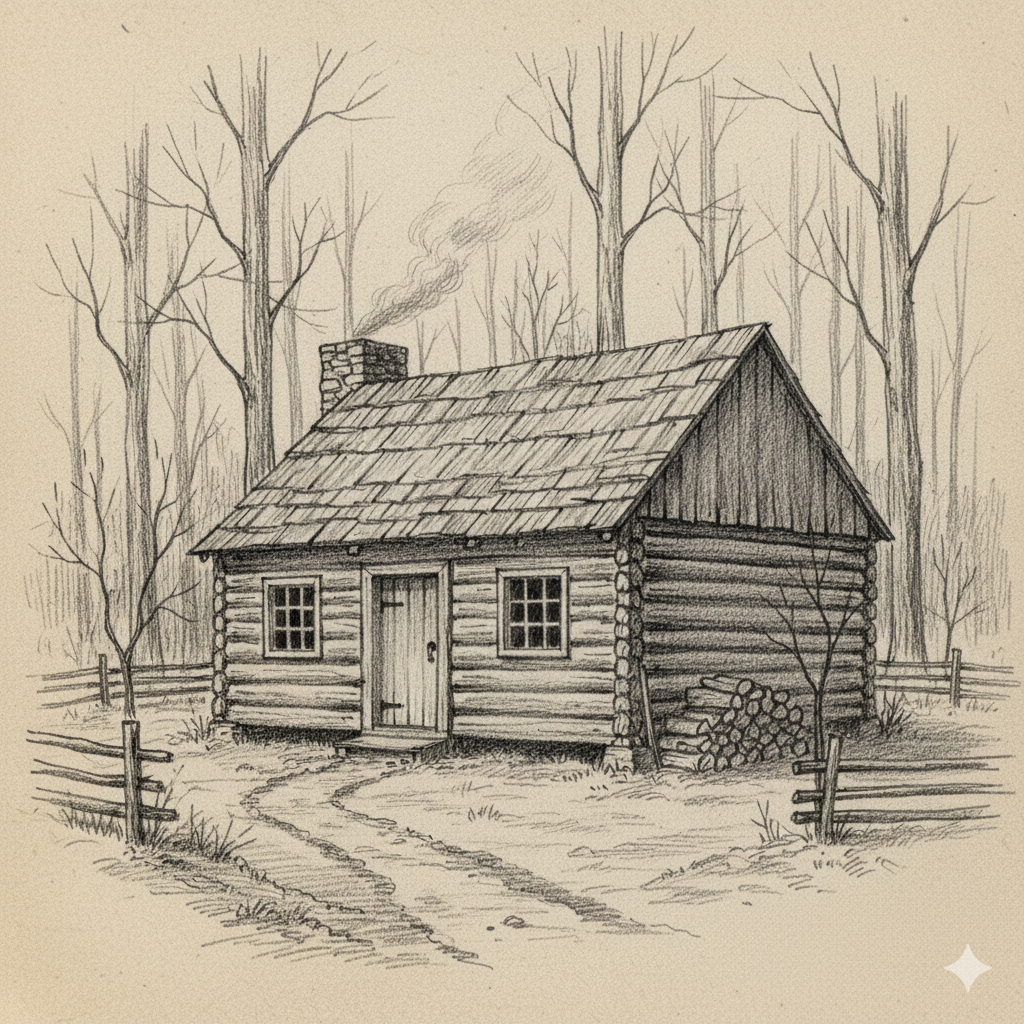
Although the Wayne treaty was made with the Indians in August, 1795, yet it was 1798 before the general government put surveyors to work platting the land and getting it ready for entry by private individuals. The wonderful Ordinance of 1787 had attracted attention throughout the Atlantic states, and thousands of people there were casting their eyes toward the Ohio valley as a land of promise. Families in Virginia, North Carolina and South Carolina were far-seeing enough to discern that slavery was an evil, and desiring to locate their families remote from its menace, were looking forward to the time when they should be able to pack up their goods, their lares and penates, and seek an abiding place in this rich valley where freedom’s corner-stone had been laid. The Eastern states, too, that had relinquished claims to the country, were attracted by its superior soil and kindly climate, and this same ordinance that repudiated primogeniture, feudalism’s relic of tyranny; that respected liberty of conscience; that set a high value on education; an ordinance that will serve as a model for all free governments the world over. Hence, just as soon as the war clouds had drifted away, might be seen set in motion the moving wagon from a hundred different directions all set in the one common purpose and in the one direction, to the Ohio valley, where the justly celebrated ordinance had guaranteed them the liberty they longed for. Although the government was apparently slow in surveying and preparing the land for the settlers, yet the country along the Ohio was soon dotted with the cabins of those who were busy selecting their locations for a home for their declining years.
FIRST FAMILIES OF DEARBORN
By the time the surveyors, in 1798, had commenced the survey, a fringe of pioneer cabins bordered the north side of the Ohio from the mouth of the Big Miami to the point opposite the mouth of the Kentucky river, the western line of the Wayne purchase. These families were hoping to be so fortunate as to secure the lands, selected by so much sacrifice, when the land office was once opened. Many of them succeeded and a few failed. By the spring of 1801, when the office of the land department was opened at Cincinnati, the country as far up the Whitewater as Brookville had been settled upon and the settlements had extended up the creeks flowing into the Ohio several miles. Yet during the first year after the office was opened there were comparatively few families that availed themselves of the privilege of making sure their choice of lands and of the improvements already made on their choice. Among those who were in the county before the sale of land commenced the following is a list. Many have been forgotten and others, perhaps, were of the restless, roving class who stayed only a short time and moved on to what was to them more inviting places:
In the Miami bottoms — Henry Hardin and family; William Gerard and family, with his sons, Eli and Elias; George Crist and family; Capt. Joseph Hayes and family; Joseph Hayes, Jr., and family; Thomas Miller and family; James Bennett and family; Benjamin Walker and family, Samuel, Joseph and John, and daughter, Jane; and Isaac Polk, Garrett, Vanness, Joseph Kitchell, William Allensworth, Isaac Allen, John Dawson, John White, Ezekiel Jackson, Daniel Perrin and John Livingstone.
In the Hogan valley — Adam Flake and family; Ephraim Morrison and family; Nicholas Cheek and family; Tavern Cheek and family, and Amos Henry, James Bruce, Ebenezer Foot, Stephens Peters, Charles Wilkins and Daniel Connor.
In the Laughery valley — George Groves and family; Benjamin Walker and family; Daniel Lynn and family, and William Maroney, Daniel and William Conaway, Benjamin and Jesse Wilson, William Ross and William and David Blue.
These men were here with their families awaiting the action of the general government in opening the country for settlement. On February 2, 1798, Oliver Wolcott, secretary of the treasury, reported to the United States Senate that no contracts had yet been made for surveying the public lands below the mouth of the Great Miami, but that surveys were expected to be commenced during the coming season. On October 11, 1798, Israel Ludlow commenced to run and mark the first principal meridian, now the state line between Ohio and Indiana. Benjamin Chambers and William Ludlow were the United States surveyors who surveyed most of the land in Dearborn county. James Hamilton and Stephen Ludlow are supposed to have been the rodmen, or assistants, in making the survey. Notwithstanding the fact that there were quite a number who had settled in the county prior to the opening of the land office, yet we find that when the office did open on the first Monday in April, 1801, that only three men availed themselves of the opportunity the first day and secured land.
FIRST FORMAL LAND ENTRIES
On April 9, 1801, Joseph Hayes entered fractional section 1, range 1, in this township, and all of section 36, lying in congressional township No. 6, range 1. These two pieces of land lie adjoining the state line and on the Elizabethtown pike, where the road enters Ohio. The hill land in the tract is now the property of Joseph and Thomas Fitch, descendants of Joseph Hayes. The same day John Brown entered the east half of section 24, in township 7, range 1, which is just south of where the town of West Harrison now stands. And Lewis Davis and Benjamin Chambers entered fractional sections 1, 2 and 3 in township 3, range 1 (now in Ohio county).
A few days later, on April 27, 1801, fractional section 2, township 5, range 1, was purchased by George Crist and Henry Hardin. On July 14, 1801, Richard Mainwaring entered the west half of section 10 in township 7, range 1, which is about the mouth of Logan creek, in Harrison and Logan townships. On July 23, 1801, Samuel Vance entered fractional sections 13, 14 and 15, in township 4, range 1, and sections 8, 9 and 10 were entered on April 22, 1801. Section 9 lies partly in Ohio county, section 10, all in Ohio county, all three sections lying about the mouth of Laughery creek. These sections were entered by Daniel Conner, but were transferred on December 2, 1806, to Oliver Ormsby. Section 21 and fractional sections 22 and 23 were entered on April 27, 1801, by Charles Wilkins. These sections lie across the mouth of Tanner’s creek. Fractional sections 27, 28 and 29 were entered by James Conn on December 19, 1801. These sections are adjacent to Aurora and just south of the sections entered by Wilkins. On August 22, 1801, Cave Johnson entered a portion of section 13, township 7, range 1. On December 8, 1801, William Allensworth and William Ramsy entered the balance of the section. This is the section on which the town of West Harrison now stands. On August 13, 1801, John Brown entered another piece of ground in section 9, township 7, range 1, and on September 16, 1801, Bayliss Ashby entered part of section 14, same township. These sections lie along the Whitewater near the mouth of Logan creek.
MANY LOSE HOMESTEADS
The above entries comprise all the land entered during the balance of the year following the opening of the Cincinnati land office. It is probable that many of the settlers who had selected lands were as yet unable to gather together sufficient money to make the payments required. Some of these who entered lands during 1801 were not bona fide settlers and it was, after all, only the few that had the cash to spare when the government was ready to put the land on the market. The lands at that time were being offered by the government in section or half sections and the cost was two dollars per acre, part cash, the deferred payments bearing interest. The land was too high for its earning value at that time, and many who made a first payment found themselves unable to make the deferred payments and were either forced to sell at the best market price they could obtain or dispose of it to some other settler. Then, too, the government wanted to dispose of the land in tracts that were too large to meet the purses of many of the settlers. It was seldom that a settler desiring to better himself by coming to these western forests was possessed of any great amount of cash. Later on the government made it possible for entries to be made in quarter sections and even less, in order to meet the requirements of the times.
In 1802 the number taking up land was even less than in the former year. Section 3 of township 5, range 1, lying about Homestead, was entered by Barnett Hulick during that year. Section 12, just north of West Harrison, in township 7, range 1, was entered, a portion of it, on June 5, 1802, by William Majors. These seem to have been all the land entries made during that year. The troubles with the Spanish at the mouth of the Mississippi may have deterred settlers from taking up land. In 1803 the conditions had changed very little. While events of vast importance to the settlers in the Ohio valley were coming to pass elsewhere, yet the means of communication were so slow that it is possible no word drifted into the valley concerning the purchase of the Louisiana Territory until the next spring. Section 26, township 5, range 2, lying close to Wilmington, was entered by Jeremiah Hunt. Part of section 11, in township 4, range 2, was entered that year by Henry Cloud, and part of section 4, township 7, range 1, on the west side of the Whitewater, in Logan township, was entered by James Adair. Section 10, just south and east of section 4, same township, was entered in the same year by John Hackleman, in part. In 1804, conditions were growing better and the land entries increased. A part of section 35, township 5, range 1, was entered by Thomas Miller during 1804. Fractional section 4, in township 4, range 2, was sold to Daniel Conner. Fractional sections 32 and 33, township 5, range 1, were sold to Charles Vattier, of Cincinnati, on September 18, 1804. The fractional section purchased by Conner is more recently the W. S. Holman estate, and the Vattier lands comprise part of the ground on which the city of Aurora now stands. Noble Butler entered a portion of section 11, in township 6, range 1, which was the section on which the camp meetings were held some forty or fifty years ago. A portion of section 13, just southeast of section 11, was entered by Thomas Miller the same year. Part of section 14, in the same township, was entered by Robert McConnell the same year. Charles Dawson entered all of section 24 and part of section 23, in the same township, in 1804, and Jacob Blasdel entered a portion of section 29 and, together with Archibald Stark, all of section 28, in the same township. This is the land on which the townsite of Cambridge was afterwards laid out and the lands of Ferris J. Nowlin, who is a lineal descendant of Jacob Blasdel, is a part of this entry. Township 6, range 1, is mostly in Miller township. In township 7, range 1, Alexander Dearmand entered a portion of section 12, just north of West Harrison, and James McCoy entered a portion of section 14 in Logan township.
During the year 1805 there seems to have been a comparative lull, even in the slow-going entries of land. Adam Flake, one of the first, if not the very first, to settle in the county, entered a portion of section 35, township 5, range 2, on South Hogan creek, and Michael Henich entered a portion of section 11, in township 4, range 2, just one mile south of Adam Flake’s entry. In Harrison township, a portion of section 25 was entered by John Allen.
HARDSHIPS OF THE PIONEERS
The “winning of the West” was a slow process and in it there was much more to do than to war with the Indians. History deals largely with the Indian wars, but says very little concerning the economic side of the matter. Historians write books to sell and the prosy details of chopping down big trees, burning the logs and clearing away the underbrush does not make as good reading to the average American as the exciting details of bloody warfare. Four years after the land office had been opened at Cincinnati, only thirty-three land entries had been made in the county. Dearborn county, when first settled, was covered thickly with forest trees. Large walnut, ash, elm, hickory, sugar and other trees were thickly interwoven with buckeye, haw, box elder, ironwood, cottonwood and water maple, and the underbrush in places was even more troublesome to clear for the coming of the plow than were the larger varieties. Cutting down the trees, burning the logs, and making a clearing even large enough to enable the settler to raise sufficient corn for his family was no small task. The Indian, according to the treaty, was supposed to keep off government ground, yet his treacherous character was well known, and he was uncomfortably in evidence at the cabin of the pioneer, demanding food and drink. Wild beasts were common. The bear, deer and occasionally an elk were common. Panthers, lynx and other smaller and less dangerous animals were to be met, and serpents of most every conceivable kind were common. In the bottoms the water was not good, the settler not digging deep enough to get the flow from deep springs, and the mosquitoes inoculated the people with malaria until chills and intermittent fevers were the common diseases of the times. On the higher lands it was more healthful and malaria was scarcely ever found. The first settler would first clear away the trees from about his buildings, then cut off a small patch so that he could raise some corn and garden vegetables. Then, perhaps, if he were able, about the middle of August he would deaden another patch so that the next spring he could burn the logs. Sometimes trees would be burned into two or three parts, thus saving the labor with the axe. This was called “niggering” a log off and was a common way of labor saving. Log-rollings were a common social event. A clearing would be made and the logs prepared to pile when the neighbors would be gathered together — men, women and children — for the rolling. Handspikes were made out of tough wood and, if a yoke of oxen belonged in the neighborhood, these patient animals were brought into requisition. Athletics were in vogue in those days, even more than today. But the champion was the man who could outlift his fellows. After the logs had been piled ready for the bonfire, some kind of entertainment was given, generally winding up with a dance. In this way a field was cleared for the spring planting. In the fall the corn was generally pulled or jerked off the stalk and thrown in a pile in a shed or barn; then some night the neighbors would be called in to “shuck” it out. The occasion was made merry by songs, and the young folks would be busy, as young people always are, getting acquainted and courting. It is said that one of the rules of the “shucking bee” was that every red ear shucked by the young men entitled them to choose from the young maidens present one whom he might kiss. It is very probable, at any rate, that the people of those days enjoyed themselves in a special way fully as much as those who now possess the most elegant parlors and move in the most highly-cultivated society.
THE EARLY CIRCUIT-RIDER
The spiritual side of the pioneers’ natures, too, was not entirely neglected. Churches were not to be found, but the traveling circuit-rider came around once or twice a year and held religious services in some of the houses central in the locality; whereupon the whole countryside for miles around would turn out to hear him and, incidentally, to meet their neighbors and get acquainted with the new emigrants. The menace of the Indian was yet about the settlers, and the watchful pioneer had his trusty rifle on its pegs over the wide-mouthed fireplace. A supply of powder and ball, too, was indispensable. As the years passed the danger from either the Indian or the wild beasts grew less and less. The clearings were growing, the forests growing less. It is related in the Dearborn county history, written in 1885, that in 1806, shortly after Ephraim Morrison arrived at where Aurora now stands, the notorious Simon Girty was sometimes seen in this region, and that on one occasion Blue Jacket, an Indian chief, borrowed a saddle from Morrison in order to accompany Girty to Detroit. The saddle was brought back according to promise. It is said of Captain Hayes that when he lived at the mouth of the Miami he explored the Big Bottoms from Tanner’s creek to Whitewater, and with his unerring rifle killed many a bear, deer and elk. The little creek that drains the hillsides by the residence of F. M. Burkam is called Elk run on account of Mr. Hayes killing a gigantic elk on the run. The day following this exploit there was preaching at one of the cabins. When the services were over, Mrs. Hayes announced to those present, “All of you that want meat come to our house; father has killed an elephant.” The story goes to illustrate the genial, open-handed kindness that existed in those days. If one neighbor killed a deer or bear, a hog or a sheep, the neighbors all shared. A story Captain Hayes told of one of his hunting trips was that he had killed a large deer on Double Lick run. The place he shot from was the bluff bank of the run which was breast high and completely concealed him from the lick as he stood in its dry bed. After waiting, as he thought, a sufficient length of time, after the report of his gun, for Indians to make their appearance, if any were about, he laid his gun down without reloading it and dragged the deer into the bushes, where he bent a sapling to hang the deer on to prepare it for packing on his horse. On his return to get his gun it was gone; an Indian had been watching him and when he was engaged with the deer, slipped up and stole his gun, but as it was empty no injury could be done with it. Droves of deer were common and the captain said he always took his pick, never killing a doe unless it was necessary. An early surveyor told that in the course of his work in the forest he had counted as many as sixty elks in one drove. He judged there were as many as one hundred in the drove.
There was little use for corn except for family use. The cattle fed off the range and the hogs fattened off the mast, which was plentiful. It is to be very much regretted that the traditions of the early pioneers, giving their homely but true picture of the everyday life, were not preserved. A truthful account of their mode of living would be both interesting and instructive. As these backwoods scenes recede into the dim past they increase in interest. An account of the hardships encountered by a family crossing over from Philadelphia to Pittsburgh, and the trip down the river in an open or covered boat would be quite a different story from coming over in these days in a palace car with sleeper and diner. Yet that was the route; and where the family was large it was the custom for the boys and girls over six or seven years of age to trudge the entire distance. Nothing was thought of it, for it was expected and they were prepared to endure the hardships.
A PRIMITIVE DOMICILE
It is possible that the first few months in the rude cabin after reaching their destination were the most trying of any of the experiences encountered by the pioneers. The first residence, if it could be called such, was generally made of round logs; the cracks filled in with sticks and this daubed over with clay. The roof was of clapboards held in place with poles reaching across the roof, called weight poles. The floor was made of split pieces of logs called puncheons. Straight-grained logs were chosen and these were split slab fashion; after which the upper side, or the side intended to form the floor, was hewed off as smooth as possible. The fireplace was a picturesque affair, but not as comfortable as a modern grate fire. It was made of logs lined with clay; or, if stone were convenient, it was built of undressed stone and was at least six feet wide to enable the settler to roll big back logs in that would keep fire for several days if necessary. Sometimes the chimney top was finished off with sticks plastered over with clay. This crude affair often got on fire and it was not an uncommon thing for these quickly made cabins to get on fire and be consumed. The door of this abiding place was made of split timber, much the same as the floor, and was stout enough to withstand hard pounding. It was generally hung on wooden hinges and fastened with a wooden latch. The latch was on the inside with a hole through the door and a string or thong of buckskin hanging on the outside, whereby the door could be opened from without. Hence the hospitable term: “My latch-string is always on the outside,” which meant that the family always welcome people to the best they had. Sometimes the house was graced with windows, but more frequently not. If windows were made they were small, generally not more than two feet square, the aperture being closed with paper, greased with lard or bear’s oil. Such a domicile was frequently erected in a single day, all the neighbors turning out to assist; at least this would be the case if there were any neighbors. A neighbor, within the meaning of those times, was anyone who resided within a range of six or eight miles. Such furniture as might be found in such a house would be riven out by the settler with his ready axe. Dishes were few and highly prized. The cooking was done in front of the fireplace in stewpan and skillet; corn pone being the staff of life. By care and thrift the settlers, after their first winter, generally were well provided with the bare necessaries of life.
THE PIONEER’S EVENING AT HOME
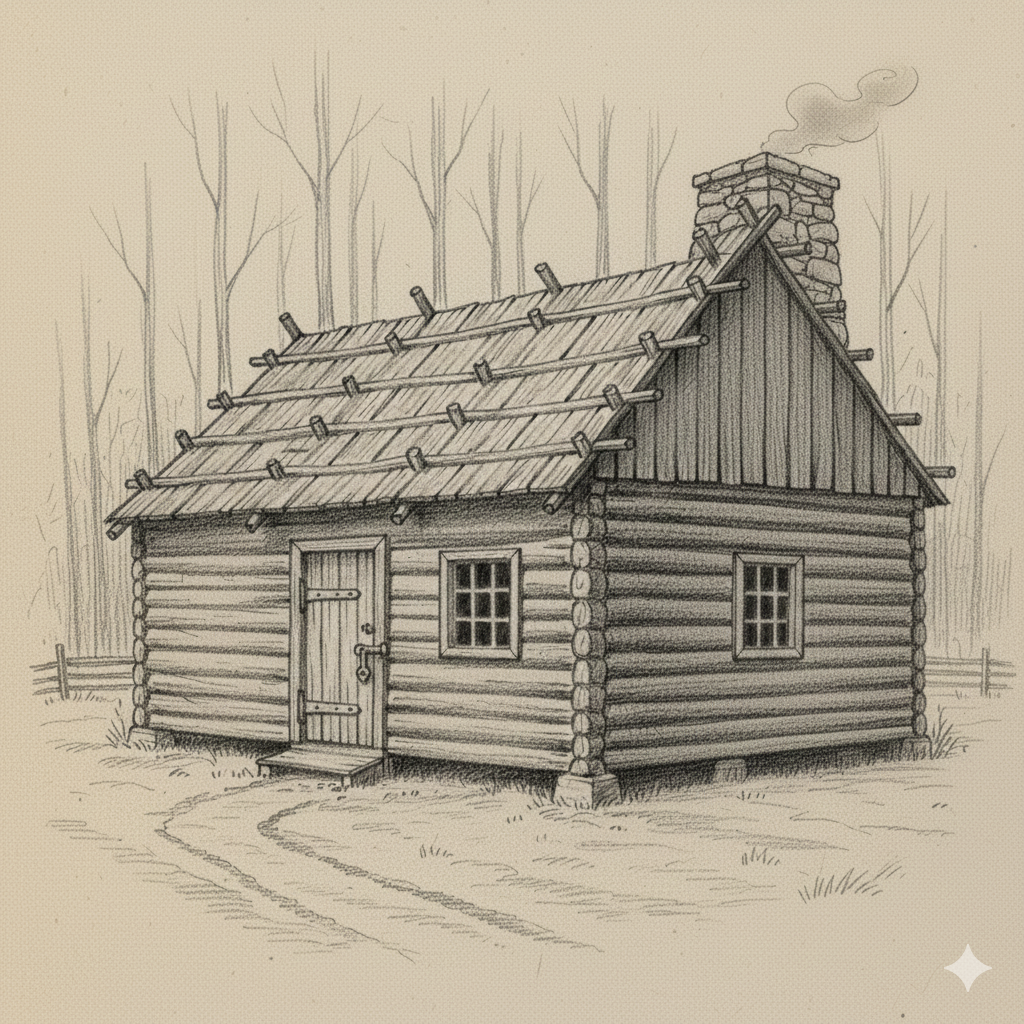
A description written by Rev. William C. Smith in his “Indiana Miscellanies” is herewith given, as illustrating the manner of lighting the homes during the long winter evenings. “During the day the door of the cabin was kept open to afford light and at night, through the winter season, light was emitted from the fire place, where huge logs were kept burning. For a few years candles and lamps were out of the question. When these came into use they were purely domestic in their manufacture. Candles were prepared by taking a wooden rod some ten or twelve inches in length, wrapping a strip of cotton or linen around it, then covering it with tallow pressed on with the hand. These ‘sluts,’ as they were sometimes called, answered the purpose of a very large candle and afforded light for several nights. Lamps were prepared by dividing a large turnip in the middle, scraping out the inside quite down to the rind, then inserting a stick, say three inches in length, in the center, so it would stand upright. A strip of cotton or linen cloth was then wrapped around this stick, and melted lard or deer’s tallow was poured in until the rind was full, when the lamp was ready for use. By the light of these primitive lamps during the long winter evenings the women spun and sewed, and the men read, when books could be obtained. When neither lard nor tallow could be had, the large blazing fire had to be turned to, to supply the needed light. By these great fireplaces many cuts of thread have been spun; many a yard of linsey woven, and many a frock or buckskin pantaloons made.
“The cabin raising and the log-rollings were labors of the settlers, in which the assistance of the neighbors was essential and cheerfully given. When a large cabin was to be raised, preparation would be made before the appointed day; the trees would be cut down, the logs dragged in and the foundations laid and the skids and forks made ready. Early in the morning of the day fixed, the neighbors gathered from miles around; the captain and the corner men selected, and the work went on with boisterous hilarity until the walls were up and the roof weighted down.”
PROGRESS OF THE PIONEERS
The cabin of round logs was generally succeeded by a hewed-log house, more pretentious and much more comfortable. Indeed houses could be made of logs as comfortable as any other kind of a building, and were erected in such a manner as to conform to the taste and means of the person building. For large families a double cabin was common; that is, two houses ten or twelve feet apart, with one roof covering the whole, the space between as a hall for various uses. Henry Clay, in an early speech, on the public lands, referring to the different kinds of dwellings sometimes to be seen standing together, as a gratifying evidence of the progress of the new states, said: “I have often witnessed this gratifying progress. On the same farm you may sometimes behold, standing together, the first rude cabin of round and unhewn logs and wooden chimney; the hewed log house chinked and shingled, with stone or brick chimneys; and lastly, the comfortable stone or brick building, each denoting the different occupants of the farm or the several stages of the condition of the same occupant.” The wearing apparel of those days was chiefly of home manufacture. The flax and the wool necessary for clothing were prepared and spun in the family, cotton being hardly known. The flax to be prepared for spinning called for much work. It was first pulled and allowed to stand out in the weather until it was sufficiently weather-beaten for the stem to break easily. Then it was taken and hackled or broken into pieces, the parts hanging only by the fibrous outside bark. After being hackled, it was “scutched,” generally on a piece of timber or board with one end made like a comb. By this “scutching” the pieces of broken stem or the woody portion was combed out and nothing but the soft bluish fibre left which was tied up in hanks to be spun. The labor of spinning was generally done in the evenings during the long winter, affording something to while away the time in the unseasonable weather and at the same time prepare the material for the weaver’s hands. The wool was taken from the sheep, washed and the burs picked out, which was quite a job. Then it was carded by hand. The family in those days knew little of the divisions of labor, as things are accomplished in these days. The wool-carding, spinning, dyeing and weaving were all done under the same roof and most generally the tailoring, too. The wool was dyed with walnut bark or butternut or with the hulls of the walnut. Linsey-woolsey was common for men’s wear, and generally was of a light blue indigo color.
DIFFICULTIES OF EARLY HUSBANDRY
Horseback riding was the common and, indeed, the only feasible means of travel. Corn was taken to the nearest mill in this fashion, a bag containing some corn being placed on the horse with one of the boys on the bag was the everyday way of procuring the corn meal from the nearest horse or water-mill. Mills at first were not to be found and the early settler would resort to temporary devices to grind his own meal; but as the years went by water-mills became common. The streams, fed by the uplands covered with vegetable mold and decayed leaves, held back the streams so that mills run by water were much more dependable than they would be in these days.
The breaking up of the ground was at first attended with great difficulty and labor. The great trees threw out their roots in every direction, some varieties very close to the surface and the labor involved in securing sufficient loose dirt to cover the corn and potatoes was great. The bar-share and shovel-plows were in common use. The “jumping” shovel-plow, with a coulter in front so it would not get fast under the roots, but would dig and cut its way among the smaller roots, was a very useful and common utensil. Wooden mould-boards were the kind used for a breaking-plow and the horses were equipped with “shuck” collars, with traces made of rope or stout leather, home tanned. The harvesting was done with the scythe for the hay harvest and the sickle in the wheat. In threshing the wheat, either a flail or horses were used. A place was cleared off, made level and the ground wet and pounded hard. The bundles of wheat were then laid down in a circle, with the heads sticking up; in the center was placed a pole, fixed in the ground, and at the top of this pole arms were fastened so as to revolve, to which the horses were tied and driven around until their tramping threshed the wheat from the heads. Then the straw was cleared off, the wheat and chaff gathered up and a fanning-mill of home-make was used to separate the chaff from the wheat. If no machine of the kind was at hand the wheat was winnowed until the chaff was separated from the wheat. The harvesting of hay was a simple matter, the hay being cut, cured and stacked in the field much like it is done today in many places.
To have a store of food for the winter was a task that required skill and forethought. To the thrifty families of that day the winter’s provender was a test of the capacity of the family to be self-supporting and forehanded. Potatoes were dug and “holed” up for the winter and spring. Cellars were made close to the house, on top of the ground, frost-proof, with heavy wooden double doors. Sometimes cellars were dug under the house and one of the puncheons in the floor kept loose so the vegetable could be secured at any time. Turnips and cabbage were plentiful. Once in awhile a wild apple tree was found on which was fruit. These wild apples were carefully laid away for the winter. Hogs, fattened on the mast, were soon plentiful and they were killed and the meat cured by salting and smoking. Berries were dried in the sun and brought out in the winter as a luxury. In most neighborhoods whisky was made in some fashion, or secured in some manner. It was kept in every household as a necessity. It was counted as good for snake bites, stomach or bowel trouble, sprains, or colds; indeed, it was used as a remedy for most any ill the settler was heir to and nothing was thought of it. At the log-rollings, house or barn-raisings, shucking bees, wood-cutting bees, or even at the quiltings, it was not an uncommon beverage. Excess in its use brought the same results as now and was denounced just as vigorously. The environments, however, and the constant struggle against nature made the people much more pugilistic than in these days. A quarrel, trivial in its nature, was frequently settled by the parties taking off their coats and fighting it out. After the battle was over they would separate good friends.
TRIBUTE TO THE EARLY SETTLER
In the early history of Dearborn county, published in 1885, the following excellent description of the early immigrant is given: “The early immigrants may be described as a bold and resolute, rather than a cultivated people. It has been laid down as a general truth that a population made up of immigrants will contain the hardy and vigorous elements of character in a far greater proportion than the same number of persons born upon the soil and accustomed to tread in the footsteps of their fathers. It required enterprise and resolution to sever the ties that bound them to the place of their birth, and, upon their arrival in the new country, the stern face of nature and the necessities of their condition made them bold and energetic. Individuality was fostered by the absence of old familiar customs, family alliances and the restraints of old social organizations. The early settlers were plain men and women of good sense, without the refinements that luxury brings and with great contempt for all shams and mere pretense.
“A majority of the early settlers belonged to the middle class. Few were, by affluence, placed above the necessity of labor with their own hands, and few were so poor that they could not become the owners of small farms. The mass of the settlers were the owners in fee simple of at least a quarter section, one hundred and sixty acres, of land. Many possessed a half section or more. After the settlements were once established few persons owned large tracts of several thousand acres, while the poorest immigrant, if industrious and thrifty, could lease land at almost his own terms.
“The backwoods age was not a golden age. However pleasing it may be to contemplate the industry and frugality, the hospitality and general sociability of the pioneer times, it would be improper to overlook the less pleasing features of the picture. Hard toil made men old before their time. The means of culture and intellectual improvement were inferior. In the absence of the refinements of literature, music and the drama, men engaged in rude, coarse and sometimes brutal amusement and public gatherings were often marred by scenes of drunken disorder and fighting. The dockets of the courts of those times show a large proportion of cases of assault and battery and affray.”
HAD LITTLE TIME FOR STUDY
While some of the settlers had books and studied them, the mass of the people had little time for study. Post roads and post offices were few and the scattered inhabitants rarely saw a newspaper or read a letter from their former homes. Their knowledge of politics was obtained from the bitter discussions of opposing aspirants for office. The traveling preacher was their most cultivated teacher. The traveler from a foreign country or from one of the older states was compelled to admit that life in the backwoods was not favorable to amenity of manners. One of these travelers wrote of the Western people in 1802: “Their generals distill whisky, their colonels keep taverns, and their statesmen feed pigs.”
At the time Dearborn county was first settled Cincinnati was the principal market for the whole Miami country, the present metropolis then being a village of about five hundred inhabitants. A voyage to New Orleans was made by flat boats, the journey requiring several months. For the journey eastward, the primitive pack horse was beginning to be exchanged for the Pennsylvania wagon with its four and six horses. Articles of produce were very low. Corn would bring ten or twelve cents the bushel in limited quantities; wheat thirty to forty cents; beef one dollar and a half to two dollars, and pork about the same, per hundred. On the other hand, articles of foreign manufacture were correspondingly high. Coffee, fifty cents the pound; pins, twenty-five cents the paper; ginghams, fifty cents the yard; fine linens, one dollar the yard, and calicoes one dollar the yard, and flour from two dollars and a half to three dollars the barrel. Money was a scarce article with the settlers. Merchants, however, who could import articles made in the East or in foreign countries realized enormous profits on their sales. The new arrivals brought most of the money that was in circulation and most of the commercial transactions were in exchange. A day’s labor would be paid in bacon, flour, tea or coffee, just as the man desired. A horse would be traded for several head of cattle or a lot of hogs. The necessity for home-made clothing made the raising of sheep more desirable than now. It was almost a necessity that each family should have a few sheep from which to get the wool for clothing in the winter. The wild animals would prey on these sheep, and it was no easy task to care for them. Bears viewed mutton as a choice article of diet for their special consumption, and the wolves were prowling about most every night.
Back to: History of Dearborn County, Indiana
Source
Shaw, Archibald, History of Dearborn County, Indiana : her people, industries and institutions, with biographical sketches of representative citizens and genealogical records of old families, Indianapolis : B.F. Bowen, 1915.