
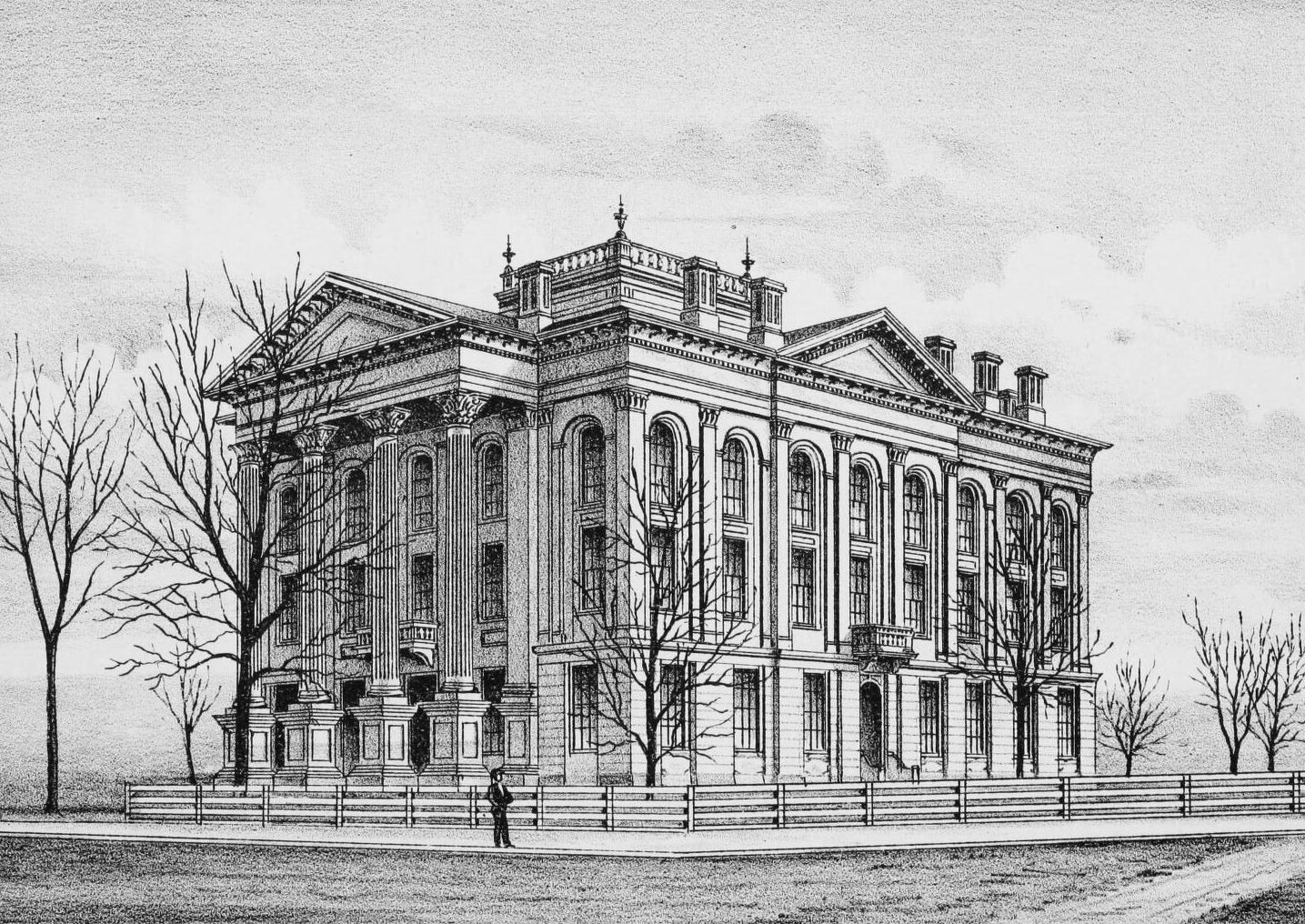
Dearborn county was created on March 7, 1803, by force of a proclamation issued on that date by William Henry Harrison, governor of Indiana Territory, defining the boundaries of the county and announcing that its name was Dearborn, in honor of Major-General Dearborn, at that time the secretary of war under President Jefferson. On the same day that Governor Harrison issued his proclamation, he appointed the following named persons to the several offices in the county, court of common pleas, general quarter-sessions of the peace and orphans’ court; Benjamin Chambers, Jabez Percival, Barnet Hulick, Samuel Brownson, Jeremiah Hunt, Richard Stevens, William Major, and James McCarty. Samuel Vance was appointed clerk of the courts, and James Dill, recorder. The commissions of these offices dated from March 7, 1803. It was necessary that the county be prepared with a military organization for defense against the Indians that were yet turbulent and disposed to give trouble, so on August 15, 1803, as governor of the territory, General Harrison issued commissions as officers of the militia to William Hall, Samuel Fulton, Daniel Lynn, Barnet Hulick and Jeremiah Johnston, as captains; William Standiford, William Spencer, William Cheek, James Hamilton and William Allensworth, lieutenants; Gersham Lee, Thomas Fulton, Michael Flake, William Thompson and James Buchanan, ensigns. On August 23, 1808, David Lamphere was commissioned sheriff and James Hamilton recorder, vice James Dill, resigned.
The first session of the courts is believed to have commenced on the first Monday in September, 1803. In the proclamation establishing the county the courts were directed to be held in Lawrenceburg, which had been laid out during the previous spring. Dr. Jabez Percival, one of the judges, had built a double log cabin and in it the first courts were held. The county at that time extended to the north, in a wedge-shaped form, to where the Indian boundary line from the mouth of the Kentucky river to Ft. Recovery crossed the Ohio line. Much of it to the north was a wilderness and the only settlers were along the Ohio and up the Whitewater to the neighborhood of Brookville.
COURT HOUSES AND JAILS
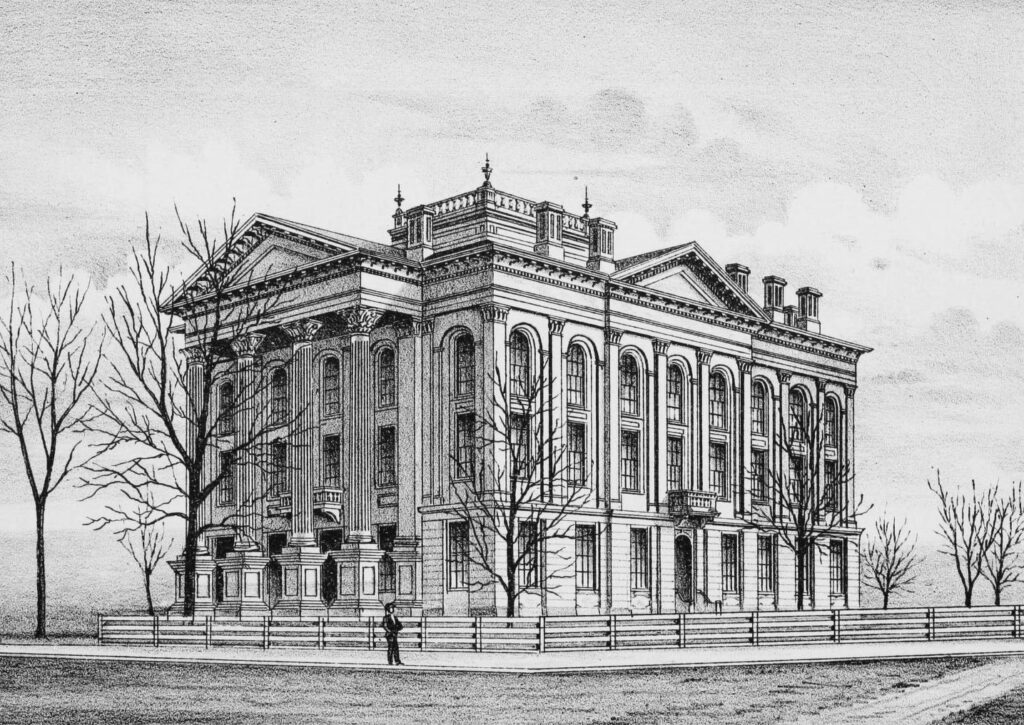
The first court house stood just where the present house stands, and was built in 1810. It was a two-story brick building, the court room being on the ground floor, with the jury room above. This building was destroyed by fire on March 5, 1826. The second building was constructed on the same foundation, and with the same walls as the first, the interior of the building having been all that burned. In May, 1827, the county board of supervisors appointed Jesse Hunt, James W. Hunter and George H. Dunn commissioners to superintend the construction of the building, which was not finished for occupancy until the late fall of 1828. The county seat was moved from Lawrenceburg to Wilmington in 1835, and a court house was erected in that village by its citizens and the people of that vicinity, which cost about four thousand dollars, with the jail. The county seat was moved back to Lawrenceburg in 1843, and the old buildings were again put into service. The present building was commenced in 1870. The cornerstone was laid on April 13, 1871, and the building was completed in 1873, at a cost of about one hundred thousand dollars. While the second court house was in use the county erected two one-story brick buildings, between the court house and Mary street, for the use of the county clerk, sheriff, treasurer, recorder and auditor.
The first jail was erected in 1804, and was built of logs. In 1806 William Cook was jailer and resided in the jail building. The second jail was supposed to have been built in 1810, at the time the first court house was erected. It is referred to as a stone jail and was two stories high, having been built on the site of the present jail. The third jail was erected at Wilmington by the citizens of the village and vicinity when the court house was located there. It was shortly afterward destroyed by fire and a second jail was built, on the public square in that village. This second jail was built under contract with the county by Timothy Kimball, and cost one thousand nine hundred and thirty-nine dollars and seventy-seven cents. The fifth jail was erected on the public square in Lawrenceburg, in 1848, the contract having been let to Timothy Kimball, and cost two thousand six hundred dollars, with two hundred and ten dollars for extra cost in building the foundation above the flood of 1832. The sixth and present jail was erected in 1858–59, at a cost of eight thousand six hundred dollars.
QUESTION OF COUNTY DIVISION
The county seat of Dearborn county has been at Lawrenceburg ever since the county was organized with the exception of the short time it was located at Wilmington, from September 26, 1836, to January 4, 1844, when the act removing the seat of justice from Wilmington to Lawrenceburg was signed by the governor of Indiana.
When the county was first organized the question of division was agitated. Franklin was laid off to the north in 1809, and the matter of establishing a county south of Laughery creek, with Rising Sun as its county seat, commenced to be talked of soon afterward. As early as 1817, before the state had hardly become organized, Col. Abpl C. Pepper, of Rising Sun, it is claimed, went to Corydon, the capital at that time, with the avowed intention of securing an act of the Legislature organizing a new county with Rising Sun as its seat of justice. But at that time there was less business and the journey was unsuccessful. The residents of the county living south of Laughery creek, however, were dissatisfied, claiming that the creek was a serious impediment to their reaching court on account of floods and the consequent danger in fording that stream. The friends of a division of the county, however, not being able to secure a division, resorted to a strategy and secured the removal of the county seat to what they claimed was a more central location, which was done in 1836. Lawrenceburg, having lost the county seat, was no longer opposed to the formation of a new county south of Laughery creek, and accordingly an alliance was made between the friends of organizing a new county and those who were in favor of relocating the county seat at Lawrenceburg, and in 1843 the issue during the election for members of the Legislature was the question of the relocation of the county seat at Lawrenceburg and the organization of a new county south of Laughery creek.
George P. Buell, of Lawrenceburg township, and Charles Dashiell, of Sparta township, the former for relocating and division, and the latter against, were the candidates for the state Senate. Buell carried the day by a large vote and the changes were made as above. After Buell’s election there seemed to be some fear among the more ardent friends of relocation that he would be influenced against the act and the following is a letter to Mr. Buell from the pen of James H. Lane, urging him to be firm to the pledge he made to his constituents during the campaign:
“Lawrenceburg, Dec. 15th, 1843.
Dear Sir:—Your letter came to hand today—I am pleased to hear our local question is in a train for final settlement—In reference to this a great change has taken place in the minds of the people of the county since the election.—You recollect a few prominent men such as David Tibbetts, Hubbs, etc. insisted on having the county seat relocated by a direct vote of the people at the ballot box. Since they have ascertained that the Kelso and Logan Democrats signed our petition a change has come over the spirit of their dreams and they now admit the question settled. The court interests have given to us the tract. They expect the county seat removed and if removed they will not be disappointed—Your course seems to me a plain one—You was nominated and elected as a Lawrenceburg man—Openly avowed that you would place Division and relocation on your ticket.—You also pledged yourself to carry out the instructions of the Wilmington convention,—That convention instructed to support relocation by a direct vote of the people at the ballot box.—You were elected—Your Democratic friends in Logan, Kelso, York, Miller, Lawrenceburg and Jackson whose firm adherence to you decided your vote in the convention—Now instruct you to vote for relocation directly to Lawrenceburg. On that petition you will find the names of your true friends. The only question then is will this instructions by petition relieve you from the former pledge.—I say without hesitation it will—The people have the right to instruct their representative—They have so done at public meetings and by petition. The petition was gotten up purposely to relieve you.—Our opponents started their remonstrance, they failed—we succeeded. Will you now disappoint your friends?—as well as your enemies, who expect you to obey our instructions and they (your enemies) expect to lose the county seat. Let us suppose hereafter if you are a candidate that you are charged with violating your pledge on this subject. Such a charge could certainly not injure you with the Whigs.—and certainly not with the Democrats, for a majority of them in the county are on the petition.—Supposing that James Milliken should ever attempt to use this against you.—You could produce the instructions of that township as expressed at that meeting when resolutions were passed instructing our senator and representative to support a bill for relocating the county seat directly to this place.—You have a majority of all the votes in all the upper townships. Then how in the name of common sense can it affect you.—My dear sir—I would not for all the county seats in the world make a suggestion which I supposed would affect your popularity.—I know however as well as I know I am living that if the law passes with your warm and zealous support, nothing will be said, for everyone expects it, both friend and enemy. The Wilmington Boys will abuse the Lawrenceburgers for getting up the instructions and it will pass off. But the other course would be fatal and deadly. Your friends have nominated you. They elected you. They have instructed you.—Place the county seat at Lawrenceburg and you are in two short years a Congressman.—Pursue a lukewarm course or oppose the bill and you are prostrate forever.—Let me assure you if the bill becomes the law you will have all the credit.—If it fails you will be held responsible. My dear sir: Let me here state that a relocation of the county seat by a direct vote of the people will forever rob Lawrenceburg of it.—Of this there is no mistake. I would rather by all means that you would oppose the law entirely than to support such a one. I have purchased pork this week from all parts of the county above Laughery.—All of the settlers talk about coming here to court in the Spring as a matter settled.—Mr. Buell: I have scribbled more than I expected when I commenced and must stop by saying that you are now senator from this county. You were placed there by the promises of your friends in Lawrenceburg with Logan and Kelso yours and the giving of Jackson.—You stand footloose in a situation to serve us and at the same time strengthen yourself in the course I am confident you will pursue.Yours respectfully,
J. H. Lane.”“N. B. Buell: Remember I labored here for you and all I have in the world is in Lawrenceburg and I say relocate by a direct vote is a thousand times worse than leaving the county seat at Wilmington. Go against it. Enter and defeat it for the present or else support it with all your might and strength and pass it, but for God’s sake no direct vote.
Remember to have the relocation to the old place specified in the law so that there can be no mistake.
J. H. L.”
Back to: History of Dearborn County, Indiana
Source
Shaw, Archibald, History of Dearborn County, Indiana : her people, industries and institutions, with biographical sketches of representative citizens and genealogical records of old families, Indianapolis : B.F. Bowen, 1915.