
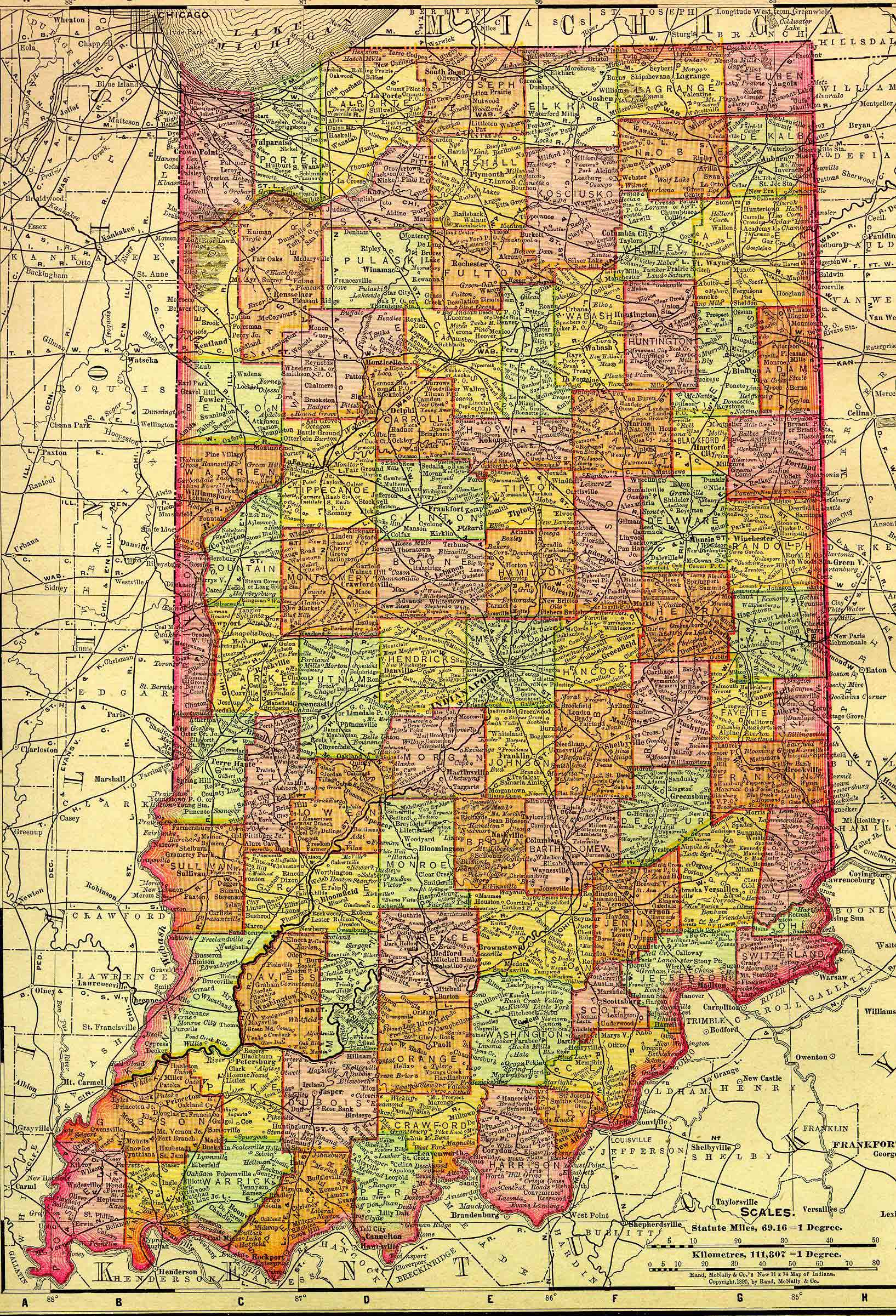
As fast as the population would warrant, new counties were established in this New Purchase. Newton County (December 9, 1859) was the last county to be organized in the state. It had been first established by the legislative act of January 29, 1839, but within a year it was found that the population was too sparse to justify its separate existence, so it was attached to Jasper County and it was not until about twenty years later that its population was sufficient to make a separate county of it. Howard County was first organized as Richardville County (May 1, 1844), but its name was changed by the legislative act of December 28, 1846, to Howard. For purposes of reference, a list of the counties, with the dates of their establishment, is here appended. The dates given represent the time the organization became effective, since in many instances it was from a few months to as much as seven years after the act establishing the county was passed before it became effective.
| No. | County | Date of Organization |
|---|---|---|
| 1 | Knox | June 20, 1790 |
| 2 | Clark | Feb. 3, 1801 |
| 3 | Dearborn | Mch. 7, 1803 |
| 4 | Harrison | Dec. 1, 1808 |
| 5 | Jefferson | Feb. 1, 1811 |
| 6 | Franklin | Feb. 1, 1811 |
| 7 | Wayne | Feb. 1, 1811 |
| 8 | Warrick | Apr. 1, 1813 |
| 9 | Gibson | Apr. 1, 1813 |
| 10 | Washington | Jan. 17, 1814 |
| 11 | Switzerland | Oct. 1, 1814 |
| 12 | Posey | Nov. 1, 1814 |
| 13 | Perry | Nov. 1, 1814 |
| 14 | Jackson | Jan. 1, 1816 |
| 15 | Orange | Feb. 1, 1816 |
| 16 | Sullivan | Jan. 15, 1817 |
| 17 | Jennings | Feb. 1, 1817 |
| 18 | Pike | Feb. 1, 1817 |
| 19 | Daviess | Feb. 15, 1817 |
| 20 | Dubois | Feb. 1, 1818 |
| 21 | Spencer | Feb. 1, 1818 |
| 22 | Vanderburgh | Feb. 1, 1818 |
| 23 | Vigo | Feb. 15, 1818 |
| 24 | Crawford | Mch. 1, 1818 |
| 25 | Lawrence | Mch. 1, 1818 |
| 26 | Monroe | Apr. 10, 1818 |
| 27 | Ripley | Apr. 10, 1818 |
| 28 | Randolph | Aug. 10, 1818 |
| 29 | Owen | Jan. 1, 1819 |
| 30 | Fayette | Jan. 1, 1819 |
| 31 | Floyd | Feb. 2, 1819 |
| 32 | Scott | Feb. 1, 1820 |
| 33 | Martin | Feb. 1, 1820 |
| 34 | Union | Feb. 1, 1820 |
| 35 | Greene | Feb. 5, 1821 |
| 36 | Bartholomew | Feb. 12, 1821 |
| 37 | Parke | Apr. 2, 1821 |
| 38 | Morgan | Feb. 15, 1822 |
| 39 | Decatur | Mch. 4, 1822 |
| 40 | Shelby | Apr. 1, 1822 |
| 41 | Rush | Apr. 1, 1822 |
| 42 | Marion | Apr. 1, 1822 |
| 43 | Putnam | Apr. 1, 1822 |
| 44 | Henry | Jun. 1, 1822 |
| 45 | Montgomery | Mch. 1, 1823 |
| 46 | Hamilton | Apr. 7, 1823 |
| 47 | Johnson | May 5, 1823 |
| 48 | Madison | Jul. 1, 1823 |
| 49 | Vermillion | Feb. 1, 1824 |
| 50 | Allen | Apr. 1, 1824 |
| 51 | Hendricks | Apr. 1, 1824 |
| 52 | Clay | Apr. 1, 1825 |
| 53 | Tippecanoe | Mch. 1, 1826 |
| 54 | Fountain | Apr. 1, 1826 |
| 55 | Warren | Mch. 1, 1827 |
| 56 | Delaware | Apr. 1, 1827 |
| 57 | Hancock | Mch. 1, 1828 |
| 58 | Carroll | Mch. 1, 1828 |
| 59 | Cass | Apr. 13, 1829 |
| 60 | Clinton | Mch. 1, 1830 |
| 61 | St. Joseph | Apr. 1, 1830 |
| 62 | Elkhart | Apr. 1, 1830 |
| 63 | Boone | Apr. 1, 1831 |
| 64 | Grant | Apr. 1, 1832 |
| 65 | Laporte | Apr. 1, 1832 |
| 66 | Lagrange | Apr. 1, 1832 |
| 67 | Huntington | Dec. 2, 1834 |
| 68 | Miami | Mch. 1, 1834 |
| 69 | White | Apr. 1, 1834 |
| 70 | Wabash | Mch. 1, 1835 |
| 71 | Porter | Feb. 1, 1836 |
| 72 | Adams | Feb. 1, 1836 |
| 73 | Jay | Mch. 1, 1836 |
| 74 | Noble | Mch. 1, 1836 |
| 75 | Fulton | Apr. 1, 1836 |
| 76 | Marshall | Apr. 1, 1836 |
| 77 | Brown | Apr. 1, 1836 |
| 78 | Kosciusko | Jun. 1, 1837 |
| 79 | Lake | Feb. 15, 1837 |
| 80 | Steuben | May 1, 1837 |
| 81 | DeKalb | May 1, 1837 |
| 82 | Wells | May 1, 1837 |
| 83 | Jasper | Mch. 15, 1838 |
| 84 | Whitley | Apr. 1, 1839 |
| 85 | Blackford | After pub., 1839 |
| 86 | Pulaski | May 6, 1840 |
| 87 | Benton | Feb. 18, 1840 |
| 88 | Ohio | Mch. 1, 1844 |
| 89 | Tipton | May 1, 1844 |
| 90 | Richardville | May 1, 1844 |
| 91 | Starke | Jan. 15, 1850 |
| 92 | Newton | Dec. 9, 1859 |
The first thirteen counties in the above list were all that were organized when the territory of Indiana petitioned Congress for an enabling act in 1815. They were in the southern part of the state and had a total population of sixty-three thousand eight hundred and ninety-seven. At that time the total state tax was only about five thousand dollars, while the assessment of the whole state in 1816 amounted to only six thousand and forty-three dollars and thirty-six cents.
CHANGES IN THE CONSTITUTION OF INDIANA
The Constitution of 1816 was framed by forty-three delegates who met at Corydon from June 10 to June 29 of that year. It was provided in the Constitution of 1816 that a vote might be taken every twelve years on the question of amending, revising or writing a wholly new instrument of government. Although several efforts were made to hold constitutional conventions between 1816 and 1850, the vote failed each time until 1848. Elections were held in 1823, 1828, 1840 and 1846, but each time there was returned an adverse vote against the calling of a constitutional convention. There were no amendments to the 1816 Constitution, although the revision of 1824 by Benjamin Parke and others was so thorough that it was said that the revision committee had done as much as a constitutional convention could have done.
It was not until 1848 that a successful vote on the question of calling a constitutional convention was carried. There were many reasons which induced the people of the state to favor a convention. Among these may be mentioned the following: The old Constitution provided that all the state officers except the governor and lieutenant-governor should be elected by the Legislature. Many of the county and township officers were appointed by the county commissioners. Again, the old Constitution attempted to handle too many matters of local concern. All divorces from 1816 to 1851 were granted by the Legislature. Special laws were passed which would apply to particular counties and even to particular townships in the county. If Noblesville wanted an alley vacated or a street closed, it had to appeal to the Legislature for permission to do so. If a man wanted to ferry people across a stream in Posey County, his representative presented a bill to the Legislature asking that the proposed ferryman be given permission to ferry people across the stream. The agitation for free schools attracted the support of the educated people of the state, and most of the newspapers were outspoken in their advocacy of better educational privileges. The desire for better schools, for freer representation in the selection of officials, for less interference by the Legislature in local affairs, led to a desire on the part of the majority of the people of the state for a new Constitution.
The second constitutional convention of Indiana met at Indianapolis, October 7, 1850, and continued in session for four months. The one hundred and fifty delegates labored faithfully to give the state a Constitution fully abreast of the times and in accordance with the best ideas of the day. More power was given the people by allowing them to select not only all of the state officials, but also their county officers as well. The convention of 1850 took a decided stand against the negro and proposed a referendum on the question of prohibiting the further emigration of negroes into the state of Indiana. The subsequent vote on this question showed that the people were not disposed to tolerate the colored race. As a matter of fact, no negro or mulatto could legally come into Indiana from 1852 until 1881, when the restriction was removed by an amendment of the Constitution. Another important feature of the new Constitution was the provision for free schools. What we now know as a public school supported at the expense of the state was unknown under the 1816 Constitution. The new Constitution established a system of free public schools, and subsequent statutory legislation strengthened the constitutional provision so that the state now ranks among the leaders in educational matters throughout the nation. The people of the state had voted on the question of free schools in 1848 and had decided that they should be established, but there was such a strong majority opposed to free schools that nothing was done. Orange County gave only an eight percent vote in favor of free schools, while Putnam and Monroe, containing DePauw and Indiana Universities, respectively, voted adversely by large majorities. But, with the backing of the Constitution, the advocates of free schools began to push the fight for their establishment, and as a result of the legislative acts of 1855, 1857 and 1867, the public schools were placed upon a sound basis.
Such in brief were the most important features of the 1852 Constitution. It has remained substantially to this day as it was written sixty-five years ago. It is true there have been some amendments, but the changes of 1878 and 1881 did not alter the Constitution in any important particular. There was no concerted effort toward calling a constitutional convention until the Legislature of 1913 provided for a referendum on the question at the polls November 4, 1914. Despite the fact that all the political parties had declared in favor of a constitutional convention in their platforms, the question was voted down by a large majority. An effort was made to have the question submitted by the Legislature of 1915, but the Legislature refused to submit the question to the voters of the state.
CAPITALS OF NORTHWEST TERRITORY AND INDIANA
The present state of Indiana was comprehended within the Northwest Territory from 1787 to 1800, and during that time the capital was located within the present state of Ohio. When the Ordinance of 1787 was put in operation on July 17, 1788, the capital was established at Marietta, the name being chosen by the directors of the Ohio Company on July 2 of the same year. The name Marietta was selected in honor of the French Queen, Marie Antoinette, compounded by curious combination of the first and last syllables of her name.
When Indiana was set off by the act of May 7, 1800, the same act located the capital at Vincennes, where it remained for nearly thirteen years. The old building in which the Territorial Assembly first met in 1805 is still standing in Vincennes. In the spring of 1813, the capital of the territory was removed to Corydon, and it was in that quaint little village that Indiana began its career as a state. It remained there until November 1824, when Samuel Merrill loaded up all of the state’s effects in three large wagons and hauled them overland to the new capital — Indianapolis. Indianapolis had been chosen as the seat of government by a committee of ten men, appointed in 1820 by the Legislature. It was not until 1824, however, that a building was erected in the new capital which would accommodate the state officials and the General Assembly. The first courthouse in Marion County was built on the site of the present building, and was erected with a view of utilizing it as a state house until a suitable capitol building could be erected. The state continued to use the Marion County courthouse until 1835, by which time an imposing state house had been erected. This building was in use until 1877, when it was razed to make way for the present beautiful building.
Back to: History of Dearborn County, Indiana
Source
Shaw, Archibald, History of Dearborn County, Indiana : her people, industries and institutions, with biographical sketches of representative citizens and genealogical records of old families, Indianapolis : B.F. Bowen, 1915.