
The mysterious people called, for want of a more definite name, “The Mound Builders,” must have inhabited Dearborn County at some period in its past. The evidences left by them would lead us to believe that the county must have been as thickly, if not more thickly, settled than it is now. On nearly every commanding position, the county over, may be found mute, but certain, evidence that these people lived here. The hillsides are not the only places, however, for in the valleys of the creeks, on every knoll that is elevated a little above the surrounding country, are mounds showing that a people have lived here. Who these people were, has so far been a mystery. Many hold that they were the early Indian race, who have degenerated into the nomadic conditions, by years of war with each other. Some believe they were the Aztecs of Mexico, who, after years of war with the Indian, as we know him, were either destroyed or compelled to emigrate to the South. Still others there are, who think they were people who had come originally from Asia and were akin to the Chinese. Others hold that at one time, many thousand years ago, there was a true Atlantis; that Europe and Africa were connected with this country by an unbroken, continuous continent, that was sunk under the ocean by some awful cataclysm. However, whatever theory is correct, if any, the evidences of the existence of some prehistoric race can be found on every hand.
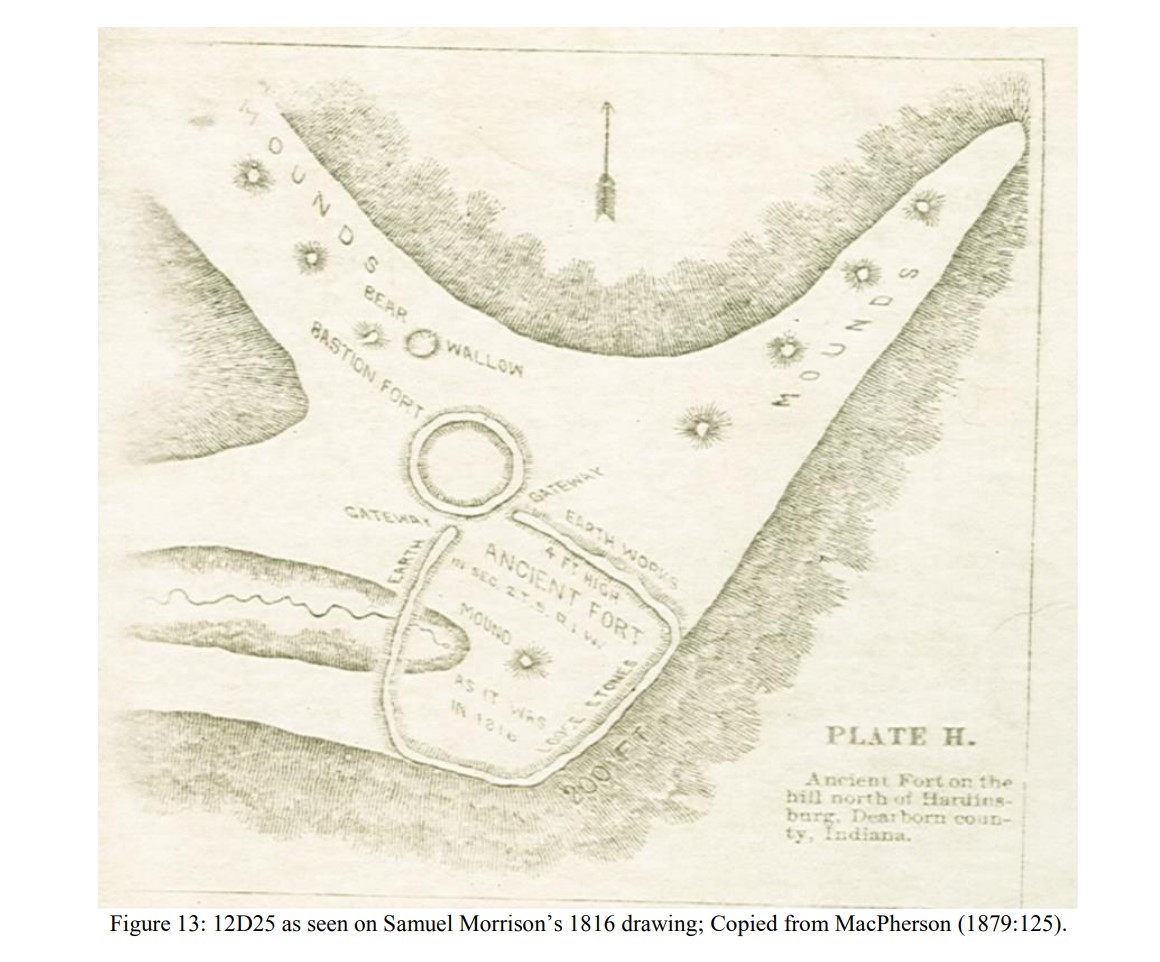
One of the most extensive evidences of the existence of this prehistoric people can be found on the hilltop overlooking the mouth of the Big Miami and immediately overlooking Lawrenceburg Junction, on the Chicago, Cincinnati, Cleveland & St. Louis Railway. It encloses some twenty or more acres of ground and a bank of earth, plainly visible, can be traced about the whole enclosure. At the most eastern point there seemed to have been a gateway or entrance of some kind; at the western part, there is a mound or redoubt, just outside of the wall. At some places the bank is yet some six or eight feet in height. Large trees are growing on the earthworks—or were, some of it having been cleared. The timber is just as large on the inside of the enclosure as on the outside, and on the bank, in places, are trees just as large as any in the woods. Samuel Morrison at one time made a survey of the enclosure and drew a map of it which can be found in some of the early histories of the Ohio Valley. One thing is distinctly noticeable, namely, that some of the mounds along the river are placed in such a position that other mounds can be seen from them, and it is the theory advanced by some, that these are intended as signal mounds. It is claimed by some archaeologists that there is a system of signal mounds extending along the Ohio from Pittsburgh to Cairo.
The New “American Encyclopedia” claims that none of these monuments is less than two thousand years of age. This, however, is assumed from their best judgment of the erosion that would occur in that time. But it must be admitted that it is difficult to form any judgment of the length of time since these mounds were built. The elements are so destructive that in a few days the work of years may be effaced; then, for years there might be no perceptible difference in the erosion. But “by whom built, whether their authors migrated to remote lands under the combined attractions of a more fertile soil and more genial climate, or whether they disappeared beneath the victorious arms of an alien race, or were swept out of existence by some direful epidemic or universal famine, are questions probably beyond the power of human investigations to answer. History is silent concerning them and their very name is lost to tradition itself.”
Gen. William H. Harrison took a deep interest in these works. “The work at the mouth of the Great Miami (Fort Hill),” he wrote to Samuel Morrison, “was a citadel more elevated than the Acropolis at Athens, although easier of access, as it is not, like the latter, a solid rock, but on three sides as nearly perpendicular as could be, composed of earth. A large space of lower ground was, however, enclosed by walls uniting it from Miami River to the Ohio. The foundation of that being of stone, as well as those of the citadel that forms the western defence, is still very visible where it crosses the Miami, which, at the period of its erection, must have discharged itself into the Ohio much lower down than it does now. I have never been able to discover the eastern wall of the enclosure, but if its direction from the citadel to the Ohio, was such as it should have been, to embrace the largest space with the least labor, there would not have been less than three hundred acres enclosed. The same land at this day, under the best cultivation, will produce from seventy to one hundred bushels of corn per acre. Under such as was then probably bestowed upon it, there would be much less, but still enough to contribute to the support of a considerable number of people, remarkable beyond all others for abstemiousness in their habits.”
There are a number of mounds about Aurora and there was said to have been quite a large one within the city limits which has been almost entirely removed by excavations in grading. Jonathan B. Gerard, a citizen of Hartford, some thirty years ago opened a mound near the mouth of Laughery Creek which was about one hundred feet in diameter and fifteen feet high. Human bones, one whole earthen pot and a great many fragments of pottery were all that was found. In the same mound two more pots were found afterwards. It is no uncommon thing to find, where the water of the Ohio has caved the bank, ancient fireplaces, where mussels and other things could be cooked without attracting attention. Among the most interesting things found are the utensils, implements, weapons and personal ornaments of prehistoric times. Some of these, no doubt, belonged to the Indian tribes, but the greater number were contemporary with the mounds and other evidences of the earlier race. Not long ago, in grading some lots in Greendale, on the lands of Warren Tebbs, a copper chisel was found in a good state of preservation. Stone pipes are frequently found, thus showing that these people were tobacco users.
At the state line, near the monument erected to mark the line between the states of Ohio and Indiana, on the farm of Thomas and Joseph Fitch, there seems to be a burial ground. In excavating for a barn foundation graves were found at regular intervals of about thirty inches, in rows, the bodies lying with their heads to the west, facing the east. They were all of the same character, with the exception of one grave, which had two bodies in it, one with its cheek on that of the other, and on their chests was a bowl or pot made of shells and clay, pieces of which material are strewn over the top of the ground thereabouts. It seemed, according to the judgment of the physicians who examined them, that the upper skeleton was that of a female. In other places adjacent, in a space of two or three acres, skeletons are found wherever any excavating has been done. The same is true in Greendale and other places where the soil is gravelly and high above the river. It is evident from the number of buried that the country must have been thickly populated about the mouth of the Miami, and close to all the streams, at least. But who they were, what their history, where they went, or how they came to disappear, is a closed volume. If the American Indian ever made Dearborn County a place of permanent residence, it must have been long before the advent of the white man. The earliest traveler gives no word of finding Indians along the Ohio in this locality, except in hunting or war parties. There are no relics in this vicinity, nor traditions of any Indian villages ever existing within the borders of Dearborn County, except temporarily when out hunting or en route to hunting grounds or to attack an enemy.
This information as written out in 1915 by Archibald Shaw is factually incorrect. There are some Late Woodland and Late Prehistoric archaeological sites within the current bounds of Dearborn County which have been investigated by archeologists. Matthew Swhart and Kevin Nolan last investigated Fort Ancient Settlement and Community Patterns in Dearborn County, Indiana in 2014.
Back to: History of Dearborn County, Indiana
Source
Shaw, Archibald, History of Dearborn County, Indiana : her people, industries and institutions, with biographical sketches of representative citizens and genealogical records of old families, Indianapolis : B.F. Bowen, 1915.