
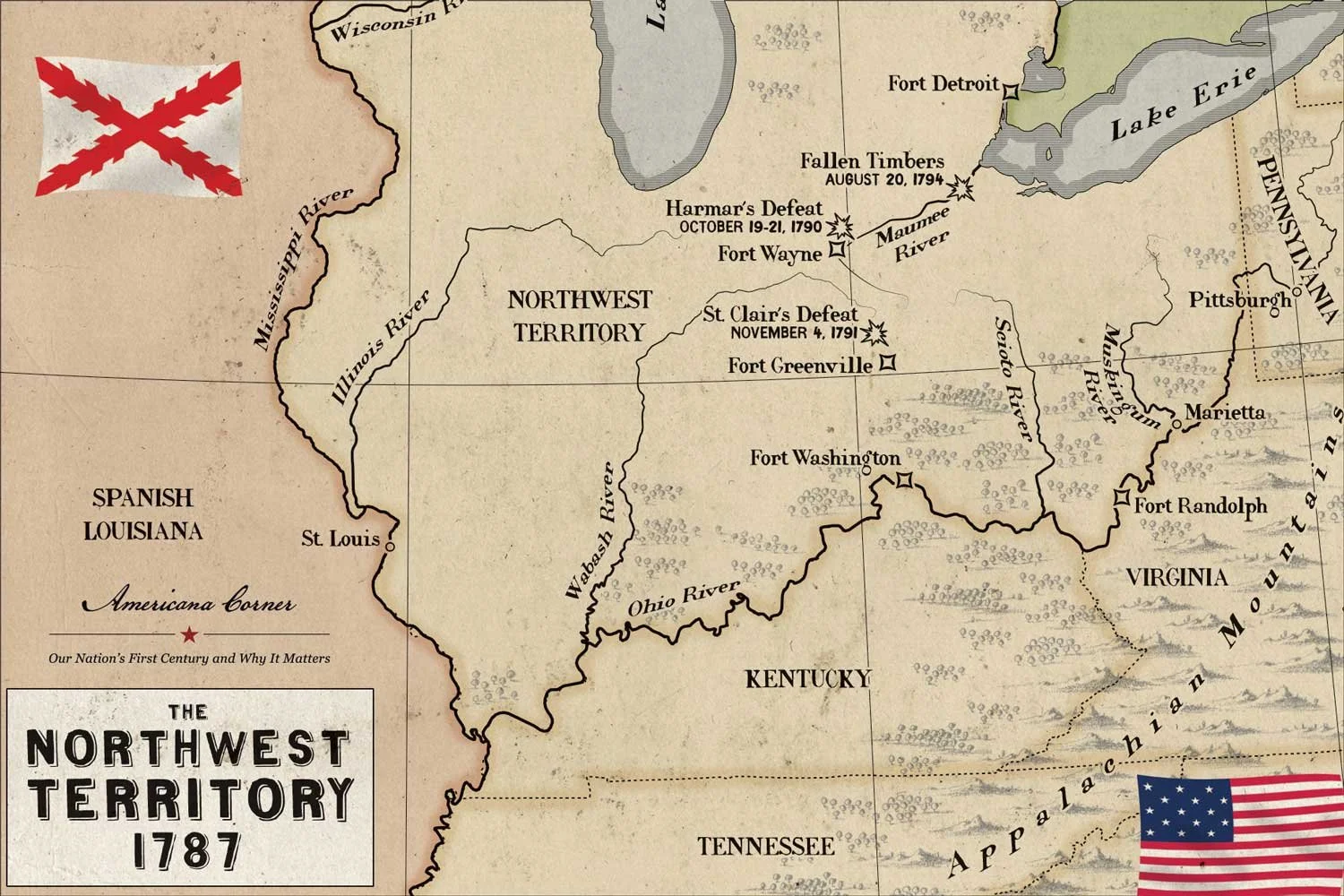
During the early period of many changes, the subjection of the great Northwest Territory was prosecuted by the determined pioneers under the able leadership of such men as George Rogers Clark, Benjamin Logan, Arthur St. Clair, Anthony Wayne, William Henry Harrison, Charles Scott, Daniel Boone, James Wilkinson, Josiah Harmar, Simon Kenton and others.
The first expedition of import in the territory of Indiana against the Indians was the unsuccessful one that George Rogers Clark prosecuted against the Wabash Indians in 1786. Depredations in Kentucky had been numerous, and in many instances atrocious, and the stealthy Indians always made their escape good by crossing the Ohio into Indiana after plundering, burning and scalping. Chief among these bands were members of the Miami and Wabash tribes. The treaty at Ft. Finney had failed in its effort to secure a lasting peace and, driven by the seriousness of the situation, Congress ordered two companies to descend the Ohio to the Falls and on June 30, 1786, ordered the raising of militia in Kentucky for the invasion of the country of the hostile tribes. This expedition was organized into two parties, one under Clark and the other under Col. Benjamin Logan. Clark was directed to march against the strongholds in the headwaters of the Wabash, and Logan was ordered to subjugate the tribes along the upper Wabash.
Colonel Logan proceeded from Maysville, Kentucky, with about five hundred mounted riflemen, crossed the Ohio and struck directly into the heart of the country he was to conquer. He succeeded in destroying several villages and taking upwards of seventy prisoners and killing about twenty.
Such good fortune, however, did not attend the efforts of General Clark. Accompanied by one thousand men, he moved from Louisville to Vincennes, arriving there in October. Supplies for his army had been sent thither by water and low river stages held up the transports in many places, causing delay, embarrassment and downright hunger. The men were put on half rations and they promptly became dissatisfied and bordered on mutiny. After waiting ten days, the provisions arrived, and it was found that the long exposure of the meat to the hot weather had spoiled it, and the men were left with rations for three days’ subsistence. With a two-hundred-mile march ahead, General Clark was in a quandary. He persuaded, cajoled and pleaded, but, one day later, three hundred men, together with some officers of high rank, mounted their horses and turned back for their homes. Open mutiny now prevailed and even the tears of the leader were of no avail. There was no alternative but to immediately abandon the expedition. So, with the remnant of his hungry men, they struggled back to the Falls, chagrined at his failure. It was the last expedition ever undertaken by the most brilliant and versatile leader of his day, and, to his credit let it be said, the only one with such an ending.
Restless tribes of Indians continued to commit acts of savagery along the western frontier, and in January, 1791, President Washington took the matter in hand and directed a communication to Congress, stating that another campaign against the Wabash Indians was necessary. He outlined the plan by saying that the strength of the tribe was about one thousand one hundred, and to this, in war time, would be added about one thousand from other tribes. The President took the stand that a move in the winter time was imperative because, if left to their own devices, they would collect strength during the winter for fresh attacks on settlements in the spring.
Acting on this statement, Congress authorized the President to raise an army of three thousand men, to be placed under the command of General St. Clair, who was appointed a major-general, and also a corps of Kentucky volunteers for the purpose of a rapid march and an immediate attack on the Wabash. This corps was placed under the command of Gen. Charles Scott.
With a force of eight hundred mounted sharpshooters, General Scott, on May 23, 1791, crossed the Ohio just above the mouth of the Kentucky River and plunged into the Indiana wilderness with all the speed possible. On June 1 they reached the Wabash River and came within sight of two Indian villages. The Indians, who had been apprised of the coming of the enemy, were making their escape in canoes when discovered, and were killed by the accurate fire of the Kentuckians. Across the river were two Kickapoo villages and from these, Indians returned the fire, but two companies succeeded in crossing the river and driving them from their homes. The following day another strong village was encountered and was taken, the Indians losing heavily in men killed and taken. On the day following they continued their march and overtook Col. James Wilkinson, with three hundred and sixty men. Together, they marched on a large Tippecanoe village, which they captured and destroyed, taking great quantities of provisions. Continuing their march, they arrived at the Ohio River on June 11 without having lost a single man, and having had only four wounded. But they had done what they set out to do.
The remarkable success of General Scott fired the Kentucky board of war with the resolve to undertake another like movement without delay. On the recommendation of General St. Clair, the command was given to Col. James Wilkinson and, with five hundred and twenty-five men at his back, he set out to destroy the Eel River towns. They left Cincinnati on August 1, 1791, taking provisions for thirty days. A long detour by way of Ft. Wayne was taken in order to mislead the enemy by avoiding the beaten paths leading to the hunting grounds of southeastern Indiana, which was their objective point. After they had traveled northward for three days and made about seventy miles, they turned their course northwestward and on August 7 reached the Wabash River, near the mouth of Eel River. Here the men made a furious charge on a village and, taking the Indians completely by surprise, captured the village, killed six and took thirty-four. Colonel Wilkinson then led his men into the open prairie, where Kickapoo villages were thickly sprinkled, but made another detour and made for the Tippecanoe village, which he had helped destroy in June. Here it was found that the Indians had replanted corn and beans. These were cut down again. About this time Colonel Wilkinson began to hear sounds of discontent among his men and a quiet inquiry developed the startling fact that two hundred and seventy horses were lame and scarcely fit for service, and that provisions were running low and would hardly last five days. Therefore he was compelled to give up returning against the Kickapoo towns, but satisfied himself with the destruction of one good-sized Kickapoo village and the destruction of much growing crops. Then the jaded army turned its face toward Kentucky and arrived at the Falls on August 21, having traversed the path made by General Scott on his June expedition. The movement, while not entirely successful, was not without a considerable measure of success. The men had covered four hundred and fifty-one miles in twenty-one days, and were the objects of much praise from their commander for their untiring service. Many prisoners were taken, among whom were sons and sisters of the king of the Ouiatenon nation. In every attack the men were given stringent orders to spare women and children. This rule obtained in every expedition sent out against hostile tribes, but occasionally, through an inadvertence, the defenseless ones were made victims. In the first village the army of Colonel Wilkinson attacked, two Indian women and one child were killed during the hurry and confusion. It was the only marring feature of the raid.
One of the oldest and most important of the Miami tribes was at the town situated at the junction of the St. Joseph and St. Mary, where they meet to form the Maumee. This particular neighborhood was more thickly populated with Indians than any in Indiana. The sagacity and far-seeing alertness of President Washington quickly saw what a strategic location this spot was for a fortification of some magnitude. A plan was inaugurated for making a campaign with the Miami tribes in that locality with the end in view of establishing a strong fortification there and connecting it with Ft. Washington at Cincinnati by a chain of intermediate stations.
HARMAR’S EXPEDITION
The first of these campaigns was given into the hands of Gen. Josiah Harmar. He left Cincinnati in September, 1790, and was misdirected by guides, so that he took a route far longer than was necessary. All in all, he had probably the worst army ever led out of Ft. Washington. Of the one thousand three hundred men in his command, nearly all of them were raw troops, inexperienced, badly armed and poorly equipped. The camp utensils and all other appurtenances were of poor quality and were not numerous. A great number of the men were unused to the discharge of firearms, and at the first sight of Indians they dropped their arms and fled in confusion. On October 13 the army reached a point about thirty miles from Ft. Wayne. Here Col. John Hardin, with six hundred militiamen, and one company of regulars, was sent forward to surprise the enemy and keep them in their forts until the main body with artillery could come up. To their surprise, however, the villages were found to be deserted. On the 17th the main body arrived and five or six towns were destroyed and about twenty thousand bushels of corn in the ear cut down. On the 21st the army started back to Cincinnati.
The following day, Colonel Hardin convinced General Harmar that another attempt ought to be made against villages just destroyed on the theory that the Indians might have since returned to secure what salvage they could. He took a detachment of three hundred and forty militiamen and sixty regulars. The Indians were there, but they were prepared and they fought bravely and with savage ferocity. The troops were defeated, many of the militiamen and most of the regulars being killed. Broken in spirit by this reverse and by dissensions among his officers, Harmar arrived in Cincinnati. The expedition is known as Harmar’s defeat. But it was a distinct success in so far that it accomplished its purpose, namely, not the intimidation of the hostile Miami tribes, but the destruction of the villages. The Indians looked upon the expedition as a dismal failure and almost an utter rout and they followed up their belief by growing bolder and striking more frequently at frontier towns. Looking to carrying out a regular plan of pillage and destruction, Little Turtle, chief of the Miamis, Blue Jacket, chief of the Shawnees, and Buckongahelas, chief of the Delawares, formed a coalition to drive the whites beyond the Ohio.
ST. CLAIR’S DEFEAT
General St. Clair, himself, organized and led an expedition in 1791. The War Department had ordered him to prepare for a quick march against the strong village at the head of the Maumee in order to establish a military post there and to locate proper places along the march from Cincinnati for auxiliary posts. He was to take up and put through the work attempted by General Harmar the year previous. The War Department urged the founding of the post at the Maumee at all hazards, considering it to be the most strategic point in the northern Indian country.
On November 3, General St. Clair arrived at the banks of a creek which he supposed to be St. Mary’s River, one of the tributaries of the Maumee. Afterward it was found to be a branch of the Wabash. He encamped there for the night, and early the next morning was taken by surprise by ambushed savages and the army met with a crushing defeat. Of upwards of one thousand five hundred men actually engaged in the battle, more than half of them were either killed or wounded. This defeat was the most disastrous suffered yet by whites at the hands of the Indians, and it served to discourage and dishearten the pioneers of the Northwest Territory. For a time following, it was thought that further efforts in the direction of subjecting the Indians in that section would be abandoned. The battle which occurred on the old Indian line in Mercer County marks the spot of Ft. Recovery.
BATTLE OF FALLEN TIMBERS
However, the gloom which prevailed after the great failure of General St. Clair soon was dispelled by drastic action by the federal government. It was readily seen that a hurried or makeshift campaign was of no avail against a foe that fought with all the treacherous tricks known to the savage. This time a force was organized under Gen. Anthony Wayne and in about three years he had them drilled, disciplined and completely equipped. His army numbered more than three thousand men when he set out in the summer of 1794. Carefully feeling his way northward, Wayne led his men around the pitfalls encountered by the leaders of other campaigns. On August 20, 1794, he threw his entire army against the Indians at Maumee Rapids, in Wood County, Ohio, and won the decisive victory which has since been known as Fallen Timbers, and sometimes the Maumee battle. The Indians had gone forth with full strength from their Indiana villages to meet the advancing army. If they had remained at home the battle would have taken place on Indiana soil. The victory brought with it an end to the long and bloody Indian wars, and a treaty of peace was entered into which was not violated, only in minor instances, until the battle of Tippecanoe, in November, 1811.
The space devoted to recounting these Indian wars is justified by the far-reaching importance of the engagements. Settlers from the Eastern states had brought their families to this new country and, in most cases, were unable to properly defend themselves from the brutal attacks of the Indians. They depended upon the armies of their country for protection and, although the quality of the armies sent in such crises was not always good enough to withstand the savage in battle, yet the fact that the expeditions were sent out for that purpose had its effect. The movement begun and completed successfully by General Wayne was the only one that was well planned and well executed. Consequently, more depends on the result of that action.
The victory of General Wayne at Fallen Timbers paved the way for the opening of the great Middle West. It brought home to the savage red man the cold fact that he had met his master and that he must retire. Civilization began in this region immediately after that battle was won and the peace pact agreed upon. As soon as the news of the victory had spread over the Eastern states and the significance of it became apparent, a rush was started that from that time to this has never ceased. The westward movement of population began then and has never stopped. Settlers poured into Ohio, Indiana and Kentucky.
Back to: History of Dearborn County, Indiana
Source
Shaw, Archibald, History of Dearborn County, Indiana : her people, industries and institutions, with biographical sketches of representative citizens and genealogical records of old families, Indianapolis : B.F. Bowen, 1915.