
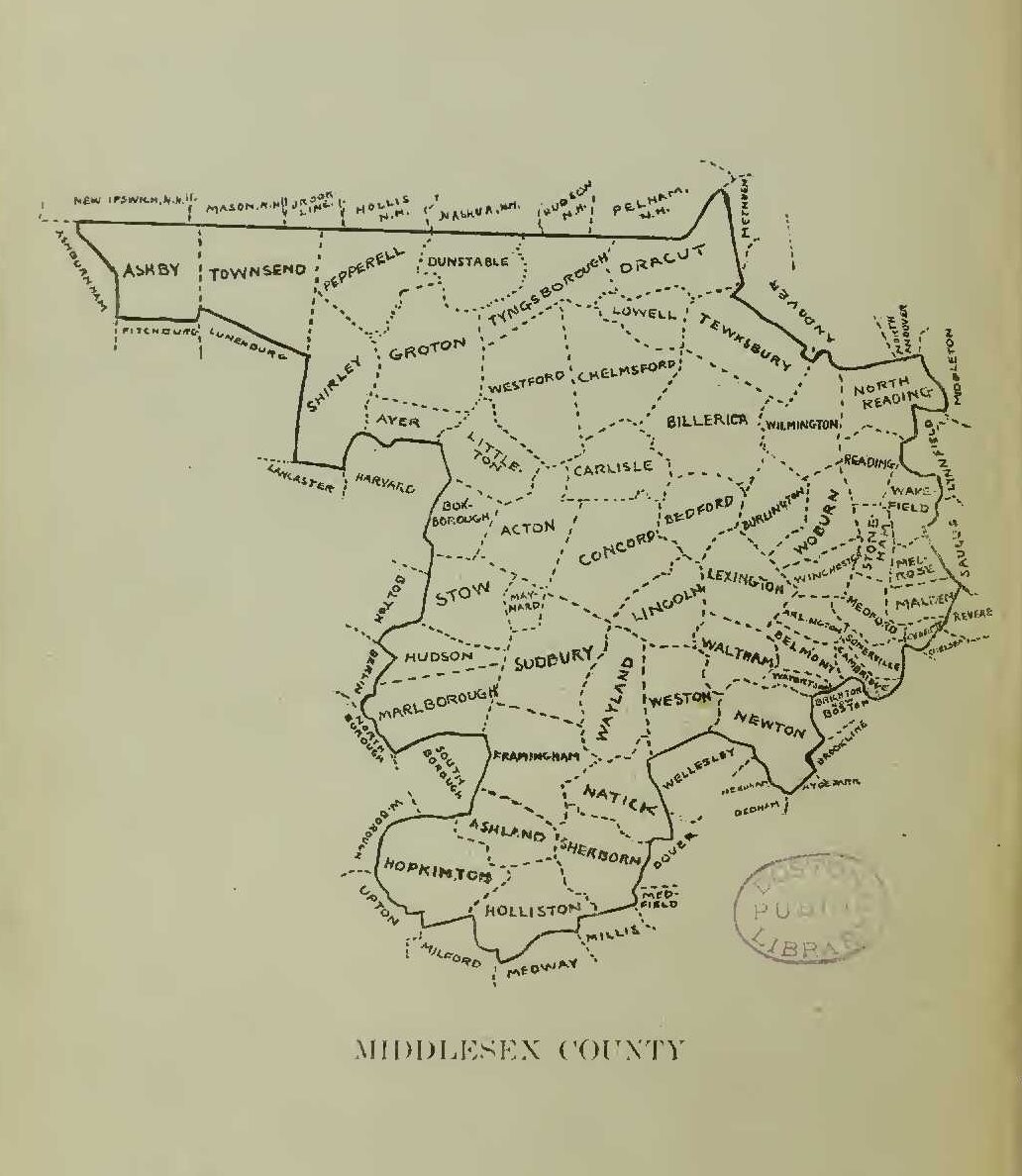
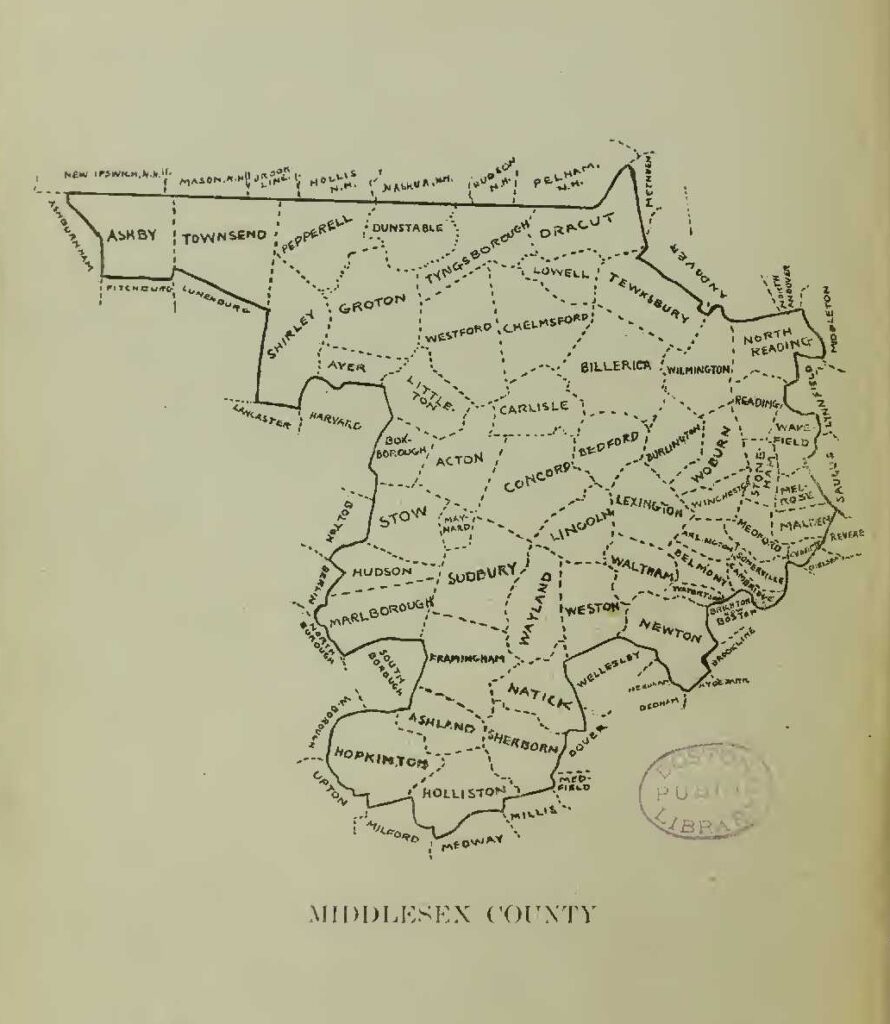
Middlesex County, Massachusetts, was created in 1643. The towns that existed within its bounds during the 1600’s fall into four groups: (1) those settled and incorporated before the county’s creation, (2) those that were settled, but not incorporated until after the county formation, (3) those that were both settled and incorporated after the county formation in 1643, and (4) those settled in the 1600s but not incorporated until the 1700s.
Understanding when a community was first settled is important to genealogical research. See the section on why this matters below.
Settled or Incorporated before County Formation
- Charlestown — settled 1629, incorporated 1630
- Cambridge — settled 1630, incorporated 1636
- Medford — settled 1630, incorporated 1630
- Watertown — settled 1630, incorporated 1630
- Concord — settled 1635, incorporated 1635
- Sudbury — settled 1638, incorporated 1639
- Woburn — settled 1640, incorporated 1642
Settled but not Incorporated until after County Formation
- Billerica — settled 1638, incorporated 1655
- Malden — settled 1640, incorporated 1649
- Lexington — settled 1641 as Cambridge Farms, incorporated 1713
Settled and Incorporated after County Formation
- Newton — settled in the 1640s as Cambridge Village, incorporated 1688
- Reading — settled 1644, incorporated 1644
- Natick — settled 1651, incorporated 1674
- Chelmsford — settled 1652, incorporated 1655
- Sherborn — settled 1652, incorporated 1674
- Groton — settled 1655, incorporated 1655
- Marlborough — settled 1657, incorporated 1660
- Dunstable — settled 1673, incorporated 1673
Settled in the 1600s, but not incorporated until the 1700s
- Acton — settled c. 1655 (as part of Concord’s outlying lands), incorporated 1735
- Westford — settled 1650s–1660s, incorporated 1729
- Framingham — settled 1660s, incorporated 1700
- Hopkinton — settled by the 1670s as part of Sherborn/Framingham lands, incorporated 1715
- Townsend — first settled 1676, incorporated 1732
- Littleton — settled 1680s, incorporated 1715
- Holliston — area settled in the late 1600s as part of Sherborn, incorporated 1724
The recognized towns in formal existence during the 1600’s were: Billerica, Cambridge, Charlestown, Chelmsford, Concord, Dunstable, Groton, Lexington, Malden, Marlborough, Medford, Natick, Newton, Reading, Sherborn, Sudbury, Watertown, and Woburn. Boundaries evolved over the century, and a few towns shifted counties temporarily, but the above list reflects the historical-geographic reality for genealogical and local history work.
Why This Matters
Knowing when a community was settled helps genealogical research for several practical reasons:
Records and Jurisdiction. Settlement dates mark when civil and ecclesiastical structures appear. Before a town exists, records may be filed under another jurisdiction, such as a parent town, a plantation, or a county seat. Misplaced land deeds, tax lists, births, and marriages often trace back to the older authority.
Migration Paths. Early settlement chronology shows how families moved. Newer towns drew population from older ones nearby. Identifying the source town can help locate origins and family networks.
Religious Organization. Churches usually formed after settlement reached a stable population. Baptism, marriage, membership, and burial records follow this timeline and may predate full civil incorporation. Knowing the sequence helps researchers know where to look for vital events.
Boundary Changes. Towns that spun off from larger parent towns frequently carried their early settlers in the parent’s records. Without the settlement context, researchers may search the wrong place or wrong period.
Land Distribution. Early land grants, proprietors’ records, and allotments were tied to initial settlement schemes. These often contain the earliest named individuals in an area and may provide the original deed to the parcel of property.
Demographic Context. Settlement dates signal when families first appear in an area and help differentiate between pioneers and later arrivals.