
 |
Two Weeks in the Wild WestThis unique summer camp
offers your boy high adventure
in one of the nation’s most spectacular regions
|
"Ford Times," July 1964
Highlight of a boy’s summer vacation is more than likely to be his sojourn at camp. Most summer camps follow a pattern in their activities, with appropriate emphasis on swimming, canoeing, woodcraft, athletics, and all ’round physical fitness. Some specialize in extended canoe trips, others in sailing. Less frequently you find a camp that schedules a unique summer experience which a boy will remember for years. Such a camp is conducted each summer in the wilds of central Idaho.
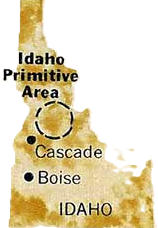
“Chuck Wagon Trips,” as this enterprising organization is called, isn’t really a “summer camp” in the usual sense. You could better define it as two weeks of high adventure in one of the nation’s most spectacular wilderness regions – the Idaho Primitive Area.
Instead of camp counsellors and athletic directors, organized sports and bugle calls, Chuck Wagon Trips has licensed wilderness guides, supervision without regimentation, and an informal program of the kind of activity boys dream about.
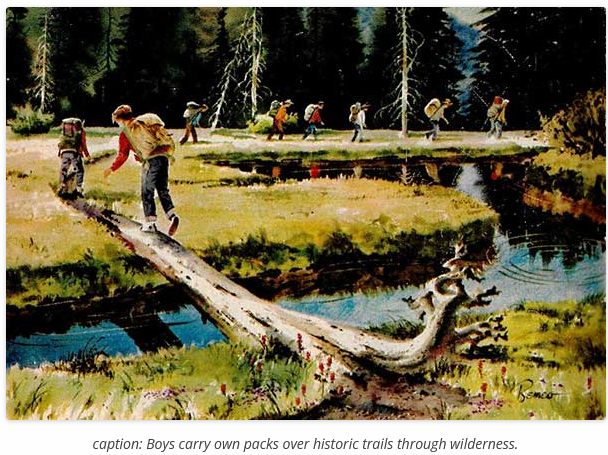
In small groups accompanied by experienced guides, the Chuck Wagon boys hike and ride horses over trails that probe deep into the Idaho Primitive Area’s million-acre mountain fastness. In this rugged, roadless, unspoiled land of forests, canyons and snow-capped peaks, the boys fish for trout in remote lakes, catch huge salmon in the tumbling streams, explore and camp in the tall mountains, back-pack over historic trails to ghost town ruins, and see big game and other wildlife at close range.
These boys, ages ten to sixteen, come off a Chuck Wagon trip with a full taste of the pioneer life led by Jim Bridger, and Lewis and Clark. No wonder they remember it, and come back for more.
The idea for Chuck Wagon Trips originated seven years ago with two California school teachers, Carl Kitchen and Bill Masek. These men shared the conviction that it is important to introduce our youth to the rewards of outdoor living. Both Kitchen and Masek enjoy working with boys. Both are expert woodsmen.
Kitchen, a licensed Idaho guide, was born and raised in the mountains bordering the Idaho Primitive Area. He knew the surrounding country intimately and felt it was ideal for the purpose of Chuck Wagon Trips. So one spring in the late fifties, at the close of the school year, the two teachers changed from suits and ties to wool shirts and Levis, transported the first group of boys to the base camp near the little mountain town of Yellow Pine, then led the first Chuck Wagon Trip into the wilderness.
Two weeks later, the boys returned, reluctantly, to civilization. Their enthusiasm spelled immediate success for the venture, and each summer since, five two-week sessions have been conducted.
In line with the guiding philosophy of Chuck Wagon Trips, the young adventurers forego the cushions’ and comforts of civilization from the time they arrive at the base camp. Between excursions into the surrounding mountains, they sleep in the loft of an abandoned barn, whose board floor and patched roof soon come to be regarded as luxuries.
Once on the trail, the Chuck Wagon boys face the rigors of wilderness living with the barest essentials, much as the early trappers and prospectors did. Each boy shoulders his own bedroll and pack and hikes long miles of steep and rugged trail.
The groups subsist on sound, simple, stick-to-the-ribs grub cooked over an open campfire. Scorning the dandified luxury of tents, the boys unroll their beds on the bare ground.
No exaggeration necessary
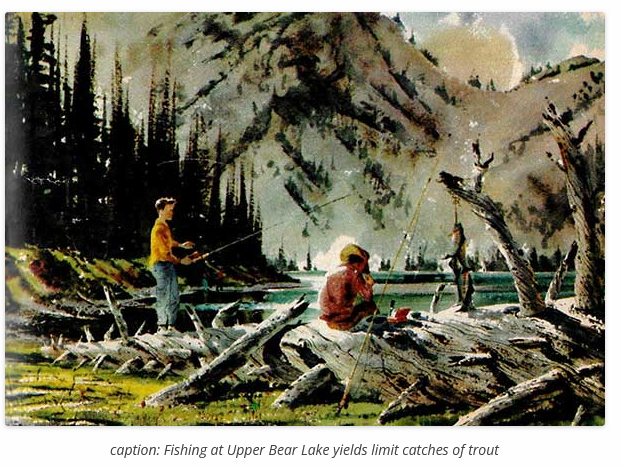
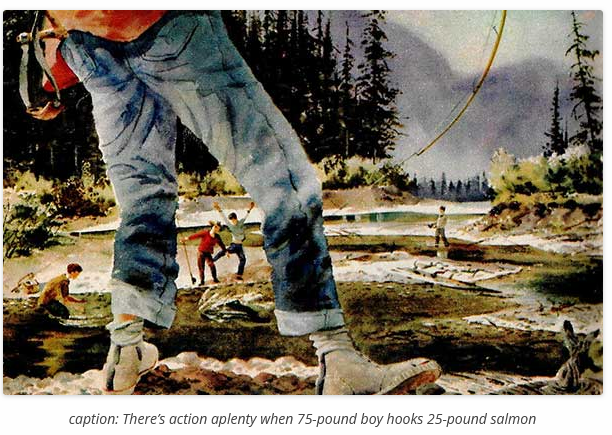
Fishing, one of the most popular trip activities, is so good in the seldom-fished lakes and streams, that exaggeration – the fisherman’s prerogative – is completely unnecessary. After instruction and practice in the use of the fly rod and spinning gear, even the inexperienced youngsters bring in their share of breakfast trout; and limit catches of huge rainbow and cutthroat have been taken in less than an hour.
But the biggest fishing thrill is provided by the Chinook salmon that travel up the streams in the Primitive Area. A twenty-five pound Chinook hooked by a seventy-five pound boy adds up to a hundred pounds of pandemonium, and whether the outcome of the battle is the fishing prize of a lifetime or the biggest one that ever got away, the encounter is one no Chuck Wagon boy will ever forget.
The fun of just exploring in this limitless, unspoiled wilderness ranks high in popularity among the Chuck Wagon’s varied activities. On these exploring trips, the groups follow trails into some of the wildest mountain country in the West. They camp out at places whose very names tingle with adventure: Thunder Mountain, Suicide Rock, Indian Creek, Cougar Basin, Chilcoot Pass, Trapper Flat, Kiwah Meadows, and River-of-No-Return, the last being the Salmon River’s Middle Fork.
Chuck Wagon “task forces” also make expeditions to at least one deserted mining town. Poking about among the ghost buildings, the youngsters’ imaginations are stirred, and the empty streets again seem to swarm with belted, gun-toting, brawling men.
Perhaps the most exciting deserted mining town is Roosevelt, the world’s only underwater ghost town. The strange story of the 1905 [sic] catastrophe that put this entire town at the bottom of a lake is told and re-told around the dimming embers of the evening campfire. Roosevelt sprang to lusty life on the banks of Monumental Creek around 1900. Sluice boxes once lined the banks of this sandy-bottomed stream, with its “colors” reflecting yellow in the sunlight. Mine shafts pierced deep into the heart of the mountain.
Then came the spring day in 1905 [sic] when a huge mass of ice, rubble and rocks broke loose from the mountainsides in the fury of flood. Mud, water, driftwood and boulders choked the stream to form a dam which flooded and obliterated the town in a single day.
The occupants fled, leaving behind the old hotels, cabins, mills, along with the Boot Hill cemetery which can be seen by the Chuck Wagon trippers of today.
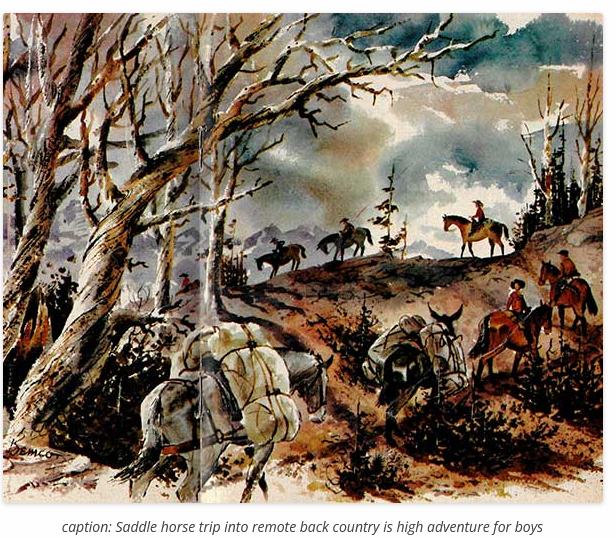
At least one of the excursions into the more remote areas is by saddle horse and pack string. To many of the boys, this pack trip is the high point in the entire Chuck Wagon adventure. Under the close watch of expert guides and packers, and mounted on sure-footed horses, the group negotiates trails ranging through deep canyons and over high mountain passes.
After two weeks of roughing it, the boys return home tanned and toughened, with a new respect for the hardiness of their pioneer forefathers, plus an appreciation of the conservationists whose efforts preserved our wilderness areas.
For more detailed information write: Chuck Wagon Trips, [XXX], Concord, California. Accommodations for parents who wish to vacation in the area are provided at Deadwood Lodge, just a few miles from the Chuck Wagon Trip base camp; information from Carl Kitchen, Cascade, Idaho. Also in Cascade is Cox’s Dude Ranch.

Webspace for this site is generously provided by Genealogy Village and Access Genealogy
Copyright © 2013 - Sharon McConnel. All Rights Reserved.